

[비즈한국] The initial results for medical school early admissions are being announced one after another. Even after the College Scholastic Ability Test (CSAT) concluded, the medical community continued to demand a "suspension of new student recruitment," yet failed to gain public empathy. However, with President Yoon Suk-yeol recently declaring martial law and including the phrase "punish residents" in the martial law decree, the medical community seems to be regaining momentum, buoyed by public criticism of the government. Nevertheless, the Ministry of Education maintains its stance that "it is practically impossible to suspend the 2025 academic year admissions as the college entrance process, including the notification of CSAT scores and the announcement of successful candidates, is proceeding normally."
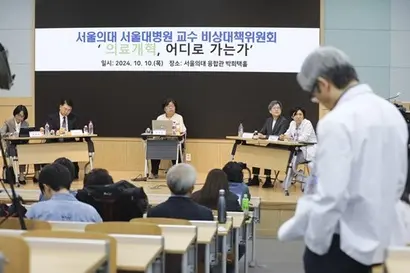
According to the medical community on the 12th, medical school professors are making back-channel contacts with university headquarters to discuss the number of new student admissions. Professors have meetings scheduled or are coordinating schedules with university presidents, admissions office heads, and academic affairs officials this week and next. "A," the head of a metropolitan area medical school professors' council, stated, "We are conducting meetings with deans at each school. Our school is also preparing for a meeting next week." The atmosphere of 'silent protests' is also resurfacing. On the afternoon of the 10th, the student council and professors' council of Pusan National University Medical School held a silent protest, holding picket signs on the first floor of the university headquarters ahead of a meeting with school administration.
The fact that a court recently recognized the 'autonomy' of universities also appears to have fueled these movements in the medical community. Kim Chang-soo, Chairman of the Korean Medical College Professors Association, said, "The High Court recently cited Yonsei University’s appeal and guaranteed a significant level of university autonomy. Regarding admission quotas, universities must now consider various factors, including whether they can autonomously provide education." Recently, the Seoul High Court reversed a first-instance decision that had suspended the validity of an early admissions essay test, citing that "the determination of pass/fail, entrance qualifications, and selection methods for private institutions are discretionary acts that the educational institution can determine by comprehensively considering character, aptitude, academic background, and knowledge to achieve educational goals," thereby upholding Yonsei University's appeal.
The medical community argues that universities should not carry over unfilled early admission spots to the regular admissions period and should reduce or suspend regular admissions as well. According to individual school admission guidelines, initial successful early admission candidates are being announced from the 7th of last month to the 13th, starting with Konyang University Medical School (for units not applying the CSAT minimum requirement). After the registration period from the 16th to the 18th, additional successful candidates will be announced and registered until the 27th, and regular application submissions begin on the 31st. For the medical community, the university presidents must make a decision before the 31st, the start date for regular applications.
The aspect the medical community is focusing on is the "possibility of modification" mentioned in the admission guidelines. Looking at the guidelines, one medical school in Seoul notes, "There may be changes such as the establishment, integration, separation, or renaming of recruitment units due to department reorganization or quota adjustments, or changes in the number of recruits per screening type." A national university medical school's guidelines state, "Changes may occur according to the Ministry of Education's quota adjustment results, amendments to school regulations, infectious diseases, or natural disasters. In case of changes, we will notify applicants via our university's admissions website, so please be sure to check the recruitment guidelines before submitting your application."
However, the university presidents, who hold the final decision-making power, remain unmoved. It has been reported that recent requests by professor groups, such as the Korean Medical College Professors Association and the Emergency Committee of Medical School Professors, for a meeting with the Medical School Presidents' Association were rejected. The Korean Medical College Professors Association stated, "The Medical School Presidents' Association informed us that 'it is difficult to hold a meeting.'" It is said that there is currently no progress in the discussions. The Emergency Committee of Medical School Professors also issued a statement on the 9th urging the association to "form a task force consisting of the Medical School Presidents' Association, the Association of Medical Deans, and medical professor groups, and immediately take action with medical professors to reset the Yoon Suk-yeol-led medical school quota increase. We ask that you reclaim the university autonomy that has been taken away and exercise it legally," but this was also rejected. The emergency committee added, "We will continue our demands while the early admission results are being announced."
Education authorities also maintain the position that suspending recruitment is practically impossible. Regarding the call from the Korean Association of Medical Colleges (KAMC) right after the martial law declaration to "strongly demand a substantive quota reduction, including a suspension of medical school recruitment, before the announcement of successful candidates for the 2025 academic year," the Ministry of Education issued a statement via its spokesperson's office: "Please understand that it is practically impossible to suspend the 2025 academic year admissions as the college entrance process, including the notification of CSAT scores and the announcement of successful candidates, is proceeding normally."
Recently, the Korean Medical Students' Parents Union has also demanded that university presidents immediately stop the recruitment of medical students for next year, even mentioning the possibility of filing a damages lawsuit. In a statement on the 9th, the group said, "The Ministry of Education announced through the media that the basis for the allocation of medical school quotas lies in the request letters sent by each university president. It has been confirmed that each university president is responsible for the disadvantages suffered by 18,000 medical students over the past year and the expected damage from the paralysis of medical education in the 2025 academic year," adding, "We demand an immediate halt to the 2025 medical school recruitment. The union has resolved to hold schools accountable through lawsuits for the disadvantages students have suffered over the past year. If each university accepts our demands even now, we will not file for damages."
On this day, the Korean Medical Association (KMA) Emergency Committee stated in a briefing regarding its 4th meeting on stopping the government's "medical tyranny" and normalizing healthcare, "The KMA Emergency Committee, representing all doctors and all sectors of the medical community, requests that the presidents return to educational principles and suspend the recruitment of new students for the 2025 academic year. We earnestly ask that the presidents no longer participate in President Yoon Suk-yeol's 'educational and medical tyranny.'"
Meanwhile, the Ministry of the Interior and Safety pre-announced a partial amendment to the "Regulations on the Organization of the Ministry of Education and its Affiliated Organizations" the previous day. To support medical education at higher education institutions, the amendment includes the creation of a temporary "Medical Education Support Officer" and "Medical Education Infrastructure Division" within the Ministry of Education, which will exist until December 31 of next year. Five personnel (one high-ranking official, one grade 4, two grade 5, and one grade 6) are scheduled to be assigned.