

[비즈한국] With the election of U.S. President Donald Trump, the virtual asset market has entered a boom period. Domestically, volatility has also increased in the wake of the martial law situation. While the domestic virtual asset market is finally showing signs of life, not all virtual assets have benefited. This isn't about obscure 'shitcoins' with unclear issuers or foundations. Even virtual assets launched by major Korean conglomerates or actively promoted by famous business figures are leaving investors in tears.
On November 23, the domestic KRW-trading exchange Gopax designated the virtual asset 'HAVAH (HVH)' as an investment caution asset. Gopax stated the reason for this designation as 'the average market capitalization for the previous 30 days having remained below 3 billion won.' New deposits for HAVAH were suspended on Gopax starting at 5:00 PM on November 23, but resumed at 3:00 PM on the 6th of this month after the reasons for the caution were resolved through a recalculation of circulating supply and market capitalization.
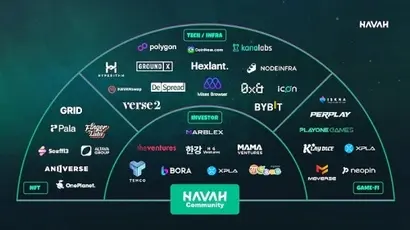
HAVAH coin is a 'Kimchi (domestic) coin' listed on four out of the five domestic KRW-trading exchanges. It can be traded on the KRW market on Korbit, Coinone, and Gopax, and on the BTC market on Bithumb. The HAVAH project aims to build an infrastructure where digital assets, such as non-fungible tokens (NFTs), can be freely connected or moved regardless of the blockchain network type. While the name may be unfamiliar, it was one of the projects that attracted attention in the market.
Its lineup of expert advisors was also impressive. HAVAH garnered attention in September 2022 by recruiting advisors including Jung Kyung-in, former CEO of PearlAbyss263750; Ryu Young-joon, former CEO of Kakao035720 Pay; Jeon Dong-jin, CEO of One Store (former CEO of Blizzard Korea); and Seo Yong-chan, former Chief Strategy Officer (CSO) of Wemakeprice.
HAVAH officially launched in January 2023. Although the NFT market had entered a downturn, the project successfully secured over 10 billion won in investment due to its promising outlook. Companies that invested in HAVAH include MARBLEX, a blockchain subsidiary of Netmarble251270, and BORA, a blockchain platform affiliated with Kakao.
However, unlike its blueprint, the coin failed to gain momentum. HAVAH was first listed on Coinone among KRW-trading exchanges on May 31, 2023. Starting at a closing price of approximately 68 won on its listing day on Coinone, HAVAH followed the downward trend of most altcoins (virtual assets other than Bitcoin). Despite a brief rebound in March, the decline deepened, and it struggled even in November when the market was 'hot' due to the U.S. presidential election, currently trading in the 6 won range. This is a 91% drop from its listing price. A HAVAH coin investor lamented, "I invested expecting the revitalization of the NFT market, but it seems unlikely I will ever recover my losses."

Wemix coin is another item that saw many investors suffer losses despite the backing of a famous domestic business figure. Wemix is a virtual asset nurtured by Wemade Vice Chairman Jang Hyun-guk and is considered a flagship among domestic altcoins. With utility through integration with Wemade games and active promotion by Vice Chairman Jang to attract investors, its market capitalization exceeded 3 trillion won at the end of 2021. However, following allegations that 'the reliability of Wemix's circulation supply plan was low,' it was delisted from domestic KRW-trading exchanges in December 2022.
Wemix was re-listed on all domestic KRW-trading exchanges except Upbit by the end of 2023, starting with Coinone in February 2023, but it has fallen sharply over the following year. The 12th marked exactly one year since it was re-listed on Bithumb (December 12, 2023), and as of 11:20 AM that day, it was trading in the 1,540 won range. This is a 71% drop compared to the closing price on the re-listing day (5,315 won). On Coinone, where it was first re-listed, it stood at 1,541 won as of 11:20 AM on the 12th, a 33% decline compared to its re-listing day (2,293 won).
The problem is that Wemade has sequentially shut down Wemix-related services this year. During the first half of the year, Wemade discontinued eight P2E (Play to Earn) games linked to Wemix, including its representative title 'Mir M,' as well as its token wallet business. Furthermore, Vice Chairman Jang is currently on trial over allegations of manipulating Wemix's circulation supply, and the outcome is expected to impact the price of Wemix. However, a possibility for a rebound remains as Wemade is preparing new titles linked to the Wemix ecosystem, such as 'Legend of Ymir,' and a new payment system.
Meanwhile, domestic KRW virtual asset exchanges have been 'making hay while the sun shines' by aggressively listing new virtual assets starting in November. In many cases, coins that were previously only traded on BTC markets were added to KRW markets. Many of these added coins include 'meme coins' with no clear utility. From November to December 12, seven new items were listed on Upbit, and if items added to the market are included, the total rises to 23. During the same period, 21 items were newly listed or added to the market on Bithumb.
Amid concerns that the Financial Services Commission has even issued investment warnings due to the increased volatility of the virtual asset market, voices of concern are being raised that damages could increase as exchanges aggressively list assets. In fact, the virtual asset 'Movement,' listed on Coinone on the 9th, skyrocketed to 998,500 won on its listing day only to plummet to a low of 862.5 won the next day, recording a massive 99.9% decline. As lack of liquidity was cited as the cause, Upbit and Bithumb, which were scheduled to list it on the same day, postponed their listing dates by one day.
A virtual asset industry official stated, "Each exchange has different listing criteria. While there are guidelines for trading support, the timing of listings and the selection of items are handled autonomously. Because new listings are announced the day before or on the day of, prices can fluctuate violently. Since the virtual asset market has recently entered a correction phase, investors should be cautious when investing in highly volatile items."