

[비즈한국] The universe is expanding. Moreover, that expansion is accelerating. The concept of accelerating expansion, which began to be discussed in 1998 following observations of supernovae at the edge of the universe, has now become the established theory explaining cosmic evolution. However, no one knows the cause behind the increasingly rapid inflation of the universe's spacetime.
The universe is filled with countless galaxies. Galaxies pull on each other through gravity. If gravity were the only force at play, the universe should actually be contracting. The fact that the universe is instead expanding faster suggests that an unknown energy is at work, inflating cosmic spacetime in opposition to gravity. Ultimately, we have simply given this unknown entity the plausible name of "dark energy" and have been diligently chasing its true identity.
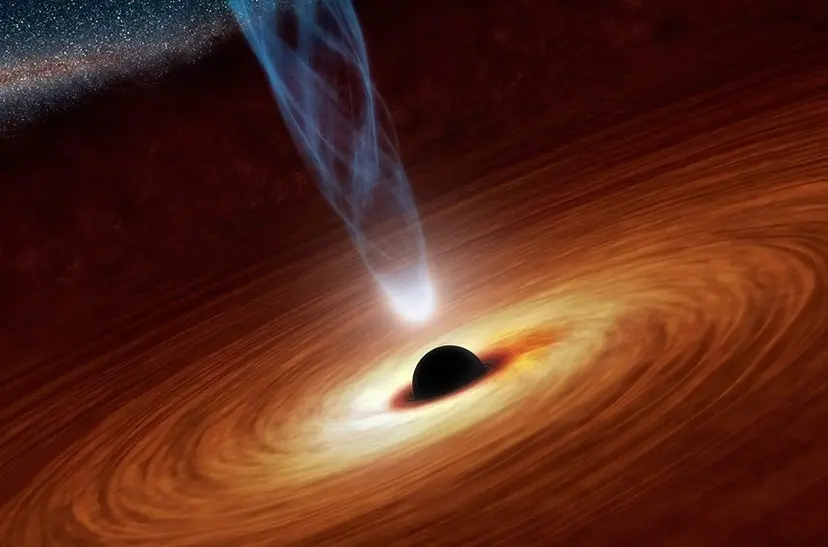
However, an intriguing hypothesis regarding the origin of dark energy has been proposed over the past few years. It suggests that black holes—one of the universe's other great mysteries, equal in stature to dark energy—might actually be the source of dark energy. That dark energy is being created within black holes! It is a fascinating hypothesis, as it connects two of the most mysterious entities in the cosmos. Could black holes really be the culprit behind the universe's ever-accelerating expansion?
What is happening inside a black hole? Nobody knows. The limit of our observation of a black hole reaches only to the event horizon. The darkness beyond it cannot be seen because spacetime is so intensely distorted that even light cannot escape. Mathematically, we merely estimate that there is a singularity at the center where all mass is concentrated at a single point. However, some physicists believe a form of repulsive force operates within, preventing a black hole from collapsing completely. In other words, they suggest that vacuum energy exists inside a black hole.
Vacuum energy literally refers to the energy contained within an empty vacuum. From the perspective of quantum mechanics, a vacuum is not actually empty. In the blink of an eye, particles and antiparticles are constantly being created and annihilated in real-time. While it may appear to be a quiet and empty world, particles are in fact appearing and disappearing in the vacuum without rest. A cubic meter of vacuum contains about 1 nanojoule of vacuum energy. This type of vacuum energy could operate even inside a black hole collapsed by immense gravity. The vacuum energy formed inside could be resisting gravity and preventing the total collapse of the black hole.
And here is where we can imagine some surprising magic. Einstein’s famous equation, E=mc², states the principle of equivalence: mass is energy, and energy is mass. As the universe expands, the black holes existing within cosmic spacetime naturally expand as well, causing them to contain more vacuum energy. The increase in the energy held by a black hole implies that its mass increases. Some astronomers hypothesize that the expansion of cosmic spacetime itself is causing black holes to grow heavier.
In 2023, an interesting study was published suggesting a possible link between cosmic expansion and black hole growth (Related article: [Science] The universe's greatest mystery: The 'strange relationship' between black holes and dark energy). The lead author of that study, Dr. Farrah, discovered a startling fact. By comparing the mass distribution of supermassive black holes in galaxies observed 11 billion years ago, 6 billion years ago, and today, he found that the mass distribution of black holes has steadily grown over time.
What is even more surprising is that as the scale of the universe expanded, the mass of the black holes grew in direct proportion to the cube of the cosmic scale! According to the results from the Farrah team, when the universe became twice as large, the mass of the black holes grew by a factor of eight, the cube of two! This could be a clue showing that as the volume of the universe increases, the mass of the black holes themselves grows in precise proportion to that volume.
However, we must be cautious about accepting this claim too quickly. We still do not accurately know the growth mechanism of supermassive black holes at the centers of galaxies. It does not seem that they simply grew through the long-term merging of smaller black holes. It is possible that giant molecular clouds in the early universe, right after the Big Bang, collapsed all at once to form such massive black holes, but this is also uncertain. Recently, we have only just begun to find pieces of the puzzle by discovering relatively young supermassive black holes at the far edge of the universe using the James Webb Space Telescope.
Astronomers are conducting the Dark Energy Spectroscopic Instrument (DESI) survey, drawing a detailed 3D map of galaxies across the universe to identify the true nature of dark energy. They are mapping galaxies across the entire sky using the telescope at the Kitt Peak National Observatory in Arizona, USA. Through this, they compare how the structure of the universe and the density of galaxies have changed from the past to the present, tracking how the expansion rate of the universe has changed over time. The first observation results from DESI were recently released, and while it is only preliminary data, it intriguingly suggests the possibility that dark energy has not remained constant but may have changed according to the age of the universe.
Recently, astronomers performed additional analyses to examine the potential fluctuation of dark energy more precisely. The rate of star formation in the universe has changed steadily over time. In the very early stages, stars were born explosively, but as the universe expanded and the raw materials for creating stars were depleted, the efficiency of star formation quieted down. Stars evolve at different speeds depending on their mass. In particular, heavy stars collapse into black holes more quickly. We can simulate how many black holes were created and collapsed at each stage as the universe aged. If dark energy is truly connected to black holes, the change in the black hole creation rate should show a similar trend to the degree of the universe's accelerating expansion and the changes in dark energy.
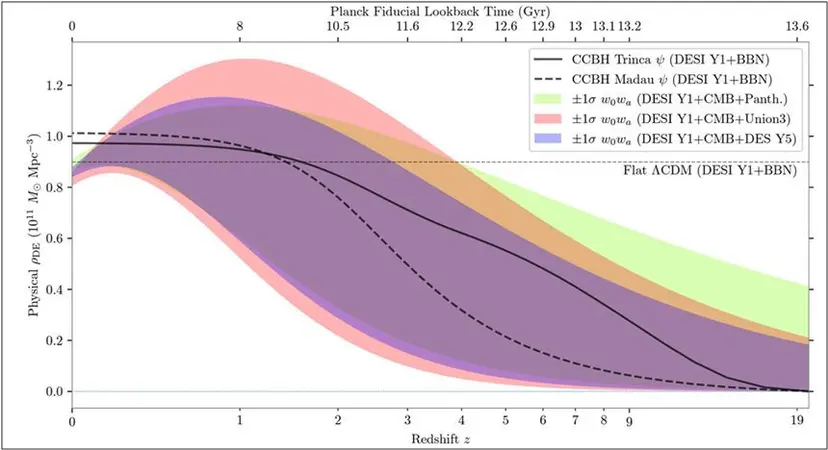
In the graph above, the x-axis represents cosmic time. (Astronomers typically use redshift, which shows how far back in time we are looking, rather than simple year units.) On the graph, the left side is the present, and moving to the right goes back to the early universe immediately after the Big Bang. Therefore, to see the chronological flow of time, you must look from the right end toward the left end. The changes in dark energy identified by these first DESI observation results are represented in color. Since only the first set of data was used, the margin of error is quite large.
You can see solid and dotted black lines on the graph. The dotted line is the result reproduced by reflecting the previously known history of star formation in the universe. The solid line is the result applying the most recent James Webb observations, which suggest that stars were being born very explosively even in the early universe just after the Big Bang. For this reason, the solid black line rises steeply even on the right side (shortly after the Big Bang). Although the margin of error for the colored DESI observation area is quite large, both the existing model (dotted line) and the model reflecting the James Webb observations (solid line) show that the black hole production rate and the universe's expansion rate align well.
However, the graph deviates significantly at the far left end, within the last 2 billion years. While the observations and the model explain cosmic expansion well up until the universe of 2 billion years ago, they diverge significantly in the most recent 2 billion years. This paper explains this by noting that the rate at which heavy stars collapse into black holes has decreased in the last 2 billion years. Because the amount of black holes produced decreased, dark energy also decreased, and the degree of acceleration in the universe's expansion has slightly diminished in the most recent era.
Their argument is extremely interesting. In fact, astronomers have traditionally analyzed the universe by setting dark energy as a constant that never changes over time in order to explain cosmic evolution. Most cosmological simulations do the same. However, looking at these results, the model that assumes dark energy is connected to black holes and therefore changes over time explains the DESI observation results much better than the existing ΛCDM (Lambda-Cold Dark Matter) model, which treats dark energy as an unchanging constant. Furthermore, the fact that the model and observations diverge most significantly in the present era brings to mind the famous mystery of "Hubble Tension," which has been troubling astronomers recently.
Hubble Tension refers to the problem where the expansion rate of the relatively recent universe, measured by the movement of galaxies, and the expansion rate of the very distant universe, measured via the cosmic microwave background, do not quite match. Perhaps this discrepancy occurs because the very degree to which the entire universe's expansion accelerates is changing over time. If dark energy is truly connected to black holes, the speed at which the universe expands may be a destiny determined by how many black holes are being created in the universe and the rate of their production.
It is not certain yet. Before we can talk about whether black holes are linked to dark energy, we must first provide complete answers to two questions. First, is the universe truly expanding at an accelerating rate? The question regarding the accelerating expansion itself—that the expansion is getting faster—has not yet been perfectly resolved. Second, if the universe is expanding at an accelerating rate due to dark energy, is dark energy truly maintaining a constant value? Or is the amount of dark energy changing over time, as has been suggested recently? Only when these two questions are definitively answered can we begin to sketch the connection between dark energy and black holes more clearly.
Isn't it fascinating? We often think of black holes as the ultimate "contraction" machines that do nothing but suck everything in. It doesn't feel like they could be something that expands anything at all. Yet, to think that such black holes might be the source of dark energy, which is causing the entire universe to inflate faster! Could there be a more dramatic twist than this?
References
https://iopscience.iop.org/article/10.3847/1538-4357/acac2e
https://iopscience.iop.org/article/10.3847/2041-8213/acb704
https://iopscience.iop.org/article/10.1088/1475-7516/2024/10/094
Who is the author, Woong-bae Ji? He loves cats and the universe. After watching "Galaxy Express 999" as a child, he dreamed of sharing the beauty of the cosmos. He currently researches the evolution of galaxies through their interactions at the Yonsei University Galaxy Evolution Research Center and the Near-Field Cosmology Laboratory. He also engages in various science communication activities, such as giving lectures and writing. He is the author of books such as "The Observatory of Flirting," "Thinking About the Universe All Day," and "Stars, the Science of Light."