

[비즈한국] The declaration of martial law, followed by the failed impeachment motion, has turned on the warning lights for South Korea's defense export front. In particular, concerns are mounting that export channels to the Middle East—a region identified as a key new strategic market—could be blocked. This is because, due to the nature of their political systems, communication between heads of state or defense ministers significantly influences the signing of contracts in the Middle East.
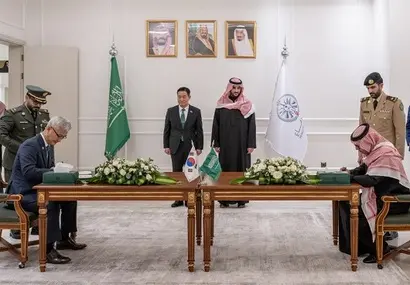
The defense industry has taken a significant hit as the aftershocks of President Yoon Suk Yeol’s declaration of martial law continue. The Middle East market, which has emerged as a new strategic export destination for the domestic defense industry following Europe, is a particular point of concern.
Following the $3.5 billion export of the M-SAM II (Cheongung-II), a medium-range surface-to-air missile system, to the UAE in 2022, the Korean defense industry also secured M-SAM II contracts this year with countries like Saudi Arabia and Iraq, which have high demand for strengthening air defense networks. Some Middle Eastern nations have even expressed interest in importing the Long-range Surface-to-Air Missile (L-SAM) system, despite it not yet being fully developed. Forecasts suggested that countries with urgent needs to build air defense systems would compete to purchase the L-SAM early, painting a bright future.
However, the domestic political situation has thrown cold water on the burgeoning Middle East export market. Middle Eastern nations typically do not sign contracts when key figures, such as a president or defense minister, are absent or in a state of flux.
General defense exports are conducted through G2G (government-to-government) transactions. As such, trust between nations is paramount. Because the introduction of a weapon system is not a one-time event, continuous communication with the partner nation is vital. Since partnerships involving technical support, maintenance, and performance upgrades must be maintained for decades, the political and diplomatic stability of the purchasing nation—and the leadership and diplomatic capability of the head of the executive branch—is a prerequisite. The vacancy in the Defense Ministry, following the resignation of Minister Kim Yong-hyun who participated in the martial law declaration, is also causing setbacks to exports.
There is immediate concern within the industry that upcoming bidding processes for long-range surface-to-air missiles, fighter jets, armored vehicles, and helicopters in the Middle East will come to a standstill. Defense companies that have been marketing in the region while receiving high praise from global institutions are feeling the growing pressure.
Domestic defense firms recorded the world's second-highest sales growth rate last year, trailing only Russia. According to the Stockholm International Peace Research Institute (SIPRI), four Korean companies made it onto the list of the top 100 defense firms: Hanwha Group, Korea Aerospace Industries (KAI)047810, LIG Nex1079550, and Hyundai Rotem064350. Among domestic firms, Hanwha Group’s defense division ranked highest at 24th, followed by KAI at 56th, LIG Nex1 at 76th, and Hyundai Rotem at 87th. All four are known to be actively engaged in marketing efforts to enter the Middle East.
With companies having been in the process of expanding into various countries, the industry is struggling to cope with the sudden martial law crisis. An industry official explained, “At a time when global defense sales are rising due to an increase in conflict zones and South Korea’s defense exports are enjoying a boom, this incident has left companies feeling bewildered. We have been making massive investments in factory expansion, R&D, and partnerships with overseas companies to compete with global players and open new markets, so this is very frustrating.”
Kim Min-seok, a member of the Korea Defense and Security Forum, diagnosed the situation: “Every country requires political considerations for arms exports. The Middle East is a region where high-ranking officials, including heads of state, personally attend contract signing ceremonies, requiring significant attention. With the President unable to fulfill his role and the Defense Minister position vacant following the martial law incident, there is a major administrative vacuum that will inevitably hinder defense exports.”