

[비즈한국] Citizens who participated in the candlelight vigil calling for the impeachment of President Yoon Suk-yeol held in front of the National Assembly in Yeouido, Seoul, last weekend experienced "mobile phone outages." Yang (32, female), a resident of Incheon, said, "From around 3 p.m., both 5G and LTE stopped working, so I couldn't know how the impeachment vote was proceeding. I grasped the news through updates from the organizers, and fellow citizens shared real-time breaking news whenever their data connection stabilized." Communication disruptions also occurred. Jeong (30, female), an office worker, said, "Messages were delayed and phone call audio was cutting out. At one point, a 'restricted service area' icon appeared," adding, "It only started working normally after I entered the Yeouido subway station."
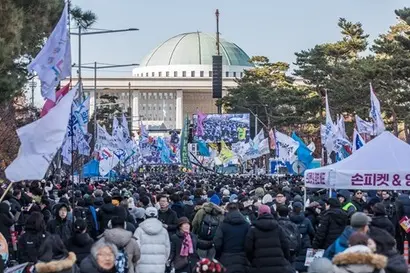
Citizen inconvenience due to communication delays at the National Assembly rally on the 7th
Communication disruptions occurred as large crowds flocked to the candlelight vigil in front of the National Assembly on the 7th, the day the impeachment motion against President Yoon Suk-yeol was voted on. With an unofficial police estimate of 150,000 people and an organizer estimate of 1 million, the demand for communications exceeded facility capacity, leading to setbacks in mobile phone calls and wireless internet usage. It was reported that SNS and portal access, as well as the transmission of photos and videos, were not smooth, and cases of disconnected calls and text messages were frequent. As it became difficult to verify the situation before and after the impeachment vote and check location information, citizens shared ways to connect to smartphone radios via SNS like X (formerly Twitter), methods for some Android devices to watch DMB news without internet access, and offline maps of the rally area.
The three major mobile carriers—SK Telecom017670, KT030200, and LG Uplus032640—prepared by deploying mobile base stations and assigning personnel to the rally site, but they could not prevent the communication delays. It was predicted that communication volume in the Yeouido area would increase significantly before and after the plenary session vote that day. Typically, the three carriers strengthen communication networks near venues expecting large crowds, such as rallies. Three main methods are utilized: deploying additional vehicle-based mobile base stations, increasing the capacity of existing base stations, and dispersing traffic to nearby base stations.
This time, too, each company's vehicle-based mobile base stations were added to locations where traffic was expected to surge on the day of the rally, mainly focusing on 5G and LTE. It was found that the settings for communication equipment at base stations along the National Assembly road were adjusted upward to accommodate more traffic than usual, and traffic was also distributed to base stations around Yeongdeungpo-gu. An SKT official explained, "We are monitoring and responding to situations where crowds gather in specific areas," and added, "We took measures to increase capacity by moving mobile base stations frequently as needed." A KT official said, "Preliminary work such as burying and laying wired equipment has been done during normal times, and on the day of the rally, we are continuously measuring traffic and expanding capacity as much as possible."
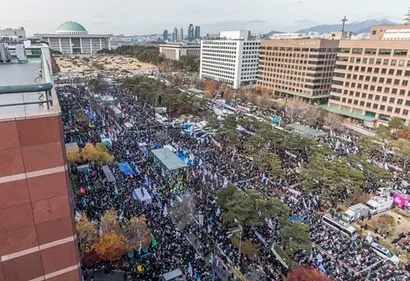
The communication blackout was identified as appearing around 3 p.m. when the rally began, peaking between 4 p.m. and 6 p.m., and easing afterward. A telecom industry official explained, "There was a limit because the data transmission volume temporarily exceeded the manageable range," adding, "We judge that it was not a complete communication outage state." Another industry official said, "The capacity that communication equipment can handle varies significantly from hundreds to thousands of people depending on factors such as location, signal strength, and obstacles. Since mobile base stations are not installed in buildings or fixed locations, it is difficult to explain based only on the number of base stations deployed. In situations with space and equipment limitations, we are trying our best to secure customer convenience."
Difficult to perfectly prepare for traffic surges… Entered emergency system immediately after martial law declaration
As the country entered the impeachment political situation following the emergency martial law, ICT companies including telecom and portal firms have been maintaining emergency response systems. The three major carriers have been in an emergency response mode, monitoring traffic changes immediately after President Yoon Suk-yeol declared emergency martial law around 10:25 p.m. on the 3rd. Initially, they focused their response on the Yeouido area and Yongsan-gu, where the Presidential Office is located. LG Uplus deployed mobile base stations immediately after the martial law declaration, anticipating that citizens would flock in front of the National Assembly.
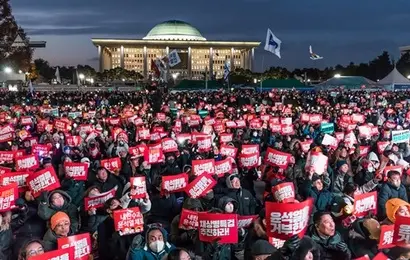
Although there was no network blackout while the emergency martial law was in effect, citizens expressed anxiety that the use of telecommunications such as phones and the internet could be restricted. While the interpretation is that the possibility of realizing communication restrictions was low, some point out that if the decree describing media control had been applied, the communication network could have been regulated. Ahn Jung-sang, an adjunct professor at Chung-Ang University's College of Communication, pointed out, "Blocking the core network is a fully possible story. In a reality where all news is provided online, the control of major base stations of the three carriers and the blocking of portals could have been implemented under the pretext of controlling internet media."
Naver035420 and Daum portals, which once experienced access errors, are also focusing on special management, such as deploying emergency personnel and expanding servers. According to the industry, traffic following this martial law is occurring on the largest scale compared to any disaster or major political event in history. At the time of the martial law declaration, Naver and Daum cafes were inaccessible around 11 p.m. as users flocked to check related news and online public opinion. Unlike disasters where traffic surges only in the short term, this time users continued to flow in until close to midnight, causing server overloads.
Tension remains as large-scale rallies are expected to be held across the country for the time being following the rejection of the impeachment motion, with traffic surges likely to recur. The industry is first preparing for the 14th, when the impeachment motion against President Yoon Suk-yeol will be voted on again. As large numbers of people are gathering in places including Yeouido, Gwanghwamun, and Yongsan in Seoul, as well as nationwide, they are putting their heart and soul into identifying demand. An industry official explained, "We are predicting the number of people by region. Regional managers are going to the field every day to check, and measures such as adjusting the orientation of equipment are also underway."