

[비즈한국] At 10:23 PM on the 3rd, when the breaking news of "President Yoon Suk-yeol's emergency special address to the nation" popped up, I was simply confused by the sudden news. However, the follow-up headline read, "President Yoon declares emergency martial law." For a fleeting moment, I wondered if it was a mistake or if I had misread it. But the reality was an emergency martial law declaration, the first in 45 years since the October 26 incident in 1979. A chilling Martial Law Command decree (No. 1) was issued, and it was announced that Army Chief of Staff General Park An-soo had been appointed Martial Law Commander.
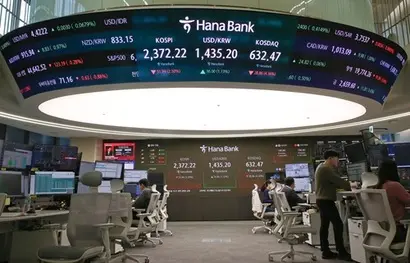
Meanwhile, Bitcoin began to plummet, and the won-dollar exchange rate even hit 1,440 won. At around 1:00 AM on the 4th, the motion to lift martial law was passed at the National Assembly plenary session, and with the Cabinet approving the motion at 4:30 AM, the emergency martial law was lifted after about six hours. Those who didn't go to bed early spent a sleepless night. Everyone was worried about the impact on the domestic stock market and the economy. Financial authorities, fearing a market shock, discussed whether to open for trading, but the market eventually operated normally. Fortunately, the KOSPI index closed at 2,464 on the 4th, down 36.10 points (1.44%) from the previous trading day, performing better than expected.
However, political uncertainty continues to rock the financial markets. This is because the impeachment motion was rejected by the National Assembly. On the 9th, the KOSPI index fell below the 2,400 mark due to selling by foreign and individual investors. From the 4th, immediately after President Yoon's declaration and lifting of martial law, through to this day, foreigners have sold 1.0278 trillion won and individuals have sold 706.8 billion won in the KOSPI market.
Kim Young-hwan, an analyst at NH Investment & Securities005940, analyzed, "In the past, when political uncertainty increased due to impeachment situations, it had a negative impact on the stock market," adding, "Once political uncertainty is resolved, the stock market will recover its losses." He added, "If political uncertainty decreases, the stock market will likely determine its direction based on fundamentals and external conditions rather than reacting sensitively to impeachment-related events," and "An early presidential election could have a positive impact on the stock market due to expectations for the new government's policies."
Consequently, there are calls to pay attention to defensive sectors. Kim Dae-jun, an analyst at Korea Investment & Securities, said, "In a situation where stock market volatility has expanded, one should pay attention to sectors with defensive characteristics such as food and beverage, telecommunications, and services," adding, "It is worth considering a strategy of increasing the weight of stocks with high dividend appeal when their prices fall."
Park Seok-joong, an analyst at Shinhan Securities, explained, "While the intensity of shocks to financial markets and the impact on each asset class will differ depending on the expected scenarios of the impeachment situation, it is highly likely that financial market volatility will continue until the end of the year." He also pointed out, "There will be limits to a trend reversal of the 'triple weakness' in stocks, bonds, and foreign exchange," and "External uncertainty pressure has increased ahead of the inauguration of U.S. President Trump next January, and instability factors in the foreign exchange market due to domestic economic contraction and the Bank of Korea's interest rate cuts still exist."
Until the impeachment situation is resolved, not only does economic policy uncertainty have an impact, but it also negatively affects domestic consumer sentiment. This is why consumers are complaining that "the desire to buy anything has completely vanished."
Foreign companies and firms dealing with foreigners are flooded with inquiries asking, "Is it okay to go to Korea now?" Even to those who are scheduled to visit Korea due to business trips, notices are being sent out saying, "It is fine to come to Korea, but do not go near Yeouido or Gwanghwamun." While the domestic stock market is currently severely undervalued and the political uncertainty will eventually end, I only hope that the darkness will lift quickly and a warm spring will come amidst a political situation where one cannot see even an inch ahead.