

[비즈한국] Since the December 3rd emergency martial law crisis, revelations and reports have continued to emerge alleging that the Yoon Suk Yeol administration carried out reckless military operations to recover from its plummeting approval ratings. Amid this, it has been suggested that the drone our military sent to North Korea was not for combat, but rather for 'non-combat training,' and may have been deployed not for surveillance or leaflet distribution, but specifically to provoke North Korea, using a device easily detected and identified by the North.
In an article last October titled 'Pyongyang Drone Incident: A North Korean Staged Play? Is That Really So?', I analyzed the data of the drone that crashed in North Korea. While I could not secure definitive evidence that it was sent by South Korea, I explained that the drone's form and content were very similar to the 'S-BAT' operated by the Drone Operations Command, and that it would not be easy for North Korea to replicate such a drone with such precision.
Following North Korea's announcement, the military—including the Joint Chiefs of Staff—refused to confirm the facts, leaving the Pyongyang drone issue in a fog. However, on the 7th, the office of Representative Park Beom-kye of the Democratic Party of Korea released a statement alleging that former Minister of National Defense Kim Yong-hyun had planned and executed the operation.
According to the announcement from Rep. Park’s office, military insiders sent the drone to Pyongyang under the direction of former Minister Kim, and induced local skirmishes by ordering strikes at the point of origin in response to the trash balloon incidents.
If, as Rep. Park claims, it is true that we sent drones to North Korea, it is highly likely that former Minister Kim Yong-hyun and other officials in the Yoon Suk Yeol administration planned it meticulously to incite a North Korean provocation. Above all, the S-BAT drone identified as the one that crashed in Pyongyang was a platform that the military had already decided to abandon for operational use after internal evaluations.
Combining the 'Report on the Conclusion of Rapid Demonstration Acquisition Project (Small Long-range Surveillance Drone)' from the Defense Acquisition Program Administration's Drone Division, obtained by this publication, and the 'Rapid Demonstration Acquisition Project 21-2 Military Utility Review Document' from the Army Planning and Management Staff, released by the office of Representative Bu Seung-chan of the Democratic Party of Korea, it is clear the drones sent were highly unsuitable for both surveillance and leaflet distribution. For this reason, the military had made it clear that these drones were used for training and education, not for combat. My view is also that this was a platform far too dangerous to be sent to North Korea.
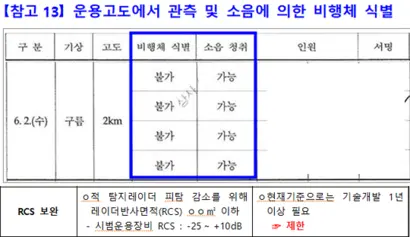
There are two problems. According to military and DAPA reports, small drones are easily heard and discovered even at high altitudes. In other words, they are unsuitable for surveillance. The Army measured at what altitudes the drone's sound could be heard over three test evaluation periods. The results showed that even when flying at an altitude of 2km, where drones are difficult to identify due to clouds, the noise was audible from the ground. Analyzing the flight path data recovered from the crashed drone, which was made public by Kim Yo-jong, Vice Department Director of the Central Committee of the Workers' Party of Korea, the drone flew at altitudes between 30m and 690m. Therefore, it is expected that Pyongyang citizens would have heard the sound of the drone flying in the middle of the night without the need for special equipment.
In fact, according to a report by the Russian media outlet 'Rossiyskaya Gazeta' on October 16, Alexander Matsegora, the Russian ambassador to North Korea, stated, "On October 8–9, the sound of a drone flying over the center of Pyongyang could be heard." Unlike South Korea, it is common knowledge that Pyongyang is dead silent at night. Comments were also made that the sound of a drone flying could not be mistaken for other noises.
Furthermore, the small drone was evaluated as being easily detected by enemy radar. The Radar Cross Section (RCS) of the small surveillance drone is known to be in the -25 to +10dB range. The military requested that the manufacturer improve the drone to lower its RCS, as it could be detected by enemy radar at these levels. However, because the technical development would have taken over a year, they decided not to improve it and use it only for educational purposes. This is practically synonymous with saying it is not used for military purposes because it is easily detected and shot down by the enemy if deployed in real operations.
If, as Rep. Park Beom-kye's office asserts, the drone that crashed in Pyongyang was indeed launched by the Yoon Suk Yeol administration, it appears the military was conducting 'Cognitive Warfare' to provoke North Korea, rather than performing surveillance or leaflet distribution. It likely contained the intent to deliberately infiltrate a weapon that is easy for North Korea to detect and shoot down, thereby stimulating a North Korean armed provocation and inducing a local skirmish.
Many questions remain regarding the drone infiltration incident. In particular, no one has announced who launched the drone or for what purpose. The entity that launched the drone remains a question mark.
According to Rep. Park Beom-kye's office, the drone sent to North Korea was dispatched under the planning of the Defense Counterintelligence Command, led by Commander Yeo In-hyung, a high school junior of former Minister Kim. Unlike organizations like the National Intelligence Service, which have independent drone operation experience and operators, the Counterintelligence Command lacks the knowledge for drone operation and planning and has no assets to conduct North Korean infiltration operations; therefore, further investigation is needed to verify who actually infiltrated the drone into North Korea.
However, according to Rep. Bu Seung-chan's office, the Defense Counterintelligence Command completely banned internal information-gathering activities related to the North Korean drone crash following the incident. It appears that Commander Yeo In-hyung had the intention of controlling information regarding the North Korean drone incident.