

[비즈한국] Following the "farm road chaos" during the recent Chuseok holiday, when countless vehicles heading home were trapped on narrow agricultural paths, Tmap Mobility has been conducting a comprehensive survey of secondary roads nationwide and revamping its services. At the time, the congestion on the farm roads occurred because drivers were presented with only two options: a national highway or the problematic farm path. Most vehicles received guidance to avoid traffic, but while the vehicles at the front moved faster than those on the national highway, severe congestion soon followed. Analysts suggest that because these secondary roads have relatively low traffic volume and lack sufficient traffic data, the algorithm's response was delayed. Although former Tmap CEO Lee Jong-ho personally promised to prevent a recurrence, user complaints regarding inaccurate Tmap guidance continue unabated. The issues also differ from the past, including connection errors and delays caused by server overloads. We examined the controversy surrounding Tmap's navigation.
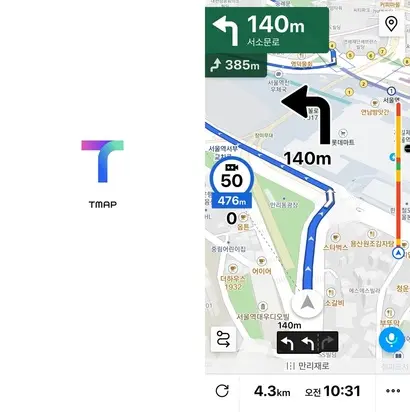
"Should I Switch?" Users Frustrated by Tmap's 'Bizarre' Secondary Road Guidance
Disappointed reviews from users regarding Tmap, the number one mobile navigation app, have been surfacing recently. Posts stating, "I use it because of the insurance discount, but it keeps directing me to bizarre paths every morning," or "It takes me on a detour instead of staying on the perfectly good main road," can be found frequently on social media. As an app used by three out of every four mobile navigation users, the volume of complaints is bound to be significant. However, the growing sentiment among users considering a "transfer" to KakaoMap or Naver Map is certainly not a positive sign.
Recent user complaints about Tmap are directed at its recommendations for narrow roads or inefficient routes. Users argue that even if a wider road is more convenient and only takes about 5 minutes longer, the app insists on directing them through alleyways. There are also numerous accounts of users taking detours as suggested by the navigation during normal traffic conditions, only to end up spending more time on their journey.
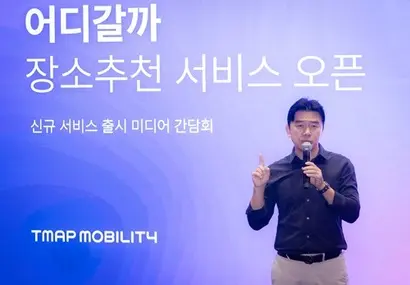
The "narrow road guidance" controversy ignited during the last Chuseok holiday when about 1,000 vehicles were trapped for up to 5 hours on a farm road between Inju-myeon, Asan, South Chungcheong Province, and Pyeongtaek Lake. After the incident, Jung Min-kyu, Chief Technology Officer (CTO) of Tmap Mobility, explained at a press conference for a new service launch, "At the time, there was a traffic concentration phenomenon where travel time on national highways increased fivefold compared to previous years, which led to vehicles being redirected to secondary roads."
Secondary roads, which are less than 12 meters wide and lack a separation between the road and sidewalk, are difficult to predict in terms of traffic demand. Unlike national highways, they lack infrastructure like CCTV to detect real-time traffic volume. Because vehicles eventually have to merge back into major roads, these paths are more vulnerable during overall traffic congestion. Unless it is a shortcut they know well, drivers unfamiliar with the area tend to avoid secondary roads that lack signs or pedestrian separation.
However, industry experts say that simply minimizing secondary road guidance is not the solution. A mobility industry insider stated, "If we can provide more optimal routes including secondary roads, that is actually a service strength. The situation last Chuseok seems to have been a problem where the algorithm failed to recognize that the secondary road was blocked as a significant factor, resulting in an inadequate response."
Bridging the Gap Between Unpopular Secondary Roads, Competitiveness, and User Perception
While some argue that the task is to bridge the gap between service optimization and user perception, others are casting doubt on the Tmap algorithm itself, claiming it is inaccurate. According to industry insiders, navigation algorithms are largely similar across all companies. The core of competition in mobile navigation services is not the algorithm itself, but rather deciding which elements—such as time, distance, tolls, and road width—should be given more weight based on accumulated road segment data.
The specific items and values assigned with weight are trade secrets for each company. Another industry insider revealed, "Time taken is not the only important factor in alternative route guidance. Detailed data, such as road class, the number of left turns, and the left-turn time of previous vehicles, are also reflected."
Kang Kyung-woo, Professor Emeritus of Transportation and Logistics Engineering at Hanyang University, explained, "Each company provides services based on its own data and simulations, but ultimately, it is prediction-based. Companies with large amounts of user data have relatively higher accuracy, but errors are larger and reliability is lower for secondary roads like farm paths where hourly traffic volume is extremely low." Kim Pil-soo, a professor of Future Automotive Engineering at Daelim University, noted, "I don't think it's limited to just user perception. Questions regarding the reliability of the algorithm remain. There is a need to inspect what the exact problem is."
Immediately after the incident, Tmap completed short-term measures and is internally developing improvements, including updates to its secondary road algorithm. The company plans to disclose details of the service revamp to prevent a recurrence early next year.
Experts emphasize that active use of navigation by users is more important than anything else. As user data becomes the foundation for service operation, they advise that efficient route selection and actual driving records can lead to more appropriate services. Professor Kang Kyung-woo suggested, "Instead of immediately selecting the recommended route, if you are in an unfamiliar area, you should check the entire route and choose one that provides the best satisfaction from the user's perspective. Rather than passive use, it is necessary to consider various options before using them."