

[비즈한국] In his first public livelihood debate held after reaching the halfway point of his term on the 2nd, President Yoon Suk-yeol once again highlighted "saving small business owners and the self-employed," which had been his number one presidential campaign pledge. With the number of self-employed individuals—which had seemed to be growing since President Yoon took office—turning to a decline for the first time in three years this year due to high interest rates and economic stagnation, he intended to introduce new support measures. However, one day after the debate, President Yoon declared martial law, plunging the political landscape into chaos and, ironically, pushing the self-employed to the brink.
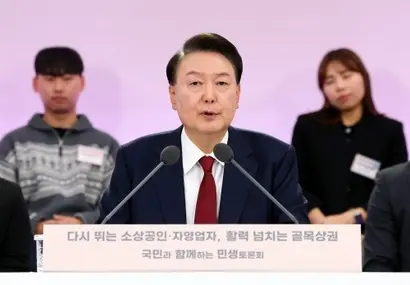
At the 30th public livelihood debate held at the Art Center Goma in Gongju, South Chungcheong Province on the 2nd, President Yoon said, "Do you happen to know what my number one presidential election pledge was? It was to save small business owners and the self-employed." He added, "Just as I placed small business owners and the self-employed at the forefront when I began my term, I will do my best in the second half of my administration to overcome polarization and open a new era of the middle class together with you."
Indeed, since taking office, President Yoon has provided loss compensation funds to small business owners affected by COVID-19 quarantine measures and implemented measures such as extending loan maturities and deferring repayments. Perhaps thanks to this, the number of self-employed individuals had been on an upward trend after President Yoon took office.
When the number of self-employed individuals began to show signs of decline this year due to the shrinking domestic economy, President Yoon brought "saving small business owners and the self-employed" back to the table as his first policy for the latter half of his term. However, as President Yoon suddenly declared martial law the following evening and the National Assembly began pushing for his impeachment, the policy to save small business owners and the self-employed effectively hit a dead end.
According to Statistics Korea, the number of self-employed individuals was 5.606 million in 2019, but it fell to 5.531 million in 2020 and 5.513 million in 2021 due to the impact of COVID-19. Afterward, in 2022, when President Yoon—who had made saving small business owners and the self-employed his top pledge—took office, the figure rose to 5.632 million, an increase of nearly 120,000, and it grew further to 5.689 million in 2023. The number of self-employed individuals, which had been rising, turned downward this year. As of January–October 2024, the number of self-employed individuals has fallen to 5.661 million.

The decline in the number of self-employed individuals is largely driven by a reduction in small-scale self-employed people who do not hire employees. In the case of self-employed individuals with employees, the number increased from a low of 1.307 million in 2021 to 1.365 million in 2022 and 1.42 million in 2023. This year, it maintained an upward trend, reaching 1.435 million.
In contrast, the number of self-employed individuals without employees increased from 4.206 million in 2021 to 4.267 million in 2022 and 4.269 million in 2023, but decreased to 4.225 million this year. As more small-scale self-employed businesses closed, the number of family members helping out in family shops without pay also declined. The number of unpaid family workers dropped from 899,000 last year to 886,000 this year.
High interest rates, which increase the burden of principal and interest repayments, and the increasingly stagnant domestic economy have dealt a direct blow to the self-employed, particularly small-scale business owners. Despite a decline in consumer prices, the domestic economy is falling into a quagmire of stagnation rather than recovering. The retail sales index, which shows consumer spending trends, fell 0.8% in October compared to the same month last year. The retail sales index has been in negative growth for seven consecutive months after a 3.4% decline in March this year.
In this situation, President Yoon’s martial law declaration and the subsequent impeachment political landscape are expected to make life difficult for the self-employed. With global investment banks lowering their growth forecasts for next year one after another, it is clear that the political turmoil triggered by President Yoon will act as a negative factor for the economy.
According to the Korea Center for International Finance, the growth forecast for South Korea in 2025 presented by eight global investment banks stood at 1.8% as of the end of last month, down 0.2 percentage points from a month earlier. Citi had the lowest forecast at 1.6%, followed by JP Morgan and Nomura at 1.7%. Notably, all eight investment banks projected next year's growth to be in the 1% range.