

[비즈한국] As the construction industry continues its "march of hardship" due to the economic downturn and rising raw material costs, the apartment subscription results for major construction companies this year have shown a stark contrast between the capital region and non-capital regions. More than half of the apartments built by major construction companies on the subscription market this year are located in the capital region, while units with subscription shortfalls are concentrated in non-capital regions. BizHankook conducted a complete survey of the subscription results for apartments built by the 6 major listed construction companies.
Apartment Supply Volume: 'Capital Region-Hyundai E&C000720'
According to an analysis of subscription records from the Korea Real Estate Board's "Subscription Home" by BizHankook, among private apartments offered for sale via Subscription Home this year (as of the 5th), a total of 78 complexes (35,136 units) were built by the 6 major listed construction companies: Samsung C&T028260, Hyundai E&C, Daewoo E&C047040, DL E&C375500, GS E&C006360, and HDC Hyundai Development Company. They recorded an average competition rate of 20 to 1 in first-priority subscriptions. The remaining supply for this year includes the Hillstate Deochon Station (139 units) in Seoul, built by Hyundai E&C, and Acro Ritz County (71 units) in Seoul, built by DL E&C.
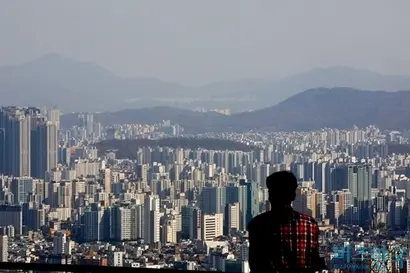
This year, the supply of apartments by the 6 major listed construction companies was concentrated in the capital region. The capital region accounted for more than half, with 48 complexes (19,323 units), including 20 in Gyeonggi (8,880 units), 12 in Incheon (6,411 units), and 16 in Seoul (4,032 units). Conversely, non-capital regions accounted for only 30 complexes (15,813 units): 8 in Daejeon (5,703 units), 4 in South Chungcheong (2,331 units), 6 in Daegu (2,305 units), 1 in North Chungcheong (1,306 units), 2 in Busan (1,066 units), 3 in Gwangju (1,016 units), 2 in South Jeolla (801 units), 1 in North Jeolla (480 units), 1 in North Gyeongsang (460 units), and 2 in Ulsan (345 units).
Hyundai E&C had the highest volume of apartment supply. The company built 19 apartment complexes that appeared on the subscription market this year, amounting to 10,398 units. The supply volumes for other construction companies are as follows: Daewoo E&C (15 complexes, 10,207 units), GS E&C (21 complexes, 9,258 units), HDC Hyundai Development Company (11 complexes, 5,370 units), DL E&C (13 complexes, 2,045 units), and Samsung C&T (6 complexes, 1,212 units).
Top Apartment Complexes for Subscription Competition: 'Seoul-Samsung C&T'
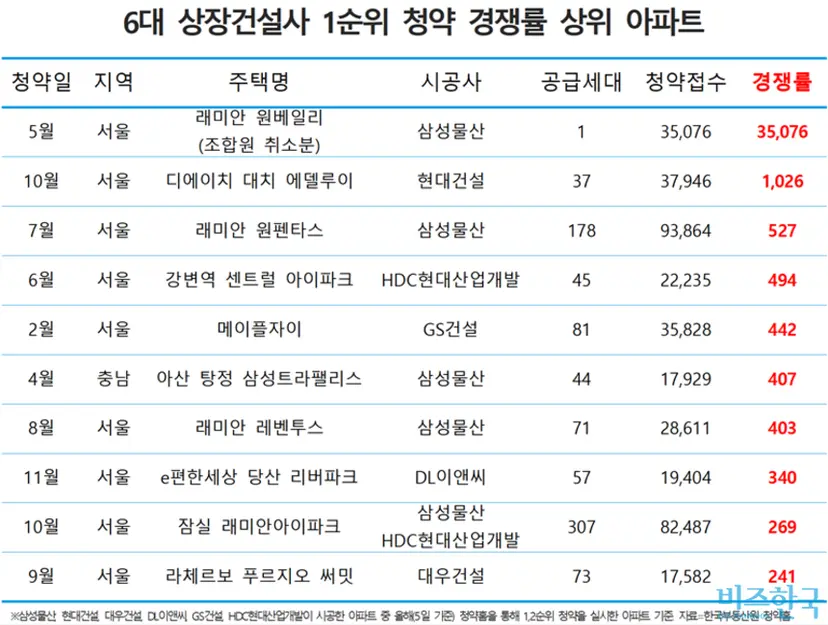
9 out of the top 10 complexes with the highest subscription competition rates are in Seoul. The site with the highest first-priority subscription competition rate this year was Raemian One Bailey (cancelled union member units) in Seoul, where a staggering 35,076 people applied for 1 unit. Following this, the first-priority subscription competition rates were: The H Daechi Edelui (37 units) in Seoul at 1,026 to 1, Raemian One Pentas (178 units) at 527 to 1, Gangbyeon Station Central IPARK (45 units) at 494 to 1, Maple Xi (81 units) at 442 to 1, and Samsung Trapalace in Tangjeong, Asan, South Chungcheong (44 units) at 407 to 1.
Half of the top 10 sites for subscription competition were built by Samsung C&T. Including the aforementioned Raemian One Bailey, Raemian One Pentas, and Asan Tangjeong Samsung Trapalace, Seoul's Raemian Leventus (71 units) recorded 403 to 1, and Jamsil Raemian IPARK (307 units, co-built with HDC) recorded 269 to 1, making the list of top apartments. Samsung C&T supplied a total of 6 complexes this year, including the Raemian Centripol in Incheon (611 units, 31 to 1), all of which completed subscriptions in the first priority. The average competition rate was around 228 to 1.
Apartment Complexes with Subscription Shortfalls: 'Non-Capital Regions, Daewoo E&C'
Conversely, apartments with subscription shortfalls were concentrated in non-capital regions. Among apartments built by the 6 major listed construction companies, a total of 25 complexes (6,787 units) failed to meet the number of applicants for the available units during the first and second priority subscription periods this year. While the capital region had only 10 complexes (2,718 units)—5 in Gyeonggi (1,870 units) and 5 in Incheon (848 units)—non-capital regions accounted for 15 complexes (4,069 units), including 3 in Daegu (1,166 units), 1 in Gangwon (1,038 units), 2 in Daejeon (770 units), 1 in South Chungcheong (372 units), 1 in Busan (241 units), 3 in Gwangju (175 units), 2 in Ulsan (151 units), 1 in North Jeolla (93 units), and 1 in North Chungcheong (63 units).
The apartment complex with the highest number of shortfall units was the Wonju Prugio The Central in Gangwon. Following the first and second priority subscriptions for the 1,225 total units offered last April, 1,038 units were left undersubscribed. This complex, composed of 9 unit types, saw shortfalls in every single type. Other complexes with significant shortfalls include Sangin Prugio Center Park in Daegu (984 units, 932 shortfall), Pyeongtaek Prugio Center Pine in Gyeonggi (832 units, 731 shortfall), Munhwa Xi SK VIEW in Daejeon (1,052 units, 542 shortfall), and Geumjeong Station Prugio Granble in Gyeonggi (906 units, 480 shortfall).
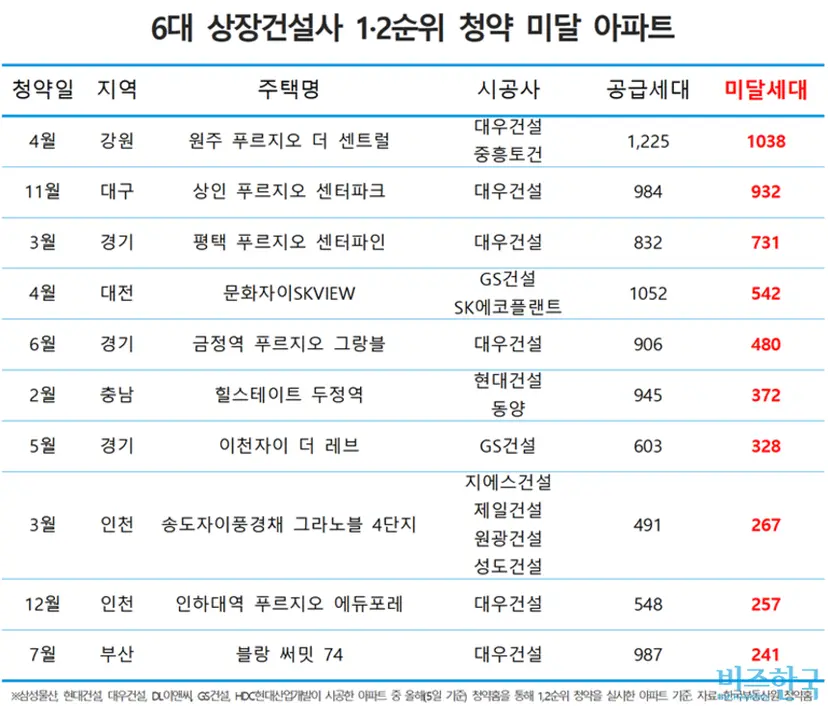
The construction company with the poorest subscription results is Daewoo E&C. Although it supplied 15 complexes (10,207 units) this year, 9 of them (4,120 units) resulted in undersubscribed units. Of the top 10 complexes with the highest number of subscription shortfalls among the 6 major listed construction companies this year, 6 were built by Daewoo E&C. Other complexes that saw subscription shortfalls by company included GS E&C with 8 complexes (1,624 units), Hyundai E&C with 5 (799 units), HDC Hyundai Development Company with 4 (268 units), and DL E&C with 2 (151 units). Samsung C&T had no complexes that experienced subscription shortfalls.
An official from the construction industry stated, "Many of the apartments sold in non-capital regions this year are projects that were contracted 4 to 5 years ago during the real estate boom. In the case of contract-based projects where payments are made upon completion, prolonged periods of unsold units can lead to a deterioration in a construction company's performance. If the unsold complex is a self-developed project, losses can be even greater." They added, "The industry trend of selectively taking on projects where housing demand is somewhat guaranteed is likely to continue for the time being."