

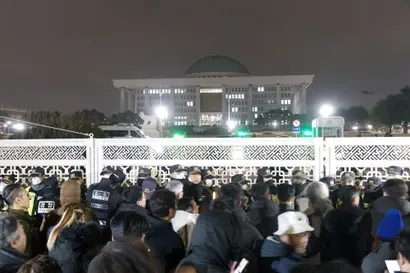
[비즈한국] The emergency martial law declared by President Yoon Suk Yeol on the 3rd ended as a "six-hour reign," but it left a major social shock. The martial law, the first in 45 years, has become another negative factor for an economy already suffering from the "three highs" (high interest rates, high inflation, and high exchange rates) and deteriorating internal and external environments. Taking responsibility for the unjustifiable martial law, the opposition party has proposed an impeachment motion against President Yoon. It has been eight years since the impeachment motion against former President Park Geun-hye was passed in December 2016, and the nation is once again facing presidential impeachment. Experts believe that the current impeachment situation will have a far more negative impact on the economy than it did eight years ago.
Instability is Much Greater Than in 2016
Experts point out that compared to the era of former President Park, this situation shows a different pattern from the start. At that time, candlelight vigils were held steadily across the country following the influence-peddling scandal, which led to the passage of the impeachment and eventually the Constitutional Court's decision. Conversely, in the Yoon Suk Yeol administration, a shocking event—martial law—occurred first, and with political strife expected to continue until the impeachment decision, the instability is analyzed to be much greater.
Ha Joon-kyung, a professor of economics at Hanyang University, said, "In 2016, protests demanding the resignation of the administration continued, the impeachment motion was passed, and three months later, the Constitutional Court upheld it. There were no procedural delays," adding, "But now the situation is different. Economic uncertainty has been created due to the martial law crisis, and discussions on impeachment are not progressing easily either. The government is also not showing any attitude of apologizing or stepping down. If this unpredictable state continues, uncertainty will inevitably grow."
There is also a view that the declaration of martial law threatened the capitalist market economy. Wi Pyeong-ryang, head of the Wi Pyeong-ryang Institute for Economy and Society, pointed out, "Liberal democracy is based on capitalism. The government's attempt at martial law showed a will for dictatorship," and added, "Martial law has had a negative impact at a time when the domestic economy was already predicted to face risks such as low growth, dampened consumer sentiment, and high inflation next year."
Crisis of No Control Tower, Who is Leading State Affairs?
The move toward mass resignation within the cabinet is another point that differs from the time of former President Park. After the influence-peddling scandal broke out, the Park Geun-hye administration carried out a cabinet reshuffle in November 2016, including the replacement of the Prime Minister and the Deputy Prime Minister for Economy, with the intention of resolving the situation. At that time, Financial Services Commission Chairman Yim Jong-yong (current Chairman of Woori Financial Group316140) was nominated as the next Deputy Prime Minister for Economy and Minister of Economy and Finance, but eventually, Deputy Prime Minister Yoo Il-ho remained in office and continued to play the role of a key aide.
However, this time, many state council members, including presidential office aides and cabinet ministers, have expressed their intention to resign even before a decision on the president's impeachment is made. Without a control tower, not only does state governance come to a halt, but the implementation of policies pursued by the government becomes difficult.
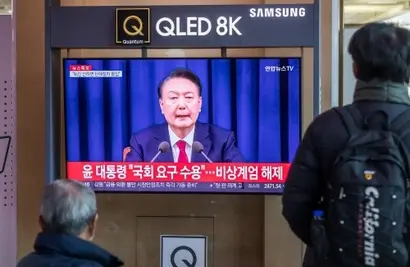
Kim Sang-bong, a professor of economics at Hansung University, pointed out, "Whether it is an impeachment decision or constitutional amendment, it takes time, and if the cabinet resigns en masse in the meantime, it effectively becomes an anarchic state. This could have a huge impact on the domestic economy," adding, "When important issues arise, who will make the decisions and who will be in charge of the economy? The difference from former President Park's time is that there is no one left in the cabinet now. Yet, President Yoon is showing an attitude of evading responsibility."
However, immediate chaos is expected to be avoided. Deputy Prime Minister and Minister of Economy and Finance Choi Sang-mok and others held an economic ministers' meeting on the 5th and showed their will to continue their duties by stating, "The cabinet will act as the center and do its best."
Will 'Korea Discount' Be Amplified?
Global credit rating agency S&P stated on the 4th that the emergency martial law "does not affect South Korea's sovereign credit rating," while assessing that "it will take time for investment sentiment to normalize." The anxiety of foreign investors was reflected in the stock market. Financial stocks, the primary beneficiaries of the Value-up Program, took a direct hit.
On the 5th, the stock price of KB Financial105560 fell by up to -10% compared to the previous day due to selling by foreigners and institutions. Shinhan Financial Group055550 also fell by -5.5%, and Hana Financial Group and Woori Financial Group recorded drops in the -3% range. Since the stock prices of Hana Financial Group086790 (-6.7%), Shinhan Financial Group (-6.6%), and KB Financial (-5.7%) all fell by more than 5% on the 4th, the decline is even greater. A financial industry official said, "It appears that overseas funds are fleeing due to the unstable political situation," and added, "At this rate, the Value-up Program, which was intended to resolve the Korea Discount, is useless."
Professor Ha Joon-kyung predicted, "We must resolve this situation well to reduce doubts about resolving the Korea Discount. Although the National Assembly lifted the martial law quickly and the president accepted it, showing that the system works properly, it must have been an unexpected event that was difficult for foreigners to understand," adding, "Only by handling it according to law and principle can we regain the investment sentiment and trust of overseas investors."
In March 2017, global credit rating agencies such as Moody's and S&P analyzed that the Constitutional Court's decision to remove former President Park Geun-hye from office had a positive impact on South Korea's creditworthiness. Director Wi pointed out, "It is not easy to meet the conditions for the impeachment to pass, but if the leadership that caused the martial law maintains power, that in itself is a risk," and noted, "It is an event that showed overseas that there is a possibility of dictatorship in South Korea, which was thought to be a stable democratic country. Future repercussions could include a decline in South Korea's credit rating and a drop in the value of the won."