

[비즈한국] The martial law declared by surprise at 10:30 PM on December 2 was lifted 6 hours later at 4:30 AM on the 4th. While no further military measures were taken, the military operations following the declaration appear to have concluded safely without loss of human life, including civilians.
Excluding political decisions, consequences, and legal violations, an analysis of the forces and equipment used in this "6-hour martial law operation" from a military perspective is as follows.
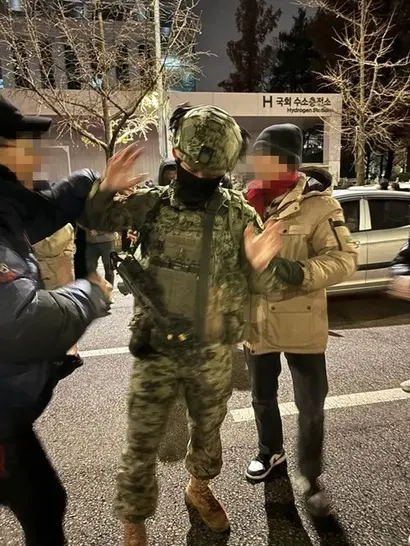
First, let’s look at the composition of the troops deployed to the National Assembly. According to the office of Rep. Park Sun-won of the National Assembly's National Defense Committee, the 1st Special Forces Brigade, the Capital Defense Command's Special Mission Military Police Battalion (SDT), and the 707th Special Mission Group (White Tiger Unit) were deployed, and the Army Special Warfare Command’s Special Operations Aviation Group (Black Falcon Unit) was mobilized to transport these special forces.
A notable characteristic of the special forces deployed to the National Assembly is that they were all thoroughly prepared for "night combat." Almost all deployed personnel were equipped with GPNVG-18 night vision goggles made by the U.S. company L3 Technologies. While standard night vision goggles typically have one or two lenses, the GPNVG features four lenses and four photo multiplier tubes, providing a much wider field of view than other goggles. However, they cost approximately 40 million won each, 10 times the price of the PVS-04K night vision goggles previously purchased by the South Korean military, and it is known that only about 1,000 units have been introduced in Korea, centered around the Special Warfare Command and other special forces units.
Some experts argue that the soldiers deployed to the martial law operation intended to initiate night combat after cutting off power to the National Assembly to arrest politicians in the darkness. However, as this is difficult to prove, the exact method the martial law units intended to use to seize the National Assembly will be uncovered through detailed investigation and inquiry. If they really prepared the night vision goggles for night operations, it is necessary to verify whether they took actions to cut off power in the National Assembly building and whether they carried stun grenades for counter-terrorism to maximize the utility of the night vision goggles. Stun grenades, which disorient people with intense light and noise, are most effective in darkness where lighting has been cut off.
On the other hand, there are claims that the martial law units entering the National Assembly did not intend to carry out missions such as hostage rescue or the assassination of enemy figures from the start. This is based on the fact that no evidence of chambered rounds was found in the firearms shown in photos, or that they were equipped with simunition ammo.
Simunition ammo consists of non-lethal, training-purpose rounds that have low power and are made of non-metallic materials, used for Close Quarters Battle (CQB) training. To use these rounds, the bolt assembly of the firearm must be replaced, and the bolt is typically painted blue, making it easy to identify. The unit seen in released photos using this simunition ammo is the 707th Special Mission Group, known as the nation's top counter-terrorism unit, using Belgian-made FN SCAR automatic rifles. The argument is that the very act of equipping this gear shows an intention to avoid the use of force before even entering the National Assembly.
However, not all units used simunition ammo; some Special Forces personnel carrying K1 submachine guns and others appeared to have inconsistent weapon-carrying policies, with some having magazines inserted and others leaving them empty. In fact, multiple media outlets and political parties raised issues regarding the possession of live ammunition by the martial law troops.
The transport of special forces personnel to the National Assembly is presumed to have been carried out by the Special Operations Aviation Group under the Army Special Warfare Command. The Special Operations Aviation Group was originally a transport helicopter unit under the Aviation Operations Command, but it was transferred to the Special Warfare Command in 2019 and has been tasked exclusively with transporting Special Warfare Command units. The UH-60P Black Hawk maneuver helicopters operated by this unit are capable of night operations as they are equipped with auxiliary fuel tanks for long-range missions and Forward Looking Infrared (FLIR) systems for night flight. However, a performance improvement project for special operations helicopters is currently underway to address issues of equipment aging and vulnerability to enemy attacks.
The problem is that these capabilities and equipment were used for the arrest of politicians and the occupation of the National Assembly rather than their original missions. In principle, while there are no fixed rules on which units should be tasked with which operations under martial law, the controversy over the legitimacy and illegality of this "National Assembly occupation operation" is expected to continue because the mobilized units are those responsible for our country's special operations and most critical wartime missions.
For example, the 1st Special Forces Brigade, the 707th Special Mission Group, and the Special Operations Aviation Group are tasked with infiltrating North Korea to assassinate enemy leaders and seize command posts during wartime, and are deployed for hostage rescue missions in peacetime; thus, it is debatable whether their deployment for the mission of arresting politicians is appropriate.
Another core issue that will continue to be debated is the legality of the operational actions of the "martial law troops" deployed to the National Assembly and the level of punishment to be meted out. Given the high probability that the martial law itself will be defined as an illegal act, some politicians and legal experts are arguing that the soldiers who participated in the operation should also be indicted as perpetrators of illegal acts for carrying out unjust orders.
There will likely be much discussion and investigation into whether some commanders issued operational guidelines to avoid armed conflict, whether some field personnel allowed politicians and others to enter the National Assembly to prevent clashes, and whether various actions that are difficult to view as active operational behavior were merely operational failures or passive resistance against the Martial Law Command. In particular, it is known that in this incident, beyond some military units acting passively, various resistance activities occurred in various departments and positions, such as actively refusing to carry out missions or using regulations to delay military deployment.
I believe it is necessary not only to conduct investigations and punishment to strictly enforce the law and resolve public sentiment, but also to investigate and honor the spirit of the soldiers who resisted unjust orders at the scene in various degrees and ways. This will become foundational material to transform the military to be dedicated to the protection of citizens—the military's fundamental purpose—beyond the realms of morality and politics, and serve as new historical data that can shape the spirit of the South Korean military.
I hope that the legislative, executive, and judicial branches, as well as the military, will use wise judgment to thoroughly investigate this martial law deployment situation and resolve the incident quickly.