

[비즈한국] Six opposition parties, including the Democratic Party of Korea, the Rebuilding Korea Party, the Reform Party, and the Progressive Party, submitted a motion to impeach President Yoon Suk Yeol to the National Assembly at 2:40 p.m. on the 4th. The motion argues that President Yoon attempted to destroy the constitutional order by declaring martial law despite failing to meet the requirements for a national emergency, thereby committing grave unconstitutional acts that violated the Constitution and laws and betrayed the trust of the people. The motion was signed by 191 opposition lawmakers, including Democratic Party leader Lee Jae-myung.
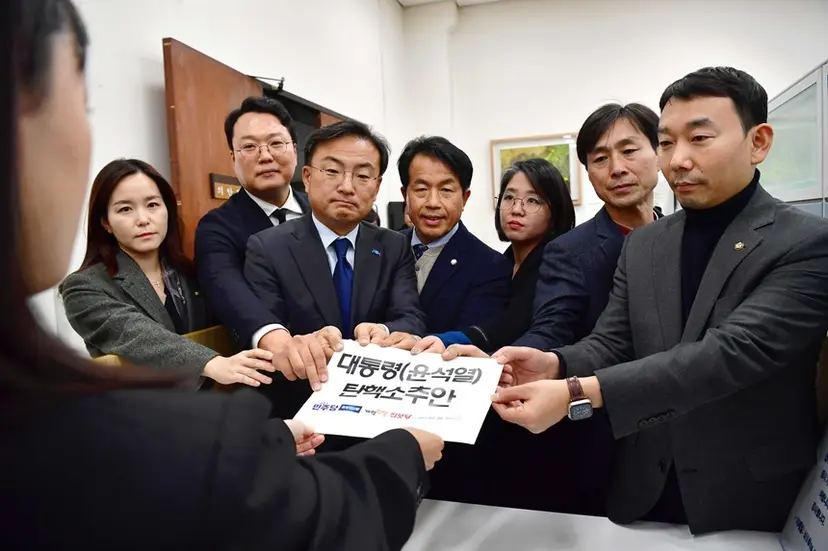
In the impeachment motion, the opposition parties pointed out that in the process of declaring martial law, President Yoon failed to properly undergo the State Council deliberation required by the Constitution, did not fulfill the obligation to notify the National Assembly, and committed a series of unconstitutional acts after the declaration, such as physically blockading the National Assembly and obstructing the lifting of martial law. In particular, they explained that these actions severely infringed upon the fundamental rights of the people guaranteed by the Constitution of the Republic of Korea and were an attempt to incapacitate the functions of the National Assembly. The sponsors of the impeachment motion strongly criticized the acts, stating that President Yoon's conduct constitutes insurrection with the intent to subvert the constitutional order.
Crucially, the martial law declared by President Yoon was issued without meeting the requirements of a "state of war, emergency, or equivalent national emergency" as stipulated in Article 77 of the Constitution. Nevertheless, President Yoon mobilized the military to blockade the National Assembly, attempted to physically block the legislature's demand to lift martial law, and issued decrees that severely infringed upon the freedom of the press and publication. This series of actions is evaluated as an unconstitutional measure that directly violated the fundamental rights of the South Korean people.
According to the National Assembly Act, this impeachment motion will be reported to the plenary session, with a vote scheduled to take place within 24 to 72 hours thereafter. For the impeachment motion to pass the National Assembly, the consent of at least two-thirds of the registered members, or 200 votes, is required. Currently, the Democratic Party and the minor opposition parties hold 192 seats, meaning the support of eight additional members from the People Power Party (PPP) is necessary. As some PPP lawmakers previously voted in favor of the resolution to lift martial law, attention is intensifying regarding the outcome of the impeachment vote. It is known that the opposition parties are continuing outreach efforts to secure the support of at least eight members from the PPP, and there is talk of the possibility that some members of the ruling party who are critical of the President may vote in favor.
Meanwhile, the People Power Party is undergoing severe internal turmoil. While demands for President Yoon's departure from the party and the mass resignation of the cabinet have emerged within the party, it is reported that they are still struggling to determine a party line. In particular, there is deep concern that impeachment could divide the party, coupled with the dilemma that defending the President to the end could result in a backlash. Although the PPP leadership is opposed to impeachment, the possibility of some members voting in favor individually cannot be ruled out. The situation bears a resemblance to the impeachment of former President Park Geun-hye, and internal tension is rising by the day.
If the impeachment motion passes the National Assembly, President Yoon's authority will be suspended immediately, and Prime Minister Han Duck-soo will assume the role of Acting President. The Constitutional Court will then conduct an impeachment trial, and if impeachment is decided by the consent of six or more justices, President Yoon will be removed from office. Currently, three seats on the Constitutional Court are vacant, necessitating the appointment of new justices. Although appointments are made by the National Assembly, they require the President's formal appointment, creating several variables in the Constitutional Court's trial schedule and procedures following the passage of the motion. In particular, if Acting President Han Duck-soo leads the appointment of new justices, it is speculated that the timing and feasibility of the appointments may change depending on the political situation.
This impeachment motion marks the third attempt to impeach a president in modern South Korean history, drawing comparisons to the cases of former Presidents Park Geun-hye and Roh Moo-hyun. The fact that the impeachment of an elected president has been proposed once again since Park Geun-hye highlights the current extreme political chaos. The Constitutional Court's trial and the political response during this impeachment process are expected to be a critical turning point that will determine the direction of South Korea's democratic development.
Immediately after the motion was filed, Democratic Party leader Lee Jae-myung held a press conference and stated, "President Yoon Suk Yeol's unconstitutional acts have reached a level that can no longer be overlooked," adding, "We have no choice but to push for President Yoon's impeachment to protect the will of the people and the Constitution." Representative Lee emphasized, "Through this impeachment, we will do our best to rectify the constitutional order and safeguard democracy." He also expressed his hope for cooperation from conscientious lawmakers within the People Power Party, declaring that they would mobilize all political means necessary to pass the impeachment motion.