

[비즈한국] Leading defense nations, including the United States, China, and European countries, have entered an intense race to secure AI pilot technology for unmanned combat aircraft. Although South Korea started late, domestic companies and organizations, such as Korea Aerospace Industries (KAI)047810, are accelerating technology development through their own investments.
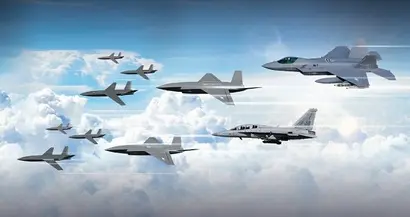
Korea Aerospace Industries (KAI) is currently developing an AI-based next-generation air combat system. In future battlefields, unmanned systems are expected to carry out major combat operations without direct human intervention; in particular, AI pilots are emerging as 'game changers' that will determine the outcome of future wars.
AI pilots can potentially outperform manned fighter jets. While humans struggle to withstand 9Gs during sharp maneuvers, AI pilots are not limited by G-force constraints, allowing them to perform more rapid and agile movements. Furthermore, thanks to AI’s advanced computational power and big data analysis, they are expected to make faster and more accurate decisions than humans to carry out missions.
Military powers have already raced to develop such technologies. Following a simulated dogfight between an AI and a human pilot in 2021, the U.S. began test flights this year with an AI pilot installed in an actual fighter jet (F-16 Viper). The U.S. plans to invest 83 trillion won by 2029 to introduce over 1,000 AI-powered unmanned combat aircraft and is currently conducting the Collaborative Combat Aircraft program. The second phase of the project, scheduled for next year, aims for international participation and the development of export versions, with KAI's potential involvement being discussed.
Europe, the U.K., and Japan are also rushing to develop unmanned aerial vehicles (UAVs) equipped with AI pilots alongside their 6th-generation fighter programs. Although South Korea started later than these advanced nations, it is focusing on securing AI pilot and UAV technology to avoid falling behind in the competition. In particular, the focus is on building a next-generation combat system by integrating AI pilots into multi-purpose UAVs.
The Agency for Defense Development (ADD) is currently operating the 'ACE (Air Combat Evolution)' program and the 'AIR (Artificial Intelligence Reinforcement)' program to develop AI pilots. ACE is a program that learns to autonomously perform combat in Within-Visual-Range (WVR) dogfights, while AIR is an AI learning program for Beyond-Visual-Range (BVR) engagements. Through these programs, AI pilots are being trained using advanced modeling and simulation methods.
KAI plans to develop AI pilots in stages. It aims to develop software logic and initial AI intelligence by 2026, and plans to demonstrate semi-autonomous formation flight—including manned-unmanned teaming, automatic target identification, and evasive maneuvers—from 2027 to 2029. To achieve this, KAI intends to conduct tests by installing AI pilots on the FA-50 supersonic multi-purpose fighter. The goal is to reach full autonomy, where unmanned combat aircraft perform missions on their own, between 2030 and 2035.
To achieve these goals, KAI plans to invest 150 billion won in securing core technologies for AI, big data, and autonomous/unmanned systems. KAI President Kang Goo-young noted that given the massive costs involved, developing such combat systems would be difficult without government support.
KAI emphasizes the importance of collaboration and technology integration with universities, research institutes, and private defense firms. President Kang stated, "While many universities, research institutes, and defense companies are conducting AI development, they lack the testbeds needed to verify their technologies," adding, "If KAI can serve as a testbed for the aerospace sector, it will create significant synergy."