

[비즈한국] In 2019, astronomers successfully captured the image of a supermassive black hole at the center of the giant elliptical galaxy M87. This was a historic achievement made possible by the "Event Horizon Telescope" (EHT) project, which mobilized radio telescopes across the globe, from the North Pole to the South Pole. Later, in 2022, they succeeded in capturing the image of the Sagittarius A* black hole at the center of our own galaxy. Although the black hole at our galaxy's center is much closer, the reason it took longer to observe is that the high density of stars and dust clouds heavily obstructs the view, making it much more difficult to image.
You might think that taking a picture of a black hole sounds impossible. Isn't the name "black hole"—a dark void—derived from the fact that its gravity is so strong that even light cannot escape? If no light comes out, how on earth can we take a photograph of it?
That is a fair point. Strictly speaking, it is impossible to photograph the black hole itself. However, we can certainly see the light leaking from just outside its event horizon. A black hole pulls in surrounding matter with its intense gravity. This matter, swirling rapidly around the black hole, heats up and emits light. The images from 2019 and 2022 are, in fact, observations of these traces of light.
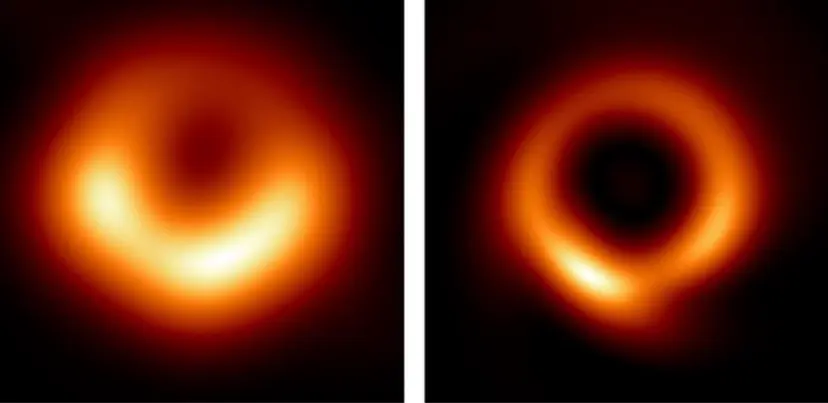
Both the black hole at the center of M87 and the one at the center of our galaxy display a characteristic ring of light. The center is completely dark and empty. Hidden within is the event horizon, the deepest darkness in the universe from which not even light can escape. Anything that crosses the event horizon can never return. While a black hole itself is a point, astronomers usually compare the scale of black holes by the size of their event horizons. Unfortunately, no one knows what happens inside the event horizon. Instead, we can see a ring of light that has traveled along the extremely warped spacetime around the black hole. What looks like an orange donut is the shadow of the black hole as identified by humanity.
The data observed by the Event Horizon Telescope is currently public and accessible to everyone. Recently, however, some astronomers who re-analyzed this archived data have raised an intriguing issue. They argue that the widely recognized orange, donut-shaped black hole image is, in fact, incorrect. They claim that they were unable to reproduce the orange donut shape that the EHT team created. Is the "authentication shot" of the black hole we saw truly flawed?
The two black holes targeted by the EHT actually appear very small in the sky. Sagittarius A*, at the center of our galaxy, has a mass about 4 million times that of the Sun. The size of its event horizon is only about 160 million km—roughly the diameter of Mercury's orbit! Yet, this black hole is a staggering 27,000 light-years away from Earth. In the Earth's sky, the width of this event horizon is a mere 0.00001 degrees; it appears as tiny as a point. Simply put, it is like trying to see a small donut from the distance of the Moon. The same is true for the black hole at the center of M87.
To clearly distinguish such a small celestial object, a gargantuan telescope is required—essentially a dish the size of the Earth. Of course, it is impossible to build such a telescope. Instead, astronomers chose to synchronize and combine observational data from radio telescopes scattered across the planet. This method of observing the same celestial object with multiple radio telescopes is called "Very Long Baseline Interferometry" (VLBI).
However, radio interferometry has inherent limitations. The ideal method would be to cover the entire surface area of the Earth with radio telescopes, but that is impossible. Consequently, there are gaps in this massive interferometric array. It is like looking at a reflection in a mirror that is full of holes, rather than one smooth, solid surface. Therefore, astronomers used artificial intelligence algorithms to track what the missing mirror segments might have reflected, thereby completing the image of the black hole.
Recently, Japanese astronomers including Makoto Miyoshi analyzed whether the image of our galaxy's central black hole released in 2022 could be reproduced using the EHT’s observation results. They found they could not recreate the famous orange donut-shaped image. Instead, they produced a single, blob-like image rather than a ring. This raised the issue that it might be impossible to clearly distinguish the light ring and the event horizon using only the existing EHT observations.
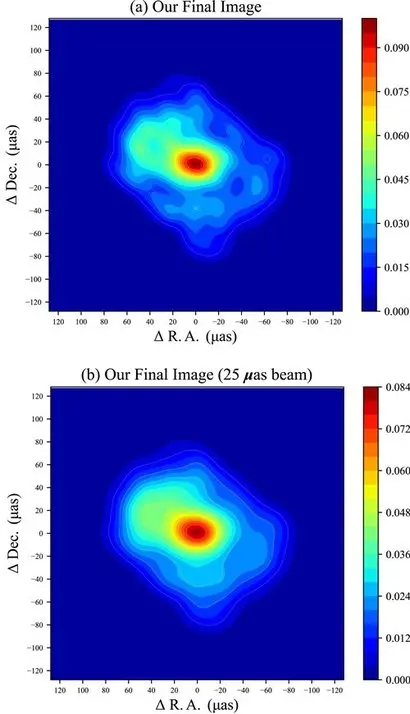
One of the core issues they raise is that the size of the light ring implemented in the original black hole images is very similar to the resolution limit of the EHT.
In astronomy, how much light from a source appears to spread is represented by a "Point Spread Function" (PSF). Light that should appear as a single point appears blurred and rounded in all directions after passing through a telescope; this shape is called the PSF. The research team challenging the findings argues that given the layout and performance of the telescopes used at the time, the limits of the PSF are nearly identical to the light ring captured in the photo. Therefore, they claim, we are looking at a single, blurred smudge rather than a clear ring of light.
In particular, they argue that a type of error occurred in the process of using AI algorithms to reconstruct the image. At the time, the EHT team reconstructed the observation data based on theoretical models of black hole images. However, the theoretical model image itself was already an ideal donut shape. They point out that because the algorithm was trained on this idealized ring shape—which may not match actual observational performance or limitations—there is a possibility that the ring shape was falsely created even though it was not actually observed.
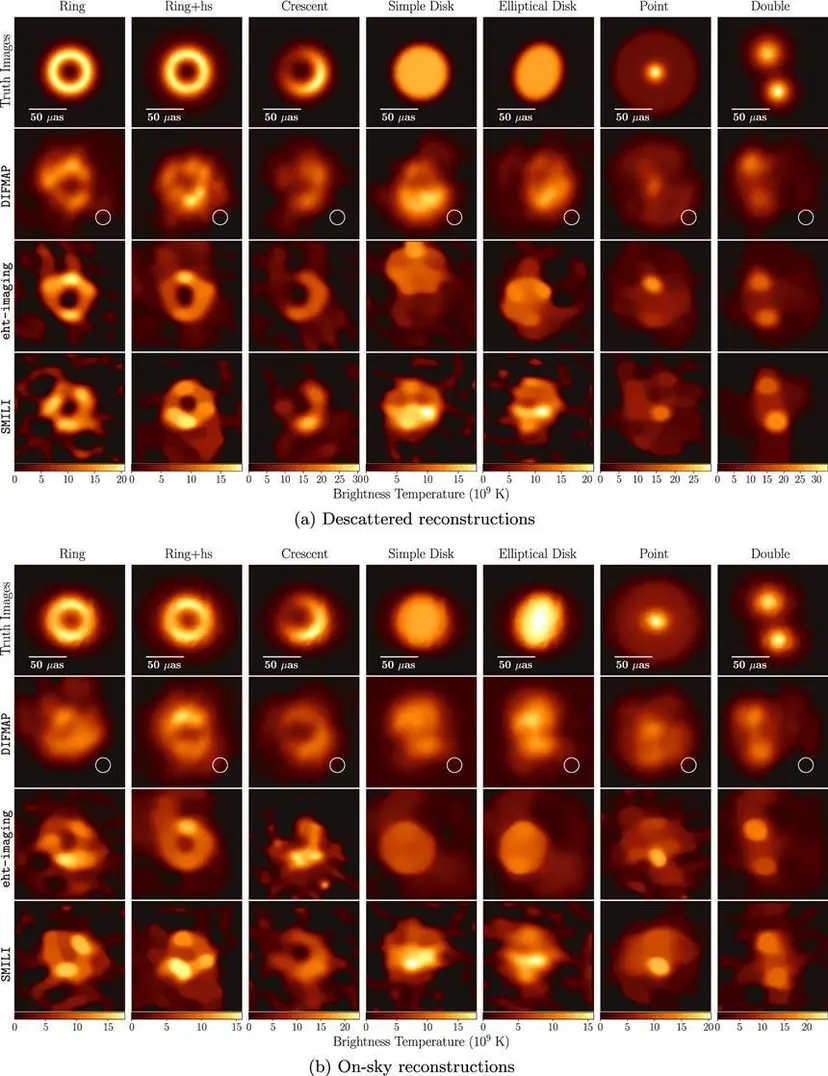
In June 2022, the EHT team posted an official response to the concerns raised by the Miyoshi team. They stated that while they welcome public verification of their results, they pointed out that the Miyoshi team misunderstood their observations. However, they did not provide detailed explanations. Eventually, the Miyoshi team published subsequent papers claiming there were fatal flaws in the analysis of the M87 galaxy's black hole image, arguing that the light ring was a phantom not actually observed. They demanded that the EHT team provide more detailed rebuttals and evidence.
For several months, the EHT team remained silent without a specific rebuttal. Then, on October 29, 2024, they posted a detailed article on their official blog refuting the Miyoshi team’s analysis.
First, the EHT team pointed out that the Miyoshi team did not sufficiently consider the variability of the black hole at the center of our galaxy. Our galaxy's central black hole has much less mass and scale compared to M87's. Consequently, its event horizon is smaller, and the matter trapped by the black hole rotates more quickly. The light around the black hole fluctuates more rapidly and constantly changes its appearance. In fact, it is estimated that the light around Sagittarius A* fluctuates every 10 minutes. The EHT team stated that they reconstructed the black hole's images one by one over time, taking this variability into account. They noted that the Miyoshi team's analysis did not sufficiently account for this.
They also presented evidence confirming the existence of the light ring from subsequent polarization observations. The EHT team has previously provided observational evidence of how the magnetic fields around the black hole are twisted by observing polarized light. Through this, they delivered a counter-rebuttal to the Miyoshi team's critique.
However, the EHT team also seems to be taking a step back and adopting a cautious stance. While refuting the Miyoshi team's claims, they acknowledged the fact that "there are other external analyses that do not support the interpretation of the EHT team." Indeed, not just the Miyoshi team, but several independent research groups are now raising the possibility that the existing ring-shaped black hole image could be a distorted result. The argument is not that there is no ring-shaped event horizon, but that since it is currently impossible to see a clear event horizon with existing telescope performance, using an algorithm trained with the expectation of a ring resulted in "seeing what they wanted to see."
To think that one of the greatest scientific achievements of the 21st century—the photograph of a black hole—could potentially be a flawed image! It is too early to judge who is right. However, it would be a mistake to misinterpret this controversy as meaning that black holes themselves do not exist. Both those who support the orange donut image and those who do not doubt the existence of these monsters in space. This should be seen as a challenge regarding what that monster's portrait actually looks like and whether the portrait we have known so far is accurate.
Ultimately, even if the orange donut photo is proven to be a flawed result, there is no need to be disappointed. Rather, I would like to highly commend the EHT team's attitude in not hiding data and making it publicly available for anyone to verify. This is simply a process of more accurately portraying the black hole. Will the orange donut photo remain the definitive authentication shot of the black hole, or will it remain as a momentarily misunderstood, distorted image? Will astronomers be able to keep eating donuts while celebrating the historic photo of the black hole?
Currently, the Event Horizon Telescope team is planning to deploy more telescopes and, simultaneously, is planning additional observations of the black holes in M87 and our galaxy with much higher resolution, including planned radio-band space telescope observations. Furthermore, they are planning to go beyond static images and attempt to capture the variability of the matter around the black hole—like a GIF—to see how the ring of light fluctuates in real-time. If these additional observations proceed, the recently heated debate over the black hole images will be resolved.
References
https://academic.oup.com/mnras/article/534/4/3237/7660988?login=false
https://iopscience.iop.org/article/10.3847/1538-4357/ac6ddb
https://eventhorizontelescope.org/blog/imaging-reanalyses-eht-data
https://eventhorizontelescope.org/blog/response-independent-analysis-ehtc-imaging-sgr-miyoshi-et-al-2024
About the author, Ji Ung-bae: He loves cats and the universe. After watching "Galaxy Express 999" as a child, he dreamed of sharing the beauty of the cosmos. He currently studies the evolution of galaxies through their interactions at the Yonsei University Galaxy Evolution Research Center and the Near-Field Cosmology Lab, and is engaged in various science communication activities, including lectures and writing. He is the author of books such as "Thumb-taping Observatory," "Thinking About the Universe All Day," and "Stars, the Science of Light."