

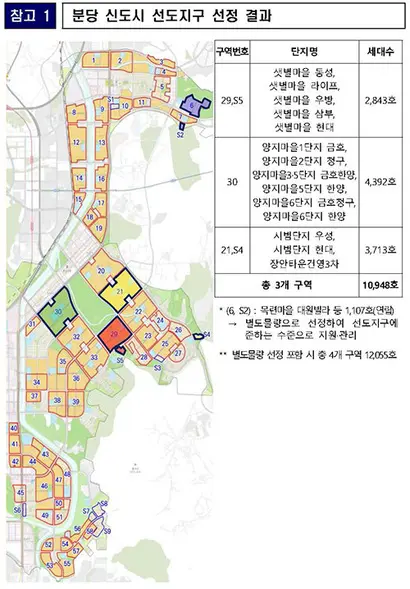
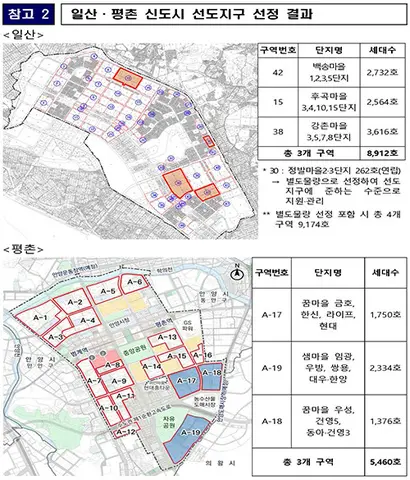
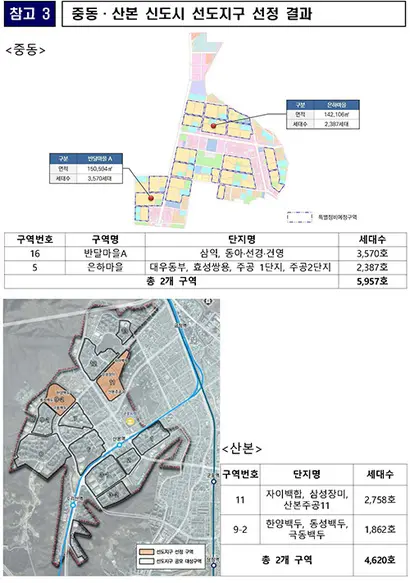
[비즈한국] Under the Special Act on First-Generation New Towns, 13 zones have been designated as "leading districts." Spanning Bundang, Ilsan, Pyeongchon, Jungdong, and Sanbon, these zones are considered the first step toward resolving the aging infrastructure issues of the first-generation new towns developed in the 1980s and 1990s. This holds special significance not merely as the start of reconstruction projects, but as a large-scale urban reorganization project involving the government, local municipalities, and residents.
Despite these positive prospects, the reconstruction projects still face numerous challenges. Factors such as additional financial contributions, relocation plans, and public contributions will be discussed in earnest following the selection of the leading districts and will serve as critical variables for investors and residents alike.

Let us examine the opportunities and limitations of reconstruction and the designation of leading districts.
Reconstruction is more than just replacing old apartments with new buildings; it is an effort to redesign the structure and functionality of a city. The recent Special Act on First-Generation New Towns has enabled the government to take the lead in providing administrative, financial, and institutional foundations to support this process.
First, government administrative support will contribute to increasing the efficiency of reconstruction projects. In the past, reconstruction processes were often delayed in the initial stages due to difficulties in securing resident consent rates. However, this special act introduces an electronic consent platform to streamline the process of gathering resident opinions and aims to reduce unnecessary conflicts.
Second, financial support will help alleviate the burden of initial project costs. The approximately 12 trillion won "Future City Fund" and specialized guarantees from the Korea Housing & Urban Guarantee Corporation (HUG) are powerful tools to resolve funding issues. In particular, they will reduce project risk by allowing construction companies to proceed with work stably through guarantees.
Nevertheless, significant uncertainties remain in reconstruction projects. Factors such as additional financial contributions, relocation plans, and public contributions have a major impact on the speed of project progress and the cooperation of residents.
Additional contributions can be a source of conflict. One of the most sensitive issues in reconstruction is the additional financial contribution required from residents. During the leading district designation process, the biggest point of contention between the government and residents was the accurate calculation of estimated additional costs. If unexpected cost increases occur as the project progresses, the amount residents must pay will rise, which can trigger resident dissatisfaction and conflict.
This issue is highly likely to be more pronounced in areas with many large apartment complexes, such as Bundang and Pyeongchon. Past cases show that the issue of additional contributions has often been a cause for delay in reconstruction projects. For example, in some reconstruction complexes in the Gangnam area, residents demanded the cancellation of projects or experienced delays due to rising construction costs. Therefore, investors must carefully examine the calculation methods for additional contributions in these regions and the potential for conflict surrounding them.
Relocation plans can also cause short-term disruption in the rental market. Reconstruction inevitably entails relocation. Approximately 36,000 households are included in the zones designated as leading districts, and the demand for relocation from these residents will have an immediate impact on local rental markets. In areas with dense, large-scale complexes like Bundang or Pyeongchon, rising rent is inevitable. In particular, if relocation plans are unclear or temporary housing facilities are insufficient, the local rental market could experience significant short-term turmoil.
These conditions offer two opportunities for investors.
First, there is a possibility that yields for "jeonse" (lump-sum deposit) or monthly rent will increase due to higher rental demand. Second, the scarcity of new housing in the region will be highlighted during the gap between the completion of relocation and the final completion of the reconstruction. However, investments utilizing relocation demand require a thorough analysis of regional market conditions and the balance of supply and demand to have a high chance of success.
Public contribution presents a dilemma of costs versus benefits. Public contribution is essential in reconstruction projects. It involves returning a portion of development profits to society, including the creation of parks, road expansions, or the construction of public facilities. Public contribution was mentioned as a key element in the recent Special Act, and the government intends to secure the project's social legitimacy through it.
The problem is that as public contributions increase, development costs rise. This is directly linked to additional financial contributions and can partially offset development profits. Investors should keep in mind that project viability could decrease due to public contributions and should calculate expected returns conservatively.
Ultimately, an investment strategy must balance opportunities and risks.
The designation of leading districts in first-generation new towns is expected to have a positive impact on the real estate market in the long term. However, uncertainties regarding additional contributions, relocation plans, and public contributions complicate investment decisions. In this situation, investors should consider the following strategies.
First, invest in core complexes within the leading districts. Complexes designated as leading districts are likely to develop quickly due to administrative and financial support. Major complexes, such as Saetbyeol Village in Bundang or Hugok Village in Ilsan, can be expected to have high premiums after reconstruction. However, considering the risk of additional contributions, it is important to approach them at an early stage when prices are relatively stable.
Second, explore the potential value of non-leading districts. Nearby areas that were not designated as leading districts are positioned at relatively lower price points, and investing in areas with potential for future designation is also promising. For example, areas that have already been under discussion, such as Mokryeon Village in Bundang or Jeongbal Village in Ilsan, have a high probability of future designation.
Third, utilize short-term rental income. Investing in leasable housing by taking advantage of the timing when relocation demand increases is also a good strategy. In particular, areas with high jeonse or monthly rent yields can provide stable cash flow in the short term.
Fourth, analyze public contributions and cost structures. One must carefully analyze the potential for cost increases due to public contributions. It may be advantageous to focus on small-scale complexes where the burden of public contribution is relatively lower, rather than complexes where project viability might be compromised.
Reconstruction of first-generation new towns is one of the most important projects in the Korean real estate market, and the designation of leading districts is the first step. While strong government support and systematic planning are positive, realistic issues like additional contributions, relocation plans, and public contributions remain. Investors must carefully analyze both opportunities and risks to formulate their strategies and approach them cautiously from a long-term perspective.
It is important to remember that reconstruction is a form of investment that pursues long-term value alongside urban reorganization rather than expecting short-term profits.
Kim Hak-ryul, head of the Smart Tube Real Estate Research Institute and famous by his pen name "Pashong," previously served as the team leader of the Real Estate Research Division at Gallup Korea. He operates the Naver blog "Pashong's World Exploration" and the YouTube channel "StuTV." His authored works include "Absolute Principles of Seoul Real Estate (2023)," "The Future of Incheon Real Estate (2022)," "Kim Hak-ryul's Absolute Principles of Real Estate Investment (2022)," "The Future Map of South Korea's Real Estate (2021)," "From Now On, Only Places That Will Rise, Rise (2020)," and "User Manual for South Korea's Real Estate (2020)."