

[비즈한국] The Agency for Defense Development (ADD) held a ceremony on the 29th to commemorate the completion of the development of the Long-range Surface-to-Air Missile (L-SAM). This project is considered a hallmark "ultra-long-term project" of the South Korean defense industry; after the long-term requirement was decided in 2010, exploration and development began in 2015, taking 10 years of full-scale development, or 15 years in total when including the project feasibility study.
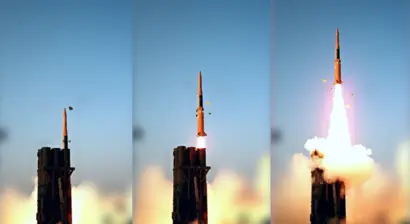
So, what exactly is the significance of completing the L-SAM development? We examine this achievement from three perspectives.
L-SAM is the first major weapon project for which South Korea has independently developed a world-class weapon system in its entirety. While there are other projects with larger budgets and longer durations, such as the Jangbogo-III submarine and the KF-21 fighter jet, those weapons had limitations in complete localization as they imported some core technologies from abroad or relied on technology transfers.
In contrast, L-SAM was completed by localizing most of its core components, including the missile itself, the Multi-Function Radar (MFR), and the command and control facilities. This is a case that records the highest localization rate among major weapon systems, representing a qualitatively different achievement compared to the Cheongung (M-SAM) medium-range surface-to-air missile project, which was developed through the transfer of Russian technology over 20 years ago. This development demonstrates that South Korea has made significant progress in achieving true defense technology independence.
Beyond being a mere domestic weapon development, L-SAM signifies that South Korea has become a nation that has independently established a multi-layered ballistic missile defense capability.
Because ballistic missiles are extremely difficult to intercept, effective defense depends on a multi-layered system that attempts multiple interceptions at different stages of flight. Systems like Europe’s MEADS (Medium Extended Air Defense System) or SAMP/T offer some interception capabilities, but they rely on U.S. weapons such as THAAD or SM-3 for multi-layered defense.
With the development of L-SAM, the South Korean military can now perform terminal-phase lower-tier defense via Cheongung-II (M-SAM PIP) and terminal-phase upper-tier defense via L-SAM. Combined with U.S.-made Patriot PAC-3 missiles and THAAD, this brings us one step closer to completing the Korea Air and Missile Defense (KAMD) system.
L-SAM is evaluated as a strategic weapon that will further enhance the export competitiveness of the Korean defense industry. Cheongung-II is already being exported to countries like Saudi Arabia, the United Arab Emirates (UAE), and Iraq, serving as the "missile shield of the Middle East." In these nations, L-SAM is highly likely to emerge as a top-priority purchase target, as it can be integrated with existing Cheongung-II systems and offers better price competitiveness than the U.S. THAAD.
Furthermore, the possibility of European countries adopting Cheongung-II and L-SAM as a "package" has increased, as the U.S., Israel, and South Korea are the only nations capable of independently supplying a multi-layered ballistic missile defense system.
While the completion of L-SAM development is clearly a major achievement, challenges remain for the Korean defense industry. Currently, the ADD and the Defense Acquisition Program Administration (DAPA) are simultaneously developing various surface-to-air missile systems, including L-SAM II, Cheongung-III, the Low-Altitude Missile Defense (LAMD) system, and ship-to-air missiles.
Measures are needed to integrate or maximize the commonality of major missile systems for efficient development and production. For example, using Cheongung-III components to create a lower-cost LAMD-II or adapting L-SAM II into a ship-to-air missile should be considered.
Additionally, addressing the vulnerability of existing missile systems to drone attacks is an urgent task. Defense systems capable of countering suicide drones must be developed and integrated with existing anti-aircraft missile systems, and hard-kill defensive capabilities—such as equipping missile launchers and radar vehicles with drone proximity warning systems or smoke grenade launchers—must be strengthened.
L-SAM is a significant achievement that symbolizes the leap of the Korean defense industry.
I hope that the completion of this development serves as an opportunity for DAPA, the ADD, and domestic defense companies to re-examine and further advance our military's defensive capabilities. Along with the systematic development of the defense industry, the day is not far off when the competitiveness of Korean defense products will be proven on the international market.