

[비즈한국] During a senior secretaries meeting on November 11, President Yoon Suk Yeol stated, "In the second half of my term, we must make proactive efforts to overcome polarization, including disparities in income and education." This reflects his assessment that while various economic indicators are improving as he reaches the midpoint of his term, the warmth of economic recovery is not properly reaching the general public.
In fact, the primary reason for President Yoon's approval rating fluctuating around the 20% mark—second only to issues involving First Lady Kim Keon-hee—is dissatisfaction with livelihood issues such as inflation. Although President Yoon has set tangible economic recovery as a goal for the latter half of his term, it remains uncertain whether this will actually be achieved. This is because local governments are immediately moving to raise various public utility fares that they had previously kept suppressed at the government's request.
At his first senior secretaries meeting after passing the midpoint of his term on November 11, President Yoon mentioned the U.S. presidential election results, saying, "Although polls said it would be a tight race, former U.S. President Donald Trump ended up winning by a landslide, and we must learn a lesson from this." He added, "Public dissatisfaction grew due to polarization, which led to the change of government in the U.S." He concluded that the deterioration of the perceived economy due to high inflation impacted the U.S. election results. Consequently, he prioritized resolving polarization so that the public could feel the economic recovery.
Much like President Yoon's concerns, the worsening of the perceived economy due to high inflation is contributing to the decline in his approval rating. According to a survey conducted by Gallup Korea from November 19 to 21 among 1,001 voters aged 18 and older nationwide, the negative assessment of President Yoon's performance reached 72%. Respondents cited "the Kim Keon-hee issue (14%)" and "economy, livelihood, and inflation (13%)" as the primary reasons for their negative assessment.
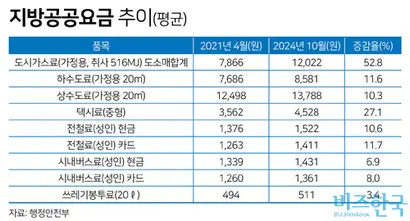
In reality, as public utility fares have risen one after another since President Yoon took office, it has driven up consumer prices and worsened the perceived economy. According to the Ministry of the Interior and Safety, the national average city gas bill (value converted from 1MJ to 516MJ), which was 7,886 won in April 2021 before President Yoon took office, rose 52.8% to 12,022 won in October of this year. Water and sewage rates rose by 10.3% and 11.6% respectively during the same period, and taxi fares jumped by 27.1%. Subway fares also increased by more than 10%.
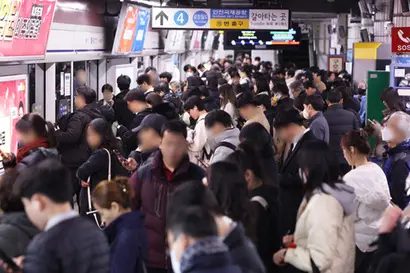
In this situation, there is a high possibility that inflation will be rattled once again as local governments have decided to raise public utility fares—including subway, city bus, water and sewage, and taxi fares—one after another starting next month. Gwangju Metropolitan City has decided to increase water and sewage rates starting next month. Specifically, the plan is to raise these rates by an average of 9% annually over the next four years. Chuncheon, Gangwon Province, has submitted a revised ordinance to its council that would raise sewage rates by 30% each in 2025 and 2026.
The Seoul Metropolitan Government is reviewing a plan to raise the base subway fare from 1,400 won to 1,550 won, an increase of 150 won, early next year. In July of last year, the Seoul Metropolitan Government decided on a 300-won subway fare increase based on the fare adjustment plan of the Price Stability Committee. However, fearing the negative impact on inflation, it raised the fare by 150 won in October of last year and had a policy to raise the remaining 150 won this year. While they had postponed the timing due to the government's policy to curb price increases, their stance is that an increase is unavoidable early next year. Since Incheon Metropolitan City is pursuing a plan to raise urban railway fares from 1,400 won to 1,550 won in February of next year, it is highly likely that Seoul's subway fare hike will take place around the same time. Gyeongsangnam-do is reviewing a plan to raise city bus fares from 1,500 won to 1,700 won (cash basis) early next year.
Taxi fares also show signs of rising one after another. Daegu Metropolitan City has decided to raise the base taxi fare from the current 4,000 won for 2km to 4,500 won for 1.7km starting next February. The distance-based fare will increase from 100 won per 130m to 100 won per 125m. Ulsan City has also decided to raise its base fare from the current 4,000 won to 4,500 won starting next year. Both Daegu and Ulsan have decided to raise their fares again just two years after their last taxi fare hikes last year.
These increases in public utility fares could further worsen the already poor perceived economy. According to the Bank of Korea's consumer sentiment survey in November, the Consumer Sentiment Index (CSI) for future economic prospects, which predicts the economic situation six months later, was only 74. The lower the CSI is below the baseline of 100, the more people perceive that the economy will deteriorate. On the other hand, the CSI for price level expectations, which looks at inflation one year ahead, recorded 147, showing that anxiety over high inflation remains significant.