

[비즈한국] The election for the 41st President of the Korean Pharmaceutical Association, who will lead the organization for the next three years, is two weeks away. With the race shaping up as a three-way contest between incumbent President Choi Kwang-hoon, Seoul Pharmaceutical Association President Kwon Young-hee, and Gyeonggi Pharmaceutical Association President Park Young-dal, we examined the candidates' pledges regarding urgent issues such as the roles of herbal pharmacists (hanyaksa), drug shortages, and pharmacy medication delivery, based on the first policy debate and their official platforms.
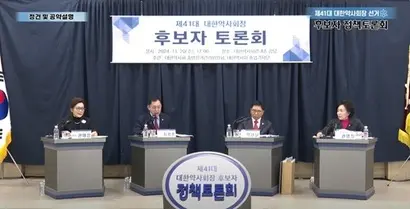
First election with ‘online’ as the default method… Will President Choi Kwang-hoon succeed in a consecutive term?
The Central Election Management Committee of the Korean Pharmaceutical Association announced the 41st presidential election on the 13th of last month. Unlike the 40th election, which was conducted solely by mail, this election uses ‘online voting’ as the default. According to the committee, only 135 voters, or about 0.4% of the total, will vote by mail. Online voting will take place from 9:00 AM on December 10 to 6:00 PM on December 12. For those choosing mail-in ballots, only those received between December 2 and 6:00 PM on December 12 will be valid. Vote counting will begin immediately after the polls close.
The candidates in order of ballot listing are incumbent President Choi Kwang-hoon, Seoul Pharmaceutical Association President Kwon Young-hee, and Gyeonggi Pharmaceutical Association President Park Young-dal. While there were initial calls for a merger between candidates Choi and Park, negotiations fell through, and candidate Kwon successfully unified her campaign with former Seoul Pharmaceutical Association President Kim Jong-hwan through public opinion polling, resulting in a three-way race. Regarding the candidates' backgrounds, Choi (born 1954, Chung-Ang University) is the current president and has served as Gyeonggi Pharmaceutical Association President and Vice President of the Korean Pharmaceutical Association. Kwon (born 1959, Sookmyung Women's University) is the current Seoul Pharmaceutical Association President and has served as Vice President of the Korean Pharmaceutical Association, a Seoul Metropolitan Council member, and Seocho-gu Pharmaceutical Association President. Park (born 1960, Chung-Ang University) is the current Gyeonggi Pharmaceutical Association President and has served as Vice President of the Korean Pharmaceutical Association.
At the first policy debate held on the 20th, candidate Choi stated, “I know how to win,” emphasizing the achievements of the current leadership. Seemingly targeting "activist" candidates, he also remarked, “Fights where one unilaterally makes demands, meets, takes photos, and then turns around and disappears are meaningless.” Candidate Kwon argued that the current leadership failed to solve various problems due to a lack of “action and execution,” citing the Korean Nurses Association’s push for the “Nursing Act” and the Korean Medical Association securing a 130% increase in “non-face-to-face treatment fees.” Candidate Park emphasized the necessity of “legal amendments” and highlighted his experience as a chief negotiator for medical fees.
Looking at specific issues, regarding the herbal pharmacist (hanyaksa) problem, candidate Choi pledged to distinguish between “herbal preparations” and “non-herbal preparations,” prohibit the joint opening of pharmacies by pharmacists and herbal pharmacists, and ban cross-employment. Candidate Kwon suggested that the scope of work between pharmacists and herbal pharmacists must be clarified and that “punitive clauses” must be established. Candidate Park proposed establishing a “control tower for responding to herbal pharmacists” to restrict the supply of non-herbal preparations, as well as amending the Pharmaceutical Affairs Act based on research commissioning and solidarity with civic groups. Like candidate Choi, he also pledged to distinguish non-herbal preparations and prohibit cross-employment.
Heaps of tasks: Herbal pharmacists, drug shortages, and medication delivery
Regarding responses to drug shortages, candidate Choi advocated for realistic drug pricing, a ban on long-term prescriptions, the legalization of public-private consultative bodies, exemptions from post-dispensing notifications for substitute drugs, and changing pharmaceutical company penalties from manufacturing and sales suspensions to monetary fines. In contrast, candidate Kwon emphasized “generic name prescribing.” She explained that expanding generic name prescribing is a way to reduce the damages caused by the separation of prescribing and dispensing. Her platform also included a ban on long-term prescriptions. Candidate Park proposed solutions such as using DUR (Drug Utilization Review) alerts at the prescription stage to induce prescription changes, active government intervention including drug price hikes and inventory stockpiling, and simplifying substitute dispensing reports.
Regarding the medication delivery issue, candidate Choi announced pledges for the principle of face-to-face receipt of dispensed medications and a ban on non-face-to-face receipt for medications prone to misuse. Candidate Kwon argued for the institutionalization of generic name prescribing for non-face-to-face treatment and creating an environment where face-to-face dispensing is possible anywhere. Candidate Park called for the creation of regulatory laws for non-face-to-face treatment platforms. Regarding medical fees, all three candidates promised to “establish a new dispensing fee for long-term prescriptions of 91 days or more.” Candidate Kwon promised to build a sustainable support system and improve manpower and fees by sector, while Park promised to establish a new fee that covers the cost of packaging material losses.
Assessments suggest that this election is difficult to predict due to many variables. Since the introduction of the direct election system, every president had succeeded in consecutive terms until the previous election, when former President Kim Dae-eup was defeated, breaking that rule. Furthermore, while the 37th to 40th elections were two-way races, this election is a three-way contest. There is also concern within the pharmaceutical community about low interest in the election. A pharmacist identified as A stated, “It seems interest in the election has significantly dropped since the last election was held via mail-in voting. Aside from the minority who want to voice their opinions actively, most people don't know much about the election.”