

[비즈한국] The universe is home to a truly diverse array of galaxies. Galaxies are generally classified into two types based on their shape. First, there are elliptical galaxies, where stars are distributed in a puffy, spherical shape. In an elliptical galaxy, individual stars orbit the central black hole randomly. It is similar to a swarm of bees buzzing in a group, which looks like a rounded elliptical shape from a distance. Second, there are disc galaxies, where stars are gathered in a flat, disc-like shape. Because the stars all rotate around the galactic center in the same direction, they form a flat disc. These are often called spiral galaxies because they typically feature large, beautiful spiral arms.
However, among the galaxies in the universe, there are some with strange shapes that are difficult to define using only these two categories. If one were to pick the most representative example, it would be Hoag's Object, which wears a distinct ring shape like a giant doughnut.
Located about 600 million light-years away, Hoag's Object is, regardless of its appearance, a galaxy. Like our own Milky Way, it is composed of countless stars gathered together. This unique ring-shaped object was first discovered in 1950. However, because its shape is so peculiar, astronomers did not initially consider it a galaxy. In fact, Arthur Hoag, the astronomer who first discovered it, thought it might be a planetary nebula in the shape of a ring.
A planetary nebula is the debris left behind when a star not massive enough to go supernova reaches the end of its evolution and collapses, shedding material in all directions. Planetary nebulae can actually take on a wide variety of shapes depending on complex conditions such as the star's rotation and whether it is part of a binary system. Among them, the ring shape is relatively simple. The Ring Nebula, which, as the name suggests, is shaped like a giant ring, is a classic example. When Hoag first discovered this strange galaxy, he simply thought it was another ring nebula discovered from afar.
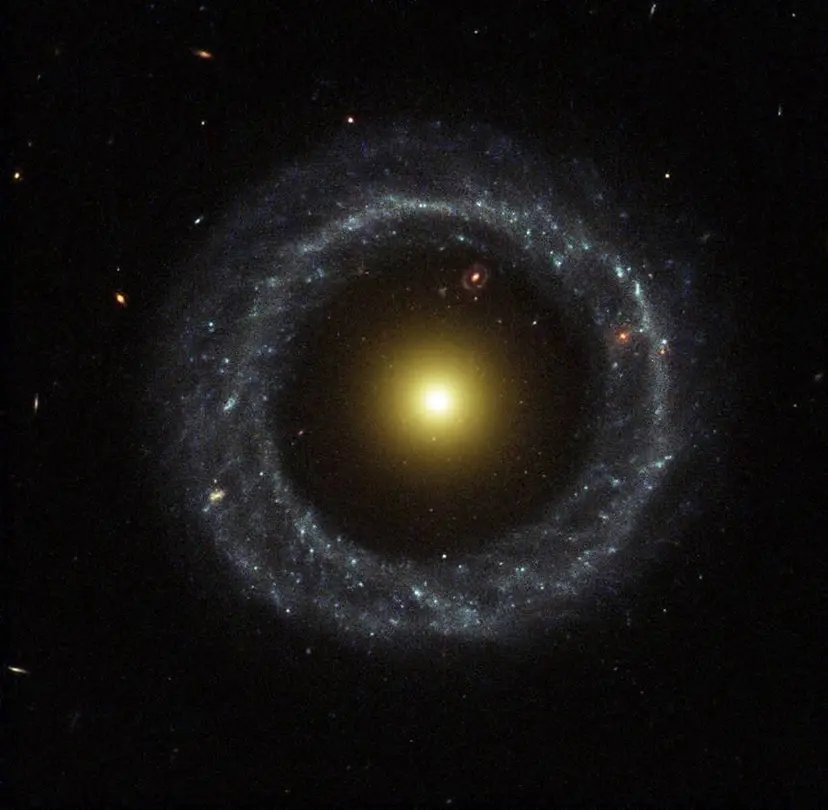
He also proposed another possibility: that it might be a gravitational lens image created by the distortion of surrounding spacetime by a massive galaxy. In fact, if a celestial body acting as a lens and a background object behind it are aligned perfectly, the background object's virtual image can appear to wrap around the lens in a perfectly round shape.
However, with the technology of the time, there was no way to determine how far the center and the outer round ring in the photo were from Earth, and Hoag's guess that it was a gravitational lens remained merely a hypothesis. Given that proper observation of gravitational lens images only became possible after the Hubble Space Telescope was launched in 1990, it feels incredibly bold that Hoag, in 1950—when even putting a single satellite into orbit was a struggle, let alone a space telescope—speculated that he might have observed a gravitational lens image using a ground-based telescope.
Later, in 1987, Hoag's Object was finally studied in more detail. Observations of the spectra of the central core and the surrounding ring revealed that both showed the same redshift. This means that both the center and the outer ring are part of the same object at the same distance. If it were truly a gravitational lens image, as Hoag had cautiously suggested, the outer ring should have appeared blurry and distorted, as it would have to be a much more distant background galaxy. However, subsequent observations show that individual stars and star clusters are clearly visible in the ring. This proves it is part of a galaxy that is not very far away.
The center of Hoag's Object glows with a distinct yellow light. Relatively old, lukewarm stars are densely packed at the galactic center. In contrast, the outer ring glows with a blue and white light, consisting of young, hot stars born much more recently. The central galactic nucleus and the outer ring are clearly separated. There is almost nothing in between. This is precisely why it is difficult to classify it simply as a disc or spiral galaxy. For a typical disc galaxy, the disc is empty. It looks as if someone ate all the toppings off a pizza and left only the round crust.
Inevitably, astronomers have come to call extremely rare exceptions like Hoag's Object "ring galaxies." Another representative example of a similar galaxy is NGC 1291.
There are also galaxies called "polar-ring galaxies," which are similar to ring galaxies, but they are fundamentally different. The origin of polar-ring galaxies is relatively well understood. These rings are formed during the process of two ordinary galaxies colliding and interacting due to their mutual gravitational pull. The outcome of galactic collisions varies depending on the mass of each galaxy, the amount of gas they contain, and the angle and speed at which they collide. Polar-ring galaxies are a very dramatic example, appearing as if two colliding galaxies have penetrated or pierced through one another. While impressive, they are clearly different from Hoag's Object. Polar-ring galaxies are also more common than perfect ring galaxies like Hoag's.
So, how does this perfect ring-shaped galaxy actually exist? One might think of the Cartwheel Galaxy as another similar-looking case. The Cartwheel Galaxy also features a bright central galactic nucleus and a ring structure surrounding the edge.
In reality, this is the result of a highly dramatic galactic collision. A smaller galaxy plowed almost directly through the center of a galaxy that was originally a normal disc shape. At that moment, a round shockwave spread in all directions, and the original spiral arms were scattered. Just as a round crater forms when a meteorite hits the moon, it can be seen as a giant, galactic version of a crater.
However, the Cartwheel Galaxy is also clearly different from Hoag's Object. If you look closely, the Cartwheel Galaxy, as its name suggests, shows several spokes of gas flowing from the edge to the nucleus. This is the appearance of the spiral arm structure being restored after being destroyed by the collision.
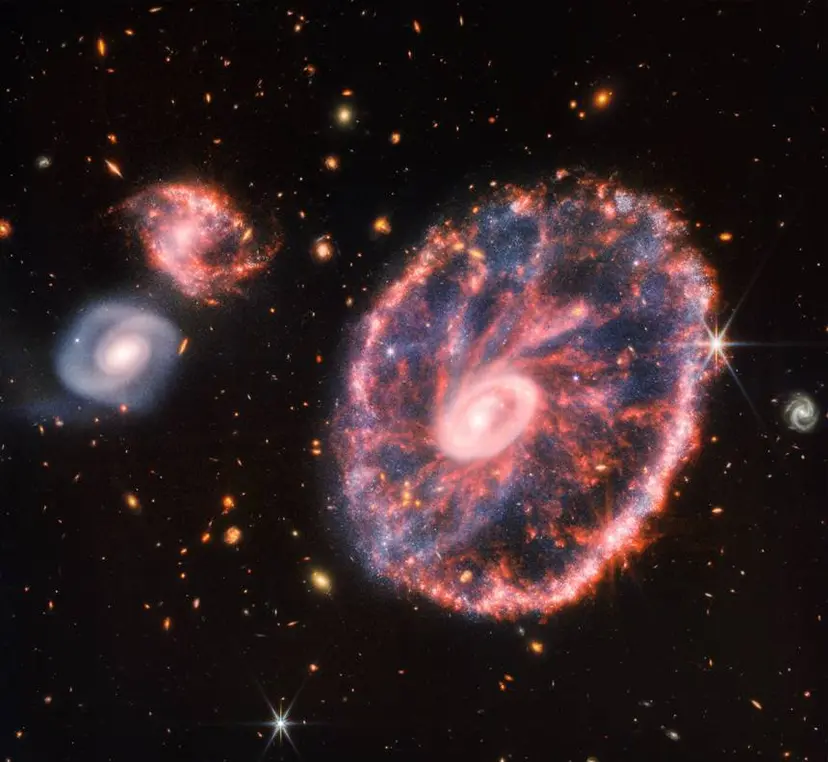
Compared to polar-ring galaxies and the Cartwheel Galaxy, the central part of Hoag's Object and its outer ring are separated much more cleanly. It looks like there is truly nothing in between. Furthermore, the outer ring is not at all asymmetric or distorted. It forms a perfect, orderly ring. Astronomers still do not clearly know how such a perfect ring can exist in the universe.
There are a few hypotheses. One is that this galaxy was originally a barred spiral galaxy with a bar in the center. The central bar structure plays an important role in modifying the mass distribution within a galaxy by pulling gas towards the center. Even without direct collisions with neighboring galaxies, a galaxy containing a bar can have its shape change much more dynamically.
According to this hypothesis, long ago, the bar structure at the center of this galaxy caused most of the gas material that had existed in the star disc to be concentrated in the center. As a result, only a round portion was left at the edge, and a yellow core of old stars formed in the center. As mentioned earlier, it is as if the central bar structure ate the entire "pizza" that originally filled the disc, leaving only the edge!
This hypothesis once attracted attention, but unfortunately, it is not widely accepted by astronomers today. Usually, when a galaxy's shape changes due to a central bar structure, it leaves behind a more distorted, elliptical galactic nucleus rather than a perfectly round one. Furthermore, because the stars in the outer ring of the galaxy are still maintaining perfectly circular orbits, the hypothesis that the dynamical motion of stars and gas was altered by a long-lost central bar structure loses ground.
It is also possible that a small, round galaxy once stripped material from a neighboring galaxy to form the round ring at its exterior. However, the outer ring of Hoag's Object, which spans 60,000 light-years in diameter, contains more gas than our own Milky Way. Therefore, it is difficult to believe that such a large amount of gas was introduced from the outside all at once. How this beautiful and unique landscape exists remains an intriguing mystery.
The photo of Hoag's Object seen earlier was taken by the Hubble Space Telescope on July 9, 2001. If you look closely at the photo, surprisingly, you can see another similar ring-shaped galaxy coincidentally overlapping at the 1 o'clock position in the distance of Hoag's Object's giant ring. To think that not just one, but two unique ring-shaped galaxies—estimated to make up only 0.1% of all galaxies in the universe—are coincidentally overlapping in a similar direction! It is a truly amazing coincidence. The sight of two Hoag-like objects exquisitely overlapping in two places with completely different distances—one in the nearby universe and one much further away—seems to show that even if the probability is extremely low, such things eventually happen somewhere in this vast universe. Even if the probability is extremely slim, the vast scale of the universe is powerful enough to offset that slimness.
Who is the author, Woong-bae Ji? He loves cats and the universe. After watching 'Galaxy Express 999' as a child, he dreamed of spreading the beauty of the universe. Currently, he researches galaxy evolution through interactions at the Center for Galaxy Evolution and the Near-Universe Cosmology Laboratory at Yonsei University. He is engaged in various science communication activities, including lectures and writing. He is the author of books such as 'The Observatory of Flirting', 'Thinking About the Universe All Day', and 'Stars, the Science of Light'.