

[비즈한국] The global content market is, in a word, a "war of money." With production costs surging, the industry has cut the number of projects, and an increasing number of companies are facing financial difficulties. Large-scale capital injection is considered essential for domestic content—such as dramas and films—to compete in overseas markets and expand its dominance. This is why a committee under the Prime Minister's Office emphasized the supply of large-scale policy funds, starting with the creation of a 1 trillion won "K-Content and Media Strategic Fund," in the "Media and Content Industry Convergence Development Plan" announced last March. However, as the fund's investment schedule lags behind and fails to meet this year's targets, concerns about its feasibility are rising.
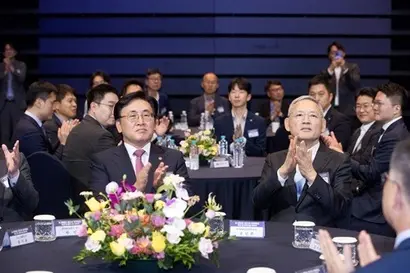
Delayed and Delayed: Sub-fund Formation Pushed to Next Year
According to the announcement in March this year, the "K-Content and Media Strategic Fund" was scheduled to select a master fund manager in April and finalize the master fund within June. This strategic fund is being created in response to the crisis faced by the industry due to skyrocketing production costs and intensified competition for intellectual property (IP). It is being pushed forward as part of the mid-to-long-term plan of the Media and Content Industry Convergence Development Committee (Convergence Committee), an advisory body under the Prime Minister. Unlike the Fund of Funds, which is limited to investments in small and medium-sized venture enterprises, this fund has no investment restrictions, allowing it to focus on large-scale content based on intellectual property (IP).
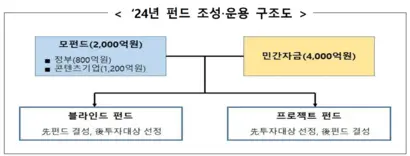
The goal is to secure a total of 1.02 trillion won by 2028, starting with the creation of 600 billion won this year (200 billion won in master fund + 400 billion won in private capital). The Ministry of Science and ICT (35 billion won) and the Ministry of Culture, Sports and Tourism (45 billion won), which are co-sponsoring the strategic fund, will invest in the master fund, while the remaining 120 billion won is planned to be raised from private content companies.
However, as most of the schedule has been delayed since the master fund manager was finalized last April, it appears difficult to raise the 600 billion won this year, including private capital. According to relevant ministries, the finalization of the 200 billion won master fund and the completion of its operational plans are currently underway. This is delayed not only from the original plan to form the master fund within the first half of the year but also from the schedule disclosed at the institutional MOU ceremony early last month. The formation of sub-funds, which can only begin after the master fund is finalized, has also been pushed back; it is now expected to begin with announcements next month and be carried out in the first half of next year.
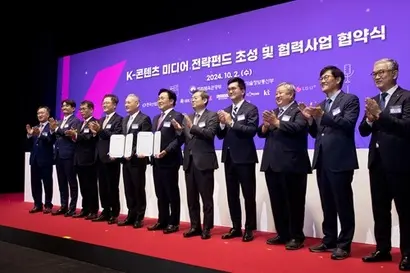
Previously, on the 2nd of last month, the Ministry of Culture, Sports and Tourism and the Ministry of Science and ICT signed an MOU for the creation of the strategic fund and cooperative projects. A total of 11 organizations are participating, including policy financial institutions like the Korea Development Bank and the Industrial Bank of Korea024110, as well as six content/media companies including CJ ENM035760, KBS, the JoongAng Group consortium (SLL), KT030200, SK Broadband, and LG Uplus032640, along with Korea Growth Investment Corp.
A Ministry of Culture, Sports and Tourism official explained, "Since the signing of the agreement, internal corporate procedures such as board approvals are taking longer than expected. The announcement for the selection of sub-fund managers will take place this year," adding, "The formation of each sub-fund is planned for the first half of next year."
Convergence Committee Stagnates: Can the 5-Year Plan Succeed Without Incentives?
As the supply of policy funds—which was intended to be a lifeline for the content industry—is delayed, voices expressing concern over whether the Convergence Committee's five-year long-term vision can be realized are growing. The Convergence Committee was launched in April last year to serve as a media control tower encompassing the Ministry of Science and ICT, the Ministry of Culture, Sports and Tourism, and the Korea Communications Commission, but its activities have effectively come to a halt since the announcement of development plans last March. Very few of the committee's plans have been implemented due to the Korea Communications Commission's dysfunctional operations and political disputes.
There are also doubts about whether the capital will be raised as targeted when the beneficiaries of the investment are not clearly defined. Hwang Geun, a professor of Media and Communication at Sunmoon University, pointed out, "There is no reason for the companies participating in the creation of the strategic fund to do so voluntarily. Telecommunications companies are not active in content investment. In the case of banks, it is not a large scale compared to their other businesses, and they are only following along because there is a government policy, but there are no fundamental business incentives." He added, "The reason why the BBC in the UK or public broadcasters in Germany can operate studios like Netflix is because they include equity sharing, not just one-off investments."
Professor Hwang emphasized, "Managing the secured funds is also likely to end up being just a formality. Content business success is hard to guarantee. You have to concentrate resources where they will work; simply supporting individual works or programs with fund capital makes it difficult to achieve policy effectiveness."
A Ministry of Culture, Sports and Tourism official responded, "The strategic fund plan involves the government first creating the master fund, which then invests in sub-funds to raise capital. We have secured the master fund, and as the formation of sub-fund capital has not yet begun in earnest, it is not a situation where there are setbacks in raising the investment capital."