

[비즈한국] With reports that the Army’s second large attack helicopter project is likely to be scrapped, the "uselessness of helicopters" debate is gaining traction. As expensive helicopters have been helplessly shot down by low-cost drones in the Russia-Ukraine war, future helicopter-related projects are also expected to be affected.
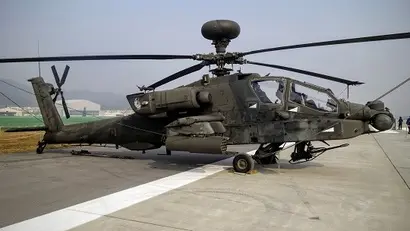
The Ministry of National Defense and the Defense Acquisition Program Administration (DAPA) are reportedly leaning toward scrapping the project as the procurement costs for the second large attack helicopter project have significantly exceeded initial estimates, leading to a re-evaluation. The project has been put on hold, and a final decision is expected to be made at the 165th Defense Acquisition Program Committee meeting scheduled for the 16th of next month.
The Army’s second large attack helicopter project was intended to support the ground forces' offensive "deep-strike maneuver operations." It aimed to acquire additional large attack helicopters via foreign procurement to conduct strategic and tactical operations, such as penetrating deep into enemy territory in the shortest possible time, occupying key areas, and annihilating core units.
In November 2022, during the 147th Defense Acquisition Program Committee, DAPA deliberated and approved the "revised basic strategy and procurement plan for the second large attack helicopter project." The project was slated for 2023–2028 with a total budget of 3.3 trillion KRW for 36 large attack helicopters. The Army currently possesses 36 Apache helicopters. Through the first project conducted from 2012 to 2021, 36 AH-64E Apache Guardian helicopters were introduced and made operational at a cost of approximately 1.9 trillion KRW.
Like the first project, Boeing's "AH-64E Apache" was the presumed choice. The problem is the recent sharp rise in U.S. weapon import prices. DAPA had set a budget of 3.3 trillion KRW for the second project. However, following the U.S. State Department’s recent approval of a foreign military sale (FMS) to South Korea for Apache helicopters (AH-64E) and related equipment worth 4.6655 trillion KRW, the budget has already been exceeded by 1.3 trillion KRW. This would require an investment of over 2.8 trillion KRW more than the 1.9 trillion KRW spent on the first procurement.
Furthermore, the "uselessness of helicopters" narrative stemming from the Russia-Ukraine war is impacting domestic projects. There have been frequent instances where Russian attack helicopters, despite being equipped with the latest survival gear, were shot down by portable surface-to-air missiles costing around 10 million KRW. Footage has also surfaced showing a Russian Mi-28 attack helicopter crashing after being struck by a Ukrainian suicide drone. This marks the first time attack helicopters have fallen to drones in combat. Consequently, it is estimated that the Russian military has lost over 300 helicopters since the start of the war.
Following this global trend, helicopter projects around the world are being canceled one after another. The U.S. has canceled its Future Attack Reconnaissance Aircraft program, and the Japan Self-Defense Forces have also halted further introductions. In Australia, there are growing calls to reconsider the acquisition of Apache helicopters.
As a result, warning lights are flashing for the large special operation helicopter project, as well as the UH-60 performance improvement project being prepared by Korea Aerospace Industries (KAI)047810 and Korean Air003490. It also appears likely to have a negative impact on the light armed helicopter project currently being readied for mass production by KAI.
Skepticism regarding attack helicopters is also emerging within military circles. A military official explained, "The price and maintenance costs of helicopters are becoming increasingly expensive. It is questionable whether purchasing helicopters with this budget is the right move. If a helicopter’s effectiveness and price competitiveness cannot be secured, it becomes useless. It might be a better approach to improve the performance of cheaper drones to significantly enhance our military's combat capability."
There are also suggestions that the military must quickly prepare for manned-unmanned teaming (MUM-T) to ensure helicopter survivability. Kim Min-seok, a member of the Korea Defense and Security Forum, stated, "Drones can carry heavy payloads. While their short operational duration is a drawback, their cost-effectiveness is excellent. We need to consider ways to combine helicopters with drones."