

[비즈한국] Even as the business closure rate for self-employed individuals hits a record high, interest from new entrepreneurs in low-cost coffee franchises remains unabated. While these franchises promote that they maintain a closure rate of less than 1% even in a recession, the significant annual increase in store ownership transfers is worth a closer look.
Behind the scenes: Active store transfers
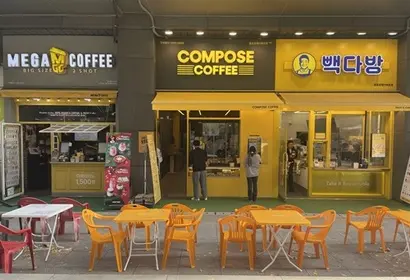
One of the most eye-catching aspects of the promotional materials for Compose Coffee, a leading low-cost coffee brand, is its low closure rate. Compose Coffee actively recruits new franchisees by highlighting that its closure rate remains very low, at under 1%. As of 2023, 15 out of 2,360 total Compose Coffee franchises terminated their contracts, resulting in a closure rate of 0.63%. Contract termination refers to ending a contract early by mutual agreement with the headquarters within the franchise term. Typically, a penalty is charged upon such termination.
Although the number of terminated stores is less than 1%, the number of franchise owners who gave up running Compose Coffee stores is not insignificant. The number of store ownership transfers for Compose Coffee last year reached 338. A transfer of ownership refers to a case where the right to operate a franchise is sold to another person, meaning that 14.3% of all franchisees handed over their stores to someone else last year alone. The number of ownership transfers for Compose Coffee has been increasing significantly every year. The number of transfers, which was 79 in 2020, rose to 133 in 2021 and 225 in 2022.
Industry experts do not view the increase in ownership transfers as a positive sign. This is because these are instances where existing franchisees have given up operating the brand. There have been continuous suggestions that ownership transfers should be included when calculating the closure rate. One coffee industry worker said, "Prospective entrepreneurs start low-cost coffee franchises with high expectations after seeing customers lined up in front of the stores. However, once they actually operate a store, they often realize that the profit is not significant compared to the time and labor invested. More and more people are failing to hold on for long and are putting their stores up for sale."
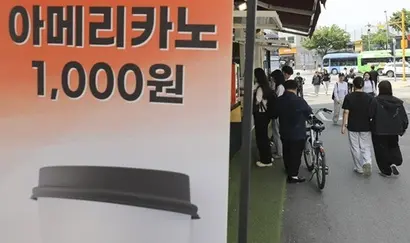
The situation is similar for the "Big 3" of low-cost coffee: Mega MGC Coffee and Paik's Coffee. Last year, the closure rates for Mega MGC Coffee and Paik's Coffee were 0.52% and 1.38%, respectively. For Mega MGC Coffee, 14 out of 2,681 stores terminated their contracts, while for Paik's Coffee, 20 out of 1,449 stores decided to terminate their contracts. On the other hand, the number of ownership transfers for both brands reached the triple digits. Last year, 333 Mega MGC Coffee stores underwent ownership transfers, and 108 Paik's Coffee franchisees changed.
Both Mega MGC Coffee and Paik's Coffee are seeing an annual increase in ownership transfers. For Mega MGC Coffee, the number of transfers rose from 101 in 2020 to 115 in 2021 and 246 in 2022. During the same period, Paik's Coffee saw increases to 55, 65, and 90, respectively.
A high number of ownership transfers means that while many franchisees are giving up their business, there are also many new entrepreneurs looking to start. An industry official said, "When operating a store, there are cases where owners give up due to personal circumstances. The low-cost coffee market has high demand for startups, so one can sell the store and receive a premium (known as 'gwonli-geum'). Since there is a possibility of recouping the investment, new entrepreneurs continue to enter the market."
Kang Seong-min, Chairman of the Korea Franchise Consultant Association, said, "In stagnant industries or markets, ownership transfers do not happen easily. A very low number of transfers can also mean that there is no demand for new businesses. Therefore, the fact that there are many ownership transfers in low-cost coffee franchises means there are still many small business owners hoping to start a low-cost coffee business." He added, "However, it is necessary to be wary if the number of transfers is too high."
Average operating period: Compose shortest at 1 year and 6 months
Industry insiders cite the average operating period of a franchise as one of the items that should be carefully checked before starting a business. The average operating period refers to how long a franchise location lasts on average. If the average is 100 days, it means that the franchise stores typically close after 100 days of operation. Kang Seong-min, Chairman of the Korea Franchise Consultant Association, said, "Checking the average operating period is very important. A short average operating period means that the franchise stores do not last long. Prospective entrepreneurs definitely need to check this."
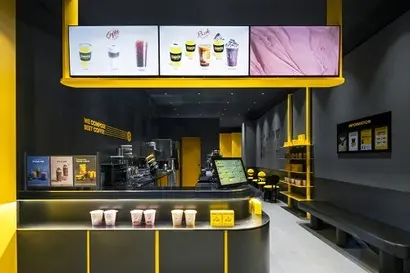
A review of the disclosure documents for low-cost coffee brands published by the Fair Trade Commission (as of 2023, or 2022 if the 2023 document was not released) shows that among the "Big 3," Compose Coffee has the shortest average operating period. The average operating period for a Compose Coffee store is 535 days (2022 data). Mega MGC Coffee is 888 days (2022) and Paik's Coffee is 1,142 days (2023). Even compared to other low-cost brands, Compose Coffee's average is on the short side. For instance, The Venti recorded 976 days (2022) and Mammoth Express recorded 749 days (2023).
A Compose Coffee official explained, "Due to the persistent economic downturn, there is significant volatility across the entire startup market. It is analyzed as a general industry trend that various variables arise, such as entrepreneurs who take on the challenge of low-cost coffee franchises—which have relatively low entry barriers—changing their business types within 2 to 3 years. Compose Coffee plans to continuously strengthen communication and support to coexist with our franchise owners even in difficult situations."
Critics continue to point out that the low-cost coffee market is already saturated. Competing within narrow alleyway commercial districts is the norm, and cases where multiple low-cost coffee brands are located side-by-side in a single commercial building are increasing. An industry official said, "It is impossible to find a commercial district in South Korea that is free of competitors. Now, competition between companies is taken for granted, and it is time to contemplate strategies on how to secure a foothold in that area and generate more revenue than competitors."