

[비즈한국] Sometimes, companies accumulate technology in one field and then expand into other areas that require similar expertise. A prime example is the Japanese company Yamaha, which has gradually broadened its horizons from musical instruments to vehicles. While not on the same scale as Yamaha, the recently introduced Writech knock fountain pen follows a similar basic trajectory in that it is a fountain pen made by a cosmetics brand.
Clika, a cosmetics brand under Fairgreen, develops one-touch cosmetics cases and manufactures and sells products like eyeliners, eyebrow pencils, and makeup brushes that utilize this technology. The hallmark of these cases is that the user can extend and retract the head with one hand by operating a button connected to the cap. Once finished, the cap seals tightly, preventing the contents from drying out or leaking. Since the cap is integrated, there is no risk of losing it.
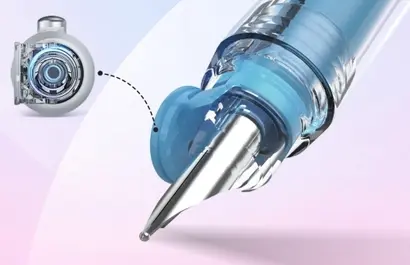
Interestingly, there is a product unrelated to cosmetics that shares a similar operating principle: the knock-type fountain pen, first introduced by Japan’s Pilot under the name "Capless." Conventional fountain pens, regardless of size, require a separate cap to protect the nib. While this cap is functionally sufficient, it must be removed with both hands and takes time. Capless pioneered a new genre of "knock-type fountain pens," allowing users to operate a fountain pen as easily as a ballpoint pen by incorporating a sealed shutter linked to the knock mechanism. If the internal mechanism of the Clika one-touch auto-cap case were replaced with a nib, feed, and ink cartridge, it would essentially become a knock-type fountain pen. The brand name, which combines "Write" and "Tech," hints at the nature of this niche lineup that emphasizes airtight case technology.
The Writech knock fountain pen is a fresh attempt in the fountain pen market, which is a competitive arena for professional writing instrument companies, but it is not without room for improvement. The shutter, which pushes forward alongside the knock, can get in the way during writing and is aesthetically unappealing. Most leading products in the knock-type fountain pen market, such as the Pilot Capless and Platinum Curidas, feature shutters that open and close inside the barrel, making them invisible unless one looks closely. Since cosmetics are primarily about looking at one’s face rather than the tool itself, the direction of the shutter opening may not matter much, but for fountain pens, users are constantly looking at the tip of the pen; therefore, a protruding shutter is a definitive design flaw.
The lack of expertise regarding fountain pens is also evident in the position of the clip. In typical knock-type fountain pens, the clip is located on the grip section where the hand rests. The reason it is placed there, despite being potentially uncomfortable to hold, is to ensure the nib faces upward when clipped to a pocket, preventing any potential ink leaks. It is standard practice to keep the nib facing up when storing a fountain pen upright. However, the clip on the Writech knock fountain pen is located opposite the grip, just like a ballpoint or mechanical pencil, which means the nib faces downward when clipped. Further study of existing knock-type fountain pen designs is needed.
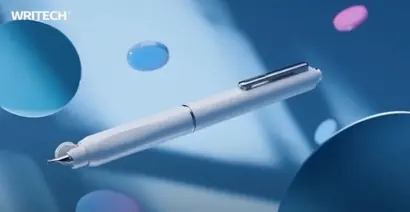
The Writech knock fountain pen is sold in plastic packaging that lacks a premium feel. This may be an obvious choice given its low price point. However, could they not showcase the story of it being developed by a cosmetics brand through paper packaging similar to that used for cosmetics? If improving the current model is difficult, developing a separate high-end model is another option.
Today, fountain pens are embraced not just for their daily utility, but as part of a more specialized hobby. It is more advantageous to emphasize their emotional value rather than just their function as a tool. The Writech knock fountain pen, born from the cross-pollination of two industries, possesses the emotional potential to gain significant attention depending on how it is marketed. Whether this fountain pen ends up as just another mediocre product or becomes a distinct alternative depends on the maker's continued dedication.
Who is the author, Han Dong-hoon?
A typeface designer. He is interested in all areas related to letters, including writing, calligraphy, designing typefaces, and teaching. He currently designs various corporate custom fonts and retail fonts at the typeface studio AlignType. He has contributed to publications such as 'Monthly Design' and the quarterly 'Design Review,' and gives lectures on typeface design on various online and offline platforms. In 2021, he published the essay collection 'The Universe in Letters.'