

[비즈한국] The relationship between the total money supply (total liquidity, M2) and the total housing market capitalization is a crucial factor in understanding the core principles of the real estate market. The money supply exerts a powerful influence on asset prices throughout the economy, and this effect is particularly prominent in the real estate market. This is why we must analyze the impact of total money supply growth on total housing market capitalization to gain perspective on the past and present of the real estate market and identify future investment opportunities.
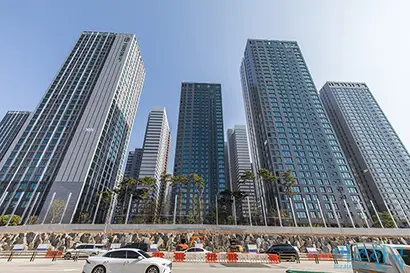
First, let’s define the concepts of total money supply (M2) and total housing market capitalization.
Total housing market capitalization is the sum of all housing assets calculated at their current market value. It is determined by individual housing prices and the supply volume, and it is significantly influenced by the total money supply.
Total money supply (M2) is the sum of liquidity, including cash in circulation, demand deposits, and time deposits within the economy. It grows steadily in accordance with central bank monetary policies, economic growth rates, and inflation.
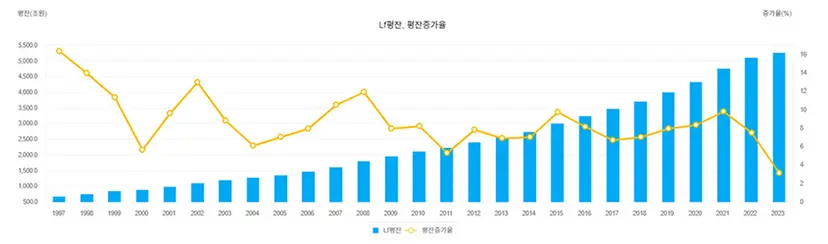
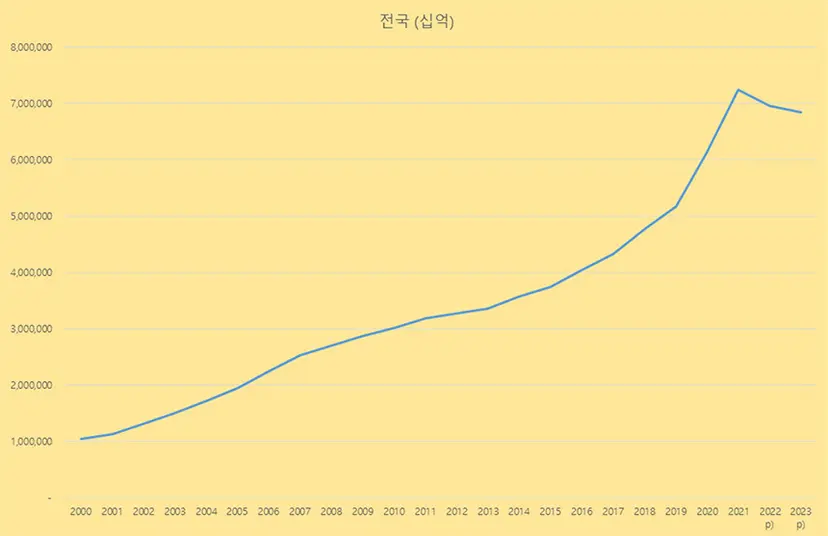
Let's analyze the correlation between total money supply and total housing market capitalization.
The total money supply and total housing market capitalization show a strong positive correlation. This is because housing is a representative real asset that absorbs liquidity. This means there is a relationship between increased liquidity and rising asset prices. When the money supply increases, more capital flows into the market, driving up the prices of investable assets (real estate, stocks, etc.). This is not only because it increases the purchasing power of homebuyers, but also because it triggers investment demand from those anticipating asset value appreciation.
A decline in currency value (inflation) and a rise in the price of real assets are also related. An increase in money supply triggers a decline in the value of money (inflation), meaning that the value of real assets like housing remains unaffected by, or even increases with, the decline in currency value. In other words, as the value of money decreases, more money is required to purchase the same real asset, causing the total housing market capitalization to rise.
The interaction between interest rates and liquidity must also be considered. When interest rates are low, an increase in money supply further boosts housing purchasing power. Low loan interest rates accelerate the inflow of liquidity into the housing market, increasing market capitalization. Conversely, when interest rates are high, the effectiveness of liquidity increases is reduced, but the absolute increase in money supply still triggers asset price appreciation in the long term.
Let’s look at examples from the history of South Korean real estate.
Following the 2008 global financial crisis, the Bank of Korea's monetary easing policy and the quantitative easing by global central banks triggered an increase in the money supply. As a result, South Korea’s total housing market capitalization rose steadily, reaching approximately 5,000 trillion won in 2020.
After the 2020 pandemic, despite concerns about a bubble in the housing market due to low interest rates and massive liquidity supply, the rise in total housing market capitalization driven by the increase in money supply did not stop.
Despite the current interest rate hikes, the money supply remains at a high level, and as a result, total housing market capitalization is recording historically high levels.
Let’s summarize the implications of the total money supply and total housing market capitalization.
Real estate is the final destination for liquidity. As the money supply increases, more funds flow into asset markets, and real estate becomes established as a representative investment vehicle that provides safe and stable returns. This phenomenon is more pronounced in countries like South Korea, which has a stable economic structure, rather than in emerging economies.
There is a reason why the money supply has never decreased. Central banks have consistently increased the money supply for economic growth and financial stability. This is one of the fundamental reasons why total housing market capitalization is bound to rise in the long term.
Ultimately, we must consider "asset parking" from an investment perspective.
The rise in asset prices due to the increase in total money supply shows that real estate is a long-term asset parking vehicle that transcends short-term volatility. In particular, during periods when the money supply is increasing rapidly, real estate is one of the asset classes that benefits the most.
With this, we can forecast the 2025 real estate market from the perspective of total money supply.
First is the stabilization of interest rates. From 2025, it is highly likely that the interest rate hike cycle will conclude and global monetary easing movements will resume. This creates an environment that can re-accelerate the rise in total housing market capitalization along with an increase in money supply.
Second is the revitalization of maintenance projects such as reconstruction, redevelopment, and remodeling. When the money supply flows into the housing market, the biggest beneficiaries are areas undergoing maintenance projects that can resolve supply shortages.
Finally, there is the factor of urban expansion. Along with transport advantages in the metropolitan area (such as the GTX), investment funds driven by the increase in money supply are highly likely to flow into suburban areas as well.
With this, the investment strategy for 2025 naturally falls into place.
These are the points to consider for long-term investment. The relationship between the increase in total money supply and total housing market capitalization becomes clearer over time. One should invest with a view toward long-term growth potential without fearing short-term adjustments.
Focus on location-based investments. The liquidity effect does not act uniformly across all regions. One must concentrate on areas supported by infrastructure and demand, especially core locations in the metropolitan area or areas with upcoming transportation improvements.
Take an interest in investments in maintenance projects such as reconstruction, redevelopment, and remodeling. This is because maintenance projects have the highest potential to yield capital gains due to the increase in money supply. It is necessary to invest only after carefully reviewing legal and institutional risks.
Also, pay attention to small-sized housing units and rental assets. Since rents tend to rise alongside an increase in money supply, investing in small-sized apartment units or assets that provide rental income can allow you to expect stable cash flow and asset value appreciation at the same time.
We have summarized that total money supply and total housing market capitalization have a close relationship, and the impact of money supply growth on the real estate market goes beyond simple price increases to affect the market structure itself. Past data confirms that the increase in money supply has continuously driven up total housing market capitalization, which explains why real estate is an attractive asset class from a long-term investment perspective.
It is highly likely that 2025 will be an important turning point for the real estate market as money supply growth, interest rate stabilization, and the revitalization of reconstruction and redevelopment align. Investors should not be swayed by short-term volatility, but should instead utilize real estate as an asset parking vehicle from a long-term perspective to aim for stable and high returns. This is because it will serve as an active asset growth strategy in the era of inflation, going beyond simple asset preservation.
Kim Hak-ryeol, director of the Smart Tube Real Estate Research Institute, well-known by his pen name "Pasyong," previously served as the team leader of the Real Estate Research Division at Gallup Korea. He operates and hosts the Naver blog "Pasyong’s World Exploration" and the YouTube channel "StueTV." His books include "Absolute Principles of Seoul Real Estate (2023)," "The Future of Incheon Real Estate (2022)," "Kim Hak-ryeol’s Absolute Principles of Real Estate Investment (2022)," "Future Map of South Korea Real Estate (2021)," "Only Places That Will Rise Will Rise from Now On (2020)," and "South Korea Real Estate User Manual (2020)."