

[비즈한국] Since taking office, the Yoon Suk Yeol administration has criticized the fiscal spending policies of the previous government, declaring that it would pursue private-led rather than government-led economic growth. It also signaled its intention to focus on targeted welfare rather than universal welfare to address the fiscal strain caused by excessive spending, while emphasizing a commitment to strengthening national defense.
However, looking at the distribution of the budget by sector since the launch of the Yoon administration, questions arise as to whether these policies are being properly implemented. The previous conservative Lee Myung-bak administration stayed true to its ideological leanings by expanding investment in social overhead capital (SOC) and increasing defense spending; the Park Geun-hye administration also prioritized defense, public order, and safety budgets. Meanwhile, the progressive Moon Jae-in administration, as the Yoon government pointed out, increased the budget share for health, welfare, and labor while lowering the share for national defense.
In contrast, under the Yoon Suk Yeol administration, and contrary to its early promises, the budget shares for industry, SMEs, energy, research and development (R&D), and national defense have consistently declined. Conversely, the share of the budget for health, welfare, and labor, which seemed to decrease at the beginning of the term, quietly rose again this year. Critics point out that this inconsistent policy-making, characterized by budget allocations that differ from its initial promises, does not lighten the burden on future generations—which President Yoon has frequently emphasized—but may actually increase it.
From his time as president-elect, President Yoon stated he would transform the nation's economic structure into one led by the private sector. To this end, he promised deregulation, tax benefits, and financial support for SMEs, and unveiled investment plans to strengthen the competitiveness of high-tech industries. It was a promise to pave the way for businesses to grow. Regarding welfare policy, he aimed at the policies of opposition parties, including the Moon Jae-in administration, stating, "There will be no indiscriminate cash handouts," and "We will provide thick, robust support starting from the most vulnerable groups." As a conservative government, he also pledged to increase defense spending.
However, the actual budget expenditure under the Yoon administration raises doubts about whether spending is moving in this intended direction. According to the Ministry of Economy and Finance, in the budget breakdown across 12 sectors, the shares for industry, SMEs, energy, and R&D have been on a downward trend under the Yoon government. Spending on industry, SMEs, and energy accounted for 4.7% of the total budget in 2021, effectively the last year of the Moon Jae-in administration, but fell to 4.5% in 2022 when the Yoon administration took office, and dropped further to 3.9% in 2023.
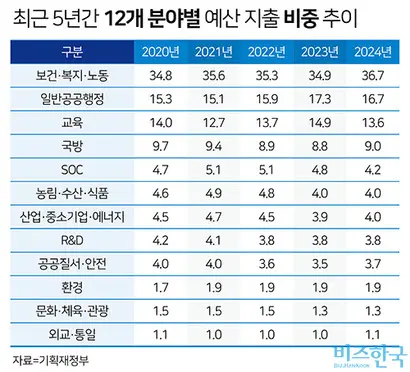
The fact that the budget share for industry, SMEs, and energy fell into the 3% range was a first since relevant statistics began in 2010. This year, it remained at a mere 4.0%, a slight increase. The R&D budget share also fell into the 3% range for the first time in 2022 (3.8%) under the Yoon administration and has remained at 3.8% for three consecutive years through this year.
In contrast, the share of expenditure in the health, welfare, and labor sectors has expanded even more than under the Moon Jae-in administration. In 2021, the last year of the Moon administration, the share for health, welfare, and labor rose to 35.6%, then decreased to 35.3% in 2022 after the Yoon government took office, and dipped to 34.9% in 2023. However, this year, the share for these sectors jumped to 36.7%, reaching an all-time high. The defense spending share has also decreased. The Moon Jae-in administration reduced the defense spending share from 10.0% in 2017 to 9.4% in 2021. Yet, under the Yoon administration, this share fell to 8.9% in 2022 and further to 8.8% in 2023. Although it rose to 9.0% this year, considering the costs allocated for raising the salaries of enlisted soldiers, the claim of "strengthening national defense" rings hollow.
In particular, these trends in expenditure share by sector differ from previous governments that utilized their budgets in line with their governing philosophies. During 2010, in the mid-term of former President Lee Myung-bak, who had a background at Hyundai Engineering & Construction, the SOC expenditure share reached 8.5%. The defense expenditure share also remained at 10.1% for three consecutive years from 2010 to 2012. Even under the conservative Park Geun-hye administration, the defense expenditure share remained at 10.0% throughout the term, with the exception of 2015 (9.9%). Conversely, the Moon Jae-in administration lowered the defense spending share, instead increasing the share for health, welfare, and labor from 32.0% in 2017 to 35.6% by 2021.