

[비즈한국] The Gaepo Gyeongnam, Usung 3rd, and Hyundai 1st (Gyeong-U-Hyeon) apartments, considered major reconstruction targets in Seoul's Gangnam district, are holding an information session regarding integrated reconstruction, which involves consolidating the three complexes for redevelopment. Since agreeing to the integrated reconstruction in November 2018, the complex has failed to reach the designation of a maintenance zone—the first step in the project—due to an inability to reconcile the conflicting interests of each complex. Why are aging reconstruction complexes attempting to integrate with adjacent complexes? BizHankook examined the trends of integrated reconstruction in Seoul.
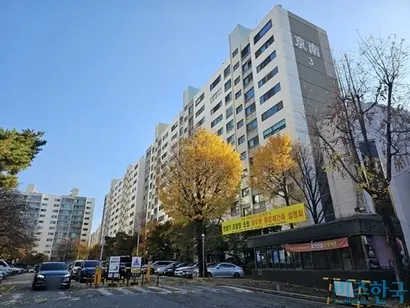
6th Year of Pushing for Integrated Reconstruction: Gyeong-U-Hyeon Holds Information Session
According to the urban planning industry, the rapid integrated reconstruction promotion committee for Gyeongnam, Usung 3rd, and Hyundai 1st (Gyeong-U-Hyeon) in Gaepo-dong, Gangnam-gu, Seoul, will hold an emergency information session regarding the integrated reconstruction on the 23rd. It is reported that Han Hyeong-gi, former vice-union head of One Bailey (and former union head of Acro River Park)—who successfully integrated five complexes including Sinbanpo 3rd, Gyeongnam, Sinbanpo 23rd, and Woojung Esher 1st and 2nd in Seocho-gu—will participate alongside residents from each complex.
Gyeong-U-Hyeon consists of the first private apartments in Gaepo-dong, all completed in 1984. Individually, the complexes are small, with 678 households in Gyeongnam, 405 in Usung 3rd, and 416 in Hyundai 1st, but combined, they reach a total of 1,499 households. Although residents agreed to the three-complex integrated reconstruction in November 2018, the project stalled before reaching the maintenance zone designation due to disputes over estimated contribution costs during the development of the maintenance plan.
The Gyeong-U-Hyeon Rapid Integrated Reconstruction Promotion Committee stated, "We will present the problems and solutions for the Gyeong-U-Hyeon integrated reconstruction, which has been stagnant for six years and is on the verge of collapse due to serious infighting following the disclosure of estimated contribution costs."
"Increasing Project Feasibility for Large Complexes": The Momentum of Seoul's Integrated Reconstruction
Integrated reconstruction refers to a method of redevelopment that groups multiple housing complexes together. Since the production scale becomes larger than when redeveloping individual complexes, it offers the benefit of reduced costs—a so-called "economy of scale." During the reconstruction process, construction costs such as materials, equipment rental, and labor become cheaper due to bulk orders. After completion, more households share the costs for facilities and services within the complex, leading to lower management fees.
Recently, successful examples of integrated reconstruction have emerged one after another. Raemian Sinbanpo Riocent (475 households), which integrated Sinbanpo 18th and 24th in Seocho-gu, Seoul, became the first integrated reconstruction complex to be completed in June 2019. Subsequently, Raemian One Bailey (2,990 households), which integrated five complexes including Sinbanpo 3rd, Gyeongnam, Sinbanpo 23rd, and Woojung Esher 1st and 2nd, was completed in August last year, raising expectations for integrated reconstruction. In September, an 84㎡ unit in this complex traded for 6 billion won, setting a record high for a "national scale" apartment.
Integrated reconstruction complexes are expected to increase. Previously, the Dachi Usung 1st and Ssangyong 2nd apartments in Gangnam-gu, Seoul, which were pursuing separate reconstruction projects, agreed to an integrated reconstruction in September last year and submitted an amendment to the integrated maintenance plan for a total of 1,332 households in October. Maple Jai, which integrated Sinbanpo Hanshin 8th, 9th, 10th, 11th, and 17th, Nokwon Hanshin Apartments, and Benny House near Raemian One Bailey, is a 3,307-household project scheduled for completion in June next year.
A construction industry official explained, "Integrating complexes lowers construction costs through economies of scale. Restrictions like slanted building lines disappear, allowing for more construction, and some underground parking retaining walls or earth-retaining structures required by individual complexes become unnecessary. In a larger complex, one can diversify the design, landscaping, and the scale and type of community facilities. In short, project feasibility is increased."
"Differences in Location and Floor Area Ratio": The Key is Coordinating Interests Between Complexes
The key to integrated reconstruction is coordinating the interests of each complex. This is because every complex has slight differences in location and floor area ratio, which determine the feasibility of the reconstruction project. If the integrated complexes simply divide the reconstruction costs and profits arithmetically, fairness issues can arise. Previously, Sinbanpo 20th and Hanshin Town, which attempted integration south of Maple Jai, and Mokwha and Sambu, which pushed for integration in Yeongdeungpo-gu, Seoul, parted ways because they could not narrow these gaps. In the case of Gyeong-U-Hyeon, the floor area ratios for Gyeongnam 1st and 2nd show differences of 158% and 203%, respectively.
The independent settlement system is considered an effective way to coordinate interests between complexes. It refers to a reconstruction method where buildings within a single project area settle development profits and costs separately. It is also called an independent accounting system. Typically, this was used by commercial areas within apartment complexes to form internal committees and separate their costs and profits from the apartments, but recently, integrated reconstruction complexes like One Bailey have also adopted independent settlement systems for each complex to prevent disputes over differing interests.
"In-place reconstruction" is also a way to bridge the interests of different complexes. It is a method where, after reconstruction, the existing residents move into the same location where their original complexes were situated. Because residents often prefer specific locations, such as those near the Han River or subway stations, this method is frequently used to reduce conflict during the reconstruction process. Raemian Riocent and One Bailey, both successful cases of integrated reconstruction, used the in-place reconstruction method in a broad sense. For Gyeong-U-Hyeon, Gyeongnam is located closest to Dogok Station on Subway Line 3 and the Suin-Bundang Line, which are situated on the northern side.
Kim Je-kyung, head of Tumi Real Estate Consulting, said, "What is most important in integrated reconstruction is to reconcile the interests of individual complexes to elicit consent. During the project implementation process, technically perfect profit distribution can be difficult, and if a specific complex does not concede, there is a high possibility that integration will fall into trouble. There is no guarantee that the premiums of a large complex and the effects of cost savings will be realized for individual complexes."