

[비즈한국] Recently, an AI medical service launched by a startup became controversial after it was discovered that it had issued prescriptions by misappropriating the names of hospitals and medical staff. The company stated, "The service itself is not problematic because medical staff provide the final confirmation." Describing it as a form of "untact (non-face-to-face) treatment," we examined how far AI-based medical services have come by looking into each service.

The first company to introduce an "AI symptom checker" was BplusLab. BplusLab launched the application "Eodiapa" in November 2018. After logging in to the app and clicking the "Smart Symptom Checker" menu, the AI asks about symptoms, onset cycle, affected area, duration, accompanying symptoms, previously diagnosed diseases, medications currently being taken, and what relieves the pain, then suggests three probable conditions. A notice at the top states: "This is not a diagnosis of disease, but a list of diseases with similar symptoms; please be sure to visit a medical institution for consultation."
According to BplusLab, its AI symptom checker algorithm consists of 230 main symptoms and predicts about 1,800 diseases. However, the service is unavailable if there is no questionnaire corresponding to the age, gender, and symptoms of the patient seeking consultation. When this reporter entered "headache" as a symptom, a notification appeared saying there was no questionnaire matching the gender and age, prompting a "Search Again" action. Furthermore, completing the smart symptom check did not lead directly to an appointment, requiring the user to apply for a "consultation request" separately. BplusLab is currently building a service that links AI symptom check records to Electronic Medical Records (EMR).
The application "Symptomi" is an AI medical service launched by Mediark last November. Like other services, if you answer questions including symptoms, medical history, and pain intensity, the AI provides analysis results. Upon completing the check, you can immediately send a questionnaire containing symptoms, cycles, and past history to the hospital. At the bottom, you can find nearby hospitals related to the condition. Symptoms are organized quite concretely based on the Q&A. For instance, in the case of abdominal pain, the result might be: "The patient feels pain around the navel, with stabbing sensations and rebound tenderness. Also, the pain worsens when the area is pressed by hand, and the pain intensity is VAS (Visual Analog Scale) 4-5."
Symptomi is differentiated by its multilingual translation capability. While it supported four languages at launch, the current service is available in 13 languages, including English, Chinese (Simplified/Traditional), Japanese, Spanish, French, Russian, Arabic, Vietnamese, Urdu, Nepali, and Mongolian. Symptomi was recently selected as an excellent project at the "Local Government Foreign Resident Support Best Practices Competition." "Eodiapa" and "Symptomi" obtained the international medical device quality management system "ISO 13485 certification" in 2021 and 2023, respectively.
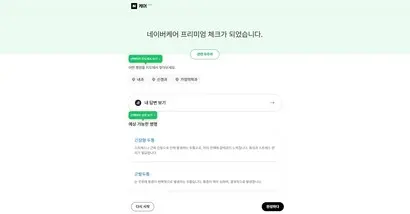
The Naver Healthcare Research Institute recently launched the "Naver Care" beta service. As with other services, if you enter symptoms and onset cycles, the AI suggests the expected disease name. This is the first AI medical service the research institute has unveiled to the general public rather than just in-house employees. Previously, the institute operated "Naver Smart Survey" for the Naver in-house clinic, a method where patients enter symptoms and the AI predicts diseases to relay to medical staff. The current "Naver Care" service does not include features like EMR automatic recording that were provided by the "Smart Survey."
You can use it by searching for "Naver Care" in the Naver search window. Naver introduces the service as an "online symptom service that helps find the expected disease and nearby hospitals when you enter painful areas or symptoms." Users can access the service after entering age and gender. The final screen notifies users: "This service provides information on related diseases based on the information entered and identifies relevant medical institutions. The information presented is provided for reference regarding potential possibilities and is not intended for medical advice, diagnosis, treatment, or prevention."