

[비즈한국] The domestic content market is currently at a critical crossroads. While it experienced rapid growth due to a surge in demand during the COVID-19 pandemic, it is now facing challenges from a global economic downturn and intensified competition. Developing differentiated content and expanding into new export markets are considered common tasks for the industry. The ‘Content IP (Intellectual Property) Market,’ held for the third time this year, is Asia’s largest IP business event, organized to facilitate meetings between companies for the expansion of secondary businesses utilizing source IPs such as webtoons, web novels, and characters. This year, attention from emerging markets like Europe and Southeast Asia, as well as the participation of diverse industry sectors like theme parks, stood out.
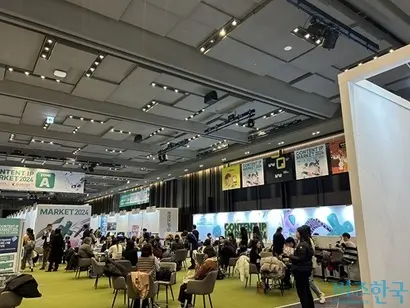
A Marketplace for Secondary Sales: Turning Novels into ‘Animations’ and Web Novels into ‘Movies’
“Due to the nature of the market, many are looking for licensing agreements or collaboration partners. I felt that there were plenty of opportunities because many large companies visited. There were even writers who came to circulate their portfolios.” (A现场 representative from Pingo Entertainment)
Pingo Entertainment is the production company behind the TV series 3D animation ‘Shasha & Milo,’ which is gaining global recognition. Shasha & Milo is the story of a girl and a boy who can transform into humans, cats, and heroes, as they grow into true heroes. Before its domestic broadcast on EBS (in 2023), its airing was already confirmed by Tencent in China and Warner Bros. Discovery’s channels in South America. Gwangju-based content company Pingo is now focused on expanding its reach following exports to Canada and the UK.
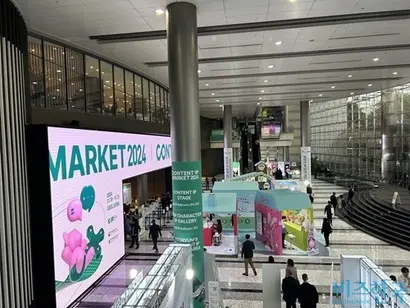
The Content IP Market, visited on the 20th, was buzzing with collaboration discussions between domestic and international content companies, platforms, distributors, and manufacturing-related businesses. Individual booths were set up in the large hall on the first floor for 1:1 meetings and consultations related to IP sales. The number of participating companies reached 90, an increase from about 70 last year. Participants included webtoon and comic production/distribution companies such as Kakao Entertainment, D&C Media263720, and Jaedam Media; animation firms like CarrieSoft317530 and SAMG Entertainment (Hatchuping); story-based companies like Daiwon C.I. and Munhakdongne; character creators like E-Land Inople; and publishers like Wisdom House. The event, held over three days from the 19th to the 21st at COEX in Gangnam-gu, Seoul, was hosted by the Ministry of Culture, Sports and Tourism and organized by the Korea Creative Content Agency (KOCCA).
Recently, as domestic literature is being newly highlighted as verified IP, the adaptation of novels into visual media is drawing attention, such as the already filmed novels ‘Because I Hate Korea’ and ‘Love in the Big City,’ or the ongoing production of ‘Pagwa.’ Officials from Japanese production companies visited the Munhak-Segyesa publisher booth for consultations. An official from Munhak-Segyesa stated, “There were buyers interested in visual adaptations, including businesses that own their own overseas distribution platforms. We also held discussions with a Japanese production company regarding manga and animation adaptations,” adding that “other publishers even suggested turning our works into webtoons.”
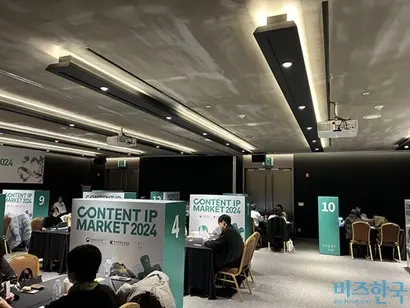
Individual business meetings for web novel writers took place at booths on the second floor. A field official explained, “We placed visually appealing content like webtoons, animations, and characters on the first floor, while dedicating a separate space for stories (web novels) that need to win through their narratives.” Writers who won awards at the KOCCA open competition met directly with companies for publishing or distribution, while writers who met production companies through KOCCA’s own distribution platform, ‘Storyum,’ held discussions with buyers to develop their works into movies or dramas.
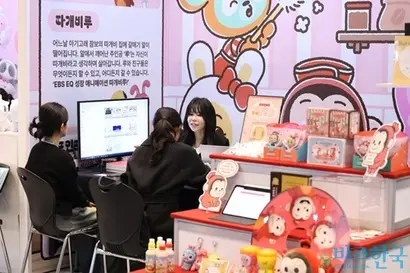
‘15-Year Veterans’ Cocomong and Taggy-B-Roo Re-emerge with Tailored Marketing
E-Land Inople, which manages the ‘Cocomong’ IP, is considered one of the most successful companies at this market. Buyers from Russia, Spain, and Indonesia showed interest and are discussing collaborations. Cocomong is a "cash cow" IP that has maintained popularity since its debut in ‘Cocomong of Refrigerator Land.’ With the protagonist Cocomong—a red sausage—and his friends based on food found in a refrigerator, the IP has high educational utility, such as teaching healthy eating habits. Following last year’s market, E-Land Inople signed a contract with China’s major toy and character company, Dongfanglan, to handle Cocomong’s IP business in China. They are accelerating video viral efforts, such as uploading cartoons to Chinese social media channels starting last week in preparation for distribution next year. They are drawing significant attention from the general F&B industry, and on this day, they even received a proposal from an airline regarding in-flight products.
Amid the growing 'kidult' (kids + adult) culture, the preschool animation ‘Taggy-B-Roo’ is also receiving positive responses on social media. Taggy-B-Roo is an IP produced by Olive Studio in 2008, just like Cocomong. Olive Studio was acquired by the E-Land Group in 2010 and now manages the group’s IP business. The success of Cocomong and Taggy-B-Roo is attributed to flexible designs that follow current trends and viral marketing that reflects the characteristics of the content.
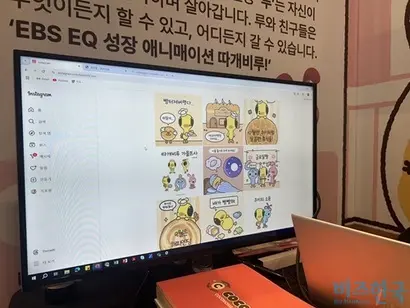
An E-Land Inople official explained, “The current trend is for old characters to be redesigned and regain popularity. Both characters have been redesigned to fit the current times, and a story about Cocomong becoming a college student is being serialized as an 'Instatoon' (Instagram webtoon). We plan everything from marketing to viral promotion strategies together with our partners. We focus on effectively applying the characters to products, resulting in high satisfaction for both buyers and consumers. Next year, we plan to showcase a recycled plastic ‘spoke guard’ (a protective cover for wheelchair spokes) produced with LG Chem. We are considering the positive influence we can have as educational content.”
The participation of the domestic theme park Lotte World also drew attention. Lotte World is recently pushing to expand its IP business. It was named among the 10 partner companies for this market, and Lotte World CEO Choi Hong-hoon stood on the opening ceremony stage as a keynote speaker.
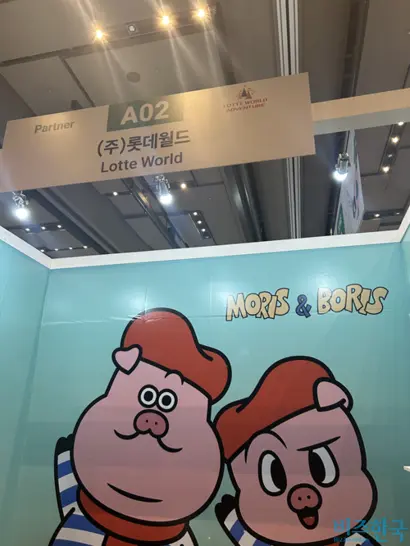
Beyond its own characters ‘Lotty’ and ‘Lorry,’ it also unveiled its new B-grade sensibility IP ‘Morris & Boris’ targeting the MZ generation. It is pursuing a two-track strategy that also involves collaborating with external content. Currently, for its global business, its educational YouTube channel for infants and toddlers, ‘Lotty Friends,’ which incorporates its own characters, is well-received. A Lotte World official stated, “We want to show that we are a company that excels in the character business even outside of the theme park. As the kids industry is on a downward trend domestically, we are considering expansion into Vietnam and Indonesia next year. We are planning to launch short-form content on Instagram for the story of Morris, the boss, and Boris, the part-timer. Much like how Universal Japan utilizes powerful IPs alongside its own, we will prioritize strong IPs for contracts inside the theme park and secure separate character capabilities for external endeavors.”
A KOCCA official said, “Meetings between production companies and buyers were held actively over the three days. As of the afternoon of the 21st, 668 people from 426 buyer companies had visited. It was noted that there was an approximately 47% increase in buyers from related industries such as food, fashion, sports, distribution, and manufacturing compared to the previous year.”