

[비즈한국] To summarize the gaming industry this year in one phrase: it has been "hit head-on by the backlash of the pandemic-era boom." NCSoft036570, the largest game company in Korea, is currently accepting voluntary resignations from over 500 employees. When combining official layoffs at companies like Netmarble251270 F&C, Com2uS078340, Devsisters194480, and CookApps, with companies like Nexon that have decided to cancel game projects or shut down studios, the number of affected entities reaches double digits.
It would not be an exaggeration to say that the recession in the Korean gaming industry in 2024 is the "coldest wind" it has faced since 2012. Furthermore, this slump is exacerbated by a grim situation where the massive investments poured into the gaming industry during the COVID-19 era are being pulled back, and as users grow weary of the "mobile MMORPG obsession"—a chronic characteristic of Korean games—both capital and market size are shrinking simultaneously.
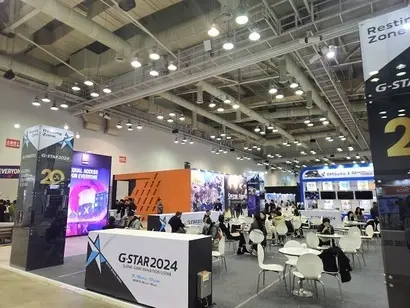
Under these circumstances, G-STAR 2024, Korea's largest comprehensive game show celebrating its 20th anniversary, successfully attracted a large number of visitors again this year, seemingly attempting to overcome the industry downturn through massive booths and events. However, the overall event content and the exhibitions and events for each company’s new titles were a mixture of expectation and concern.
First, let’s summarize the negative elements. Large game company booths, which are responsible for the success of G-STAR and play a significant role in determining its operation and scale, were successful in attracting crowds again this year, but there were unsettling factors.
For example, Pearl Abyss263750, which is developing "Crimson Desert" and challenging the console game market—currently attracting attention as a new market in the Korean gaming industry—unveiled the first gameplay demonstration of Crimson Desert at their largest booth ever. While numerous visitors waited over 3 hours to play, the evaluations were sharply divided, leaving the game as a "love-it-or-hate-it" title.
The reason for this was the difficulty level. Despite Pearl Abyss showing a 20-minute video explaining the worldview and controls to users before the demonstration, the controls using a game controller and keyboard were excessively complex, meaning only a few users could play the demo version properly. Additionally, despite being developed as an open-world game that implements a vast world without loading, they only presented a so-called "G-STAR build," which featured battles against three types of boss monsters rather than showcasing the open world, leaving many disappointed.
Another major booth, "Lionheart Studio," a subsidiary of Kakao Games, set up a massive booth and revealed four new games in development. However, for "Valhalla Survivor," the only game available for actual hands-on play, while there were favorable comments regarding its fun factor, it was a very simple mobile game that mimicked the gameplay style and composition of the indie game "Vampire Survivors," which was created by a one-man developer and gained immense popularity after its release in 2022. Consequently, it failed to leave a strong impression on users expecting blockbuster titles.
On the other hand, there were companies that proved their gameplay quality, received favorable reviews on-site, and garnered positive reactions regarding the gaming experience. In the case of "inZOI," a life simulation game presented by Krafton, they showcased a version where life content was added to the character creation feature revealed this past August. It was well-received by users for implementing many key elements of a life simulation game—such as experiencing someone else's life by eating tteokbokki at a snack bar, strolling along a beach, or practicing the guitar or working in life zones modeled after actual cities like Samseong-dong in Gangnam, Seoul, or major cities in the U.S.
"Project Overkill," revealed for the first time by Nexon at this G-STAR, was also one of the large booths that received praise for its gameplay quality. Inheriting the worldview of "Dungeon & Fighter," which contributed to making Nexon the gaming empire it is today, Project Overkill successfully translated the feel of the 2D-graphics-based Dungeon & Fighter into 3D, well-capturing the unique sense of impact and the fun of combat.
Although Project Overkill did not feature revolutionary new technology or creative gameplay, it received much praise for implementing the gold standard of an action RPG with satisfying impact that users can enjoy. In fact, while I was playing, I witnessed a representative from a large Chinese game company watching my gameplay and asking questions, confirming that there is significant interest from domestic and international publishers as well as users.
Another possibility shown by Korean games at this G-STAR was the qualitative and quantitative growth of small and medium-sized game companies and indie games. Since before and after the pandemic, G-STAR has gradually increased the number of booths for indie games developed by individuals or small teams, not just large developers. At this year's G-STAR, many users visited and supported small indie games and startup games as well as the large corporate booths.
In particular, games that have been listed on Steam, a platform used by gamers worldwide, or are preparing to do so, presented even more developed versions at this G-STAR through user feedback received from previous closed tests and demo releases.
For example, in the case of "RIM: The Vessel of Souls" by the two-person developer IF Moon Games or "PMC Manager" by 5MIN Lab, one could feel the effort to find the core value of games—"fun"—by providing unique actions or gameplay not found in other games while maintaining the popularity of currently trending "Vampire-like action games" or "auto-battler simulation games."
Outside the venue, the unique actions of small developers also stood out. "Trickcal Revive," released by the small developer "Epid Games," is growing rapidly due to its recent practice of actively reflecting user feedback through various live broadcasts. At this G-STAR, instead of a traditional exhibition, the CEO and Vice CEO drove a game promotional vehicle, converted from a campaign truck, to meet users in person.
A spectacular scene unfolded where users approached the game company's leadership to request autographs and handshakes. At a time when users are protesting the non-communicative behavior of large game companies or conducting so-called "truck protests," a very rare phenomenon occurred where a small or medium-sized game company gained popularity by actively engaging with user feedback.
In the business world, while the phrase "crisis is an opportunity" is frequently used, it is true that the current Korean gaming industry is not hearing much hopeful news due to the sluggish performance of mobile MMORPGs, collective actions by users, and the simultaneous decline in investment and revenue.
However, since G-STAR this year showed not only the industry's recession but also the efforts of various entities pursuing the essence of games—fun—and striving for communication and mutual growth with users, which is a prerequisite for games as a service, I look forward to the industry building on these positive aspects shown at G-STAR so that the game market may find hope again next year.