

[비즈한국] There is a saying, "The value of 'together'." It appeared in a corporate image advertisement over a decade ago. It is a wonderful tagline that carries the meaning that the power of togetherness can change the world. Being together implies empathy or communication, and this power can create a new paradigm. Art also holds value when it gains empathy from people. Empathy comes from the zeitgeist and a universal language of art. The 'Korea Art Promotion Project' also aims to showcase the thoughts of various people through an accessible art language. As we reach Season 10, we support artists who strive to practice Confucius' idea that "good art must be easy to understand."
At the beginning of the 20th century, riddle-like paintings appeared. Europeans who saw these works were amazed, saying, "I didn't know it could be painted like this."
The person who instantly garnered attention in the Parisian art scene with such paintings was Giorgio de Chirico (1888-1978), who was born in Greece and debuted as a painter in Italy. Even the poet Guillaume Apollinaire, who was considered the spiritual pillar of the new art movement at the time, stepped forward to praise them as "metaphysical paintings."
Chirico's work occupies a place in Western art history under the name "Metaphysical Art." "Metaphysical Art," which emerged as a movement in 20th-century Western art history, refers to the works Chirico produced between 1911 and 1918. Why did Chirico's paintings receive such high acclaim?
After Impressionism, Western art realized that painting was no longer about copying reality. Artists had to find new ways of painting to replace the representation of reality. From the turn of the 20th century, the search for a new path was intense. One of those paths was Chirico's painting.
The path Chirico found was a world as vague as a fog. His paintings evoked an atmosphere similar to the feelings one gets when reading a philosophy book. While they are not clearly understandable, it is evident that there is an image of profound thought. This is because he painted the world of thought as a landscape.
Chirico's paintings, which contain plazas with a strange atmosphere that combines landscapes with absurd objects, brought the inside of the mind—where thoughts arise—out into concrete forms. That is why they could be accepted as a new method of painting in the art world of the time. Chirico's work became the foundation for Surrealism that appeared in later art history and had a massive influence on painters like Salvador Dalí and René Magritte.
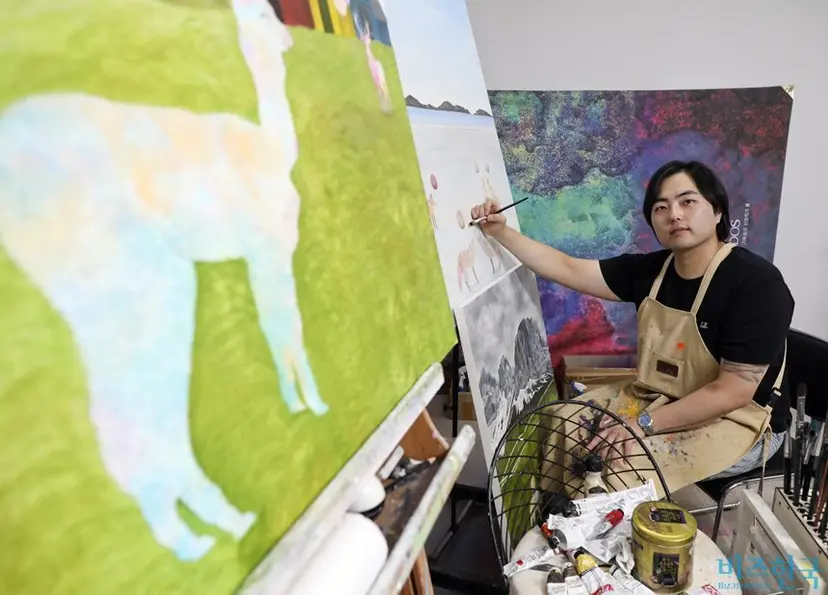
Kim Ki-seop's paintings are also imbued with a metaphysical atmosphere. In a way, they look like lyrical, ordinary landscapes, but they do not appear as simple scenery.
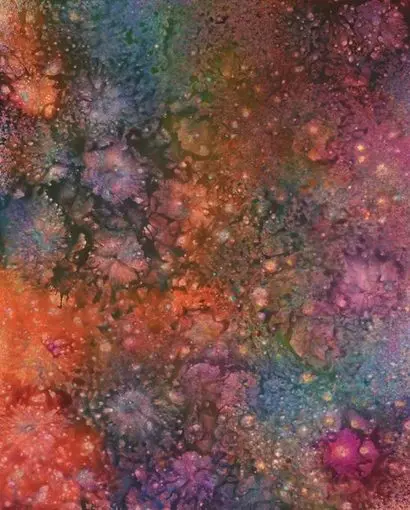
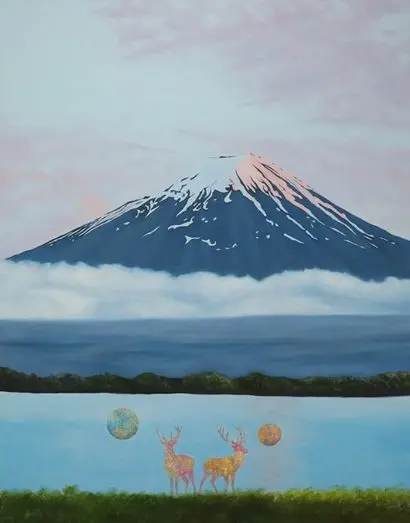
Mount Fuji, bathed in the strong light of sunrise and draped in clouds, is laid out in the background, while deer painted in distinct silhouettes play leisurely in the foreground. In other works, wolves howl on a beach where calm waves roll in. However, the bodies of these animals are flattened, composed of numerous color dots, and take on an abstract quality.
What does the artist want to say through the combination of lyrical landscapes and irrational animals? Describing his paintings as "lonely landscapes," he says he wanted to show the lonely sensibilities residing within his inner self through these scenes.
Among the many faces of thought, the one Kim Ki-seop chose is "loneliness." The artist, who views the loneliness we feel in mountain or seaside landscapes as a fundamental human emotion, expresses it by directing it into a landscape. Kim Ki-seop's paintings, containing his contemplation, feel not like a dry philosophy book, but like reading a book of poetry that makes you fall into deep reflection.