

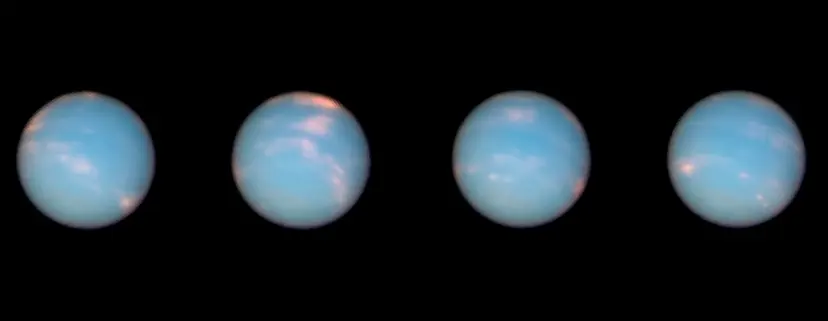
[비즈한국] On June 25, 2011, the eyes of the Hubble Space Telescope were turned toward Neptune. Since Pluto had lost its status as a planet of the solar system five years before the photo below was taken, Neptune was already considered the official final planet of the solar system. Neptune is now regarded as the last planet we encounter, the final gateway before leaving the solar system.
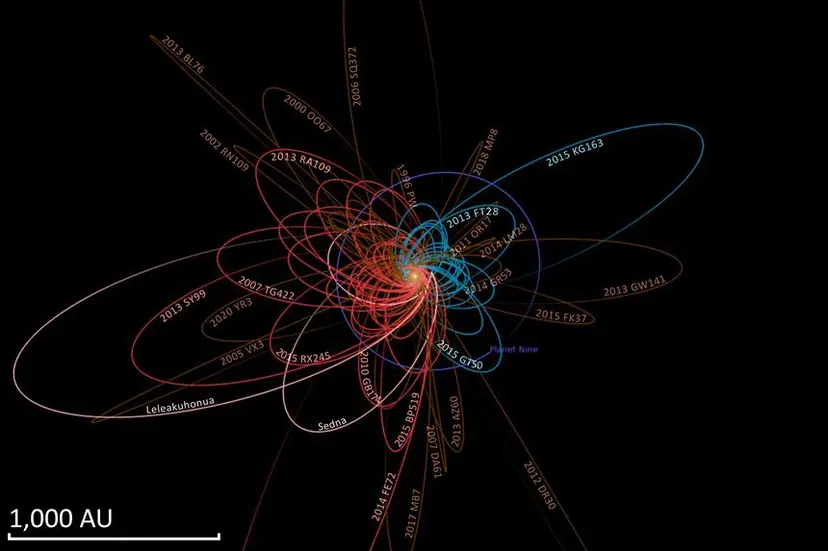
However, the solar system actually continues well beyond Neptune. There is a swarm of much smaller minor bodies beyond Neptune. There are far more of them than one might think. In particular, one after another, minor bodies have been discovered that orbit in highly elongated elliptical paths, starting from just beyond Neptune's orbit. These objects are called Trans-Neptunian Objects (TNOs). More than 3,000 TNOs have been discovered to date. They follow characteristic, highly elongated elliptical orbits ranging from 100 times the distance between the Sun and the Earth to as far as 200–300 times that distance.
At one point, it was discovered that the elliptical orbits of TNOs were unusually clustered in one direction. This was an awkward distribution, contrary to the expectation that TNOs would be randomly distributed. To explain this, some astronomers raised the possibility that an undiscovered ninth planet might be hiding on the exact opposite side from where the TNO orbits were clustered. They argued that there is one more massive planet—not an ambiguous one like Pluto, but one clearly recognizable as a planet, on the scale of Uranus or Neptune—hiding out there. This claim attracted even more attention because it was made by Mike Brown, an astronomer nicknamed the "Pluto Killer," who was responsible for Pluto being stripped of its planetary status.
The hunt by astronomers wandering through the darkness to find the "real" final planet of the solar system is not over yet. The ninth planet has yet to be confirmed. Could there be a completely different reason?
Recently, a very interesting analysis regarding this has emerged. Perhaps there is another real reason, other than a ninth planet, for why our solar system looks the way it does today. It is the possibility that shortly after the solar system was formed, a star almost the size of the Sun entered deep into the inner solar system and grazed past us.
The TNOs discovered so far are broadly categorized into three groups. First, there are objects in the Kuiper Belt that follow nearly perfect circular orbits inside and outside Neptune's orbit. Second, there are objects that travel significantly inside and outside Neptune's orbit in much more elongated elliptical paths, with Sedna being a prime example. And then there are cases where they follow orbits tilted at very large angles, close to 60 degrees, much like comets.
TNOs are, in any case, members of the solar system captured by the Sun's gravity. However, because they are located so far out, they are not solely influenced by the Sun's gravity. Their orbits are also affected by other objects that may be hiding in the darkness outside the solar system, not just the Sun. Therefore, how their orbits are distributed serves as an important guide to who might be hiding where beyond the darkness.
Astronomers contemplated the possibility that our solar system experienced a kind of "flyby" in the past, where it grazed past another star at a relatively close distance. In fact, stars grazing past each other at close range is quite common. Even in a sparse star cluster with low stellar density, flybys between stars occur in more than 1% of the total star population. Every star is bound to feel the presence of another. There is no star that lives its life alone from birth until it disappears from the universe without ever interacting with any other star.
Astronomers ran numerous simulations to see if they could reproduce the orbits of TNOs found in the solar system today, and compared the results. The result is quite fascinating.
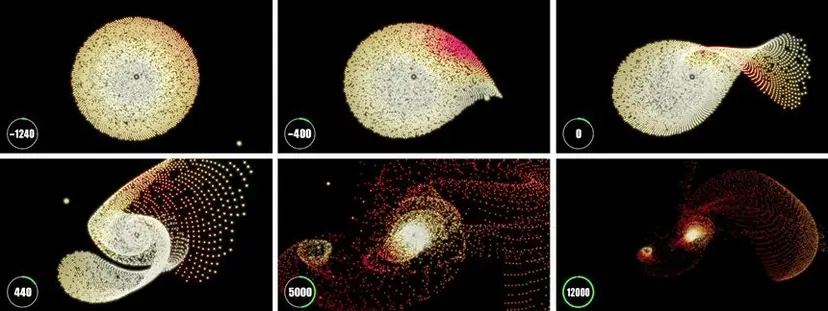
According to the simulation, the current state of the solar system is best reproduced by assuming that a slightly lighter star, about 80% of our Sun's mass, passed by at a distance of about 100 AU from our Sun. A distance of 100 AU is slightly less than four times the current Sun-Neptune distance. This falls within the orbital range of TNOs that trace large, elongated elliptical paths around the Sun today. It is about 16.5 billion km. The "Pale Blue Dot" photo, taken by the Voyager probe as it headed out of the solar system beyond Neptune, was taken from about 6 billion km away from Earth. A distance of 16.5 billion km can be seen as roughly 2 to 3 times the distance of Voyager when it took that photo. At this distance, it’s fair to say that the star didn't just graze past the solar system, but effectively entered the inner solar system once and then left. It is estimated that this encounter between the two stars occurred in the very early stages, just 10 million years after our solar system was formed.
The gravitational interaction with the star that visited deep into the solar system in the past caused major changes to the orbits of planets, asteroids, and minor bodies orbiting the Sun. In particular, the orbits of minor bodies wandering at the edge of the solar system fluctuated wildly, turning into long, elongated ellipses, and their orbital inclinations became severely tilted. This explains the current distribution of minor bodies at the edge of the solar system much better than simply assuming the existence of a ninth planet.
Such a flyby of two stars would have triggered various chain reactions not only at the edge of the solar system but also further inside. Even now, looking at the moons around gas giants like Jupiter and Saturn, there are cases where they revolve in the opposite direction, unlike some other moons. It is difficult to see these moons as having been created together with the central planet when it was first born. Instead, they can be seen as moons captured from the outside later. According to the simulation, about 7% of all TNOs are pulled into the inner solar system. It well demonstrates that during the process of another star passing close to the solar system, many minor bodies at the edge of the solar system could have been pulled deeper into the inner solar system, eventually being captured by the gravity of Jupiter and Saturn, becoming moons that orbit in reverse or follow highly inclined paths.
Some astronomers go a step further, thinking that the accidental close encounter of the two stars may have acted as a special stroke of luck for our Earth. For example, it could be the reason for the giant impact that gave us the huge Moon we have nearby today. It is also possible that it served as the catalyst for a significant event where a massive amount of icy bodies wandering the cold edges of the outermost solar system poured into the inner solar system, including Earth, supplying frozen water and organic materials. In fact, many astronomers are now keeping an open mind to the possibility that the origin of life on Earth is not just found on Earth, but that extraterrestrial materials frozen onto icy bodies like asteroids or comets were supplied to Earth by flying in.
The closest star outside our solar system today is Proxima Centauri, which can be reached in about 4.2 years at the speed of light. The Sun and surrounding stars are not fixed in place in the universe. They are traversing the space of our galaxy at slightly different directions and speeds. Therefore, the distance between each star changes slightly over time, and the star closest to the solar system also changes. In about 40,000 years, Proxima Centauri, which was our closest star, will move slightly further away, and a star called Ross 248 will approach the closest. By then, this star will have approached within about 3 light-years of the solar system. Meanwhile, Voyager, which left the solar system long ago, will also be cruising through space and passing by other stars. In about 40,000 to 50,000 years, Voyager 1 will pass by a star called Gliese 445 at a distance of almost 1 light-year. At that time, for the first time, the star closest to the humanity-made Voyager 1 will not be our Sun, but another star.
Currently, our Sun is a solitary star that does not belong to any particular star cluster. Even though nearly half of the universe consists of binary stars with companion stars by their side, our poor Sun has no one. However, that does not mean it has never interacted with any other star. The Sun, too, must have consistently engaged in even light interactions, like mere brushes of clothing, for a long time. The highly elongated TNOs and the distribution of minor bodies found at the edge of the solar system today show that our Sun is clearly not a lonely entity, but one that influences and is influenced by the countless existences in the universe.
There is a concept called cosmological awareness. It is the realization that everything visible in the universe is influenced by things that are invisible, and that everything known is connected to everything that is not yet known. Today, we look at objects at the edge of the solar system and imagine what might be happening in the interstellar space beyond. We are confirming that we are clearly connected to the world outside the vast fence called the solar system.
Reference
https://www.nature.com/articles/s41550-024-02349-x
Who is the author Woong-bae Ji? He loves cats and the universe. After watching 'Galaxy Express 999' as a child, he dreamed of making the beauty of the universe known. He is currently researching the evolution of galaxies through their interactions at the Center for Galaxy Evolution and the Near-Universe Cosmology Laboratory at Yonsei University, and is engaged in various science communication activities such as lectures and writing. He has written books such as 'The Observatory of Flirting', 'Thinking About the Universe All Day', and 'Stars, the Science of Light'.