

[비즈한국] Hustem Korea, an agricultural corporation known for a '1 trillion won-scale' illegal multi-level marketing scheme, has been declared bankrupt. While Hustem Korea promoted itself as an agricultural, livestock, and marine product sales and distribution business, it was found to have actually been conducting financial transactions through a multi-level marketing structure. The company's CEO and his associates were arrested for violations of the Door-to-Door Sales Act and were recently referred to prosecution on charges of fraud and illegal deposit-taking. With actual damages estimated to far exceed 1 trillion won, attention is now focused on whether victim relief will be possible.

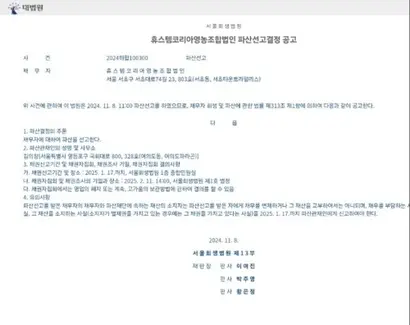
On November 8, the 13th Division of the Seoul Bankruptcy Court (Presiding Judge Lee Yeo-jin) declared the bankruptcy of Hustem Korea. The period for filing claims runs until January 17, 2025, and a meeting of creditors is scheduled for February 11. The court determined that victims who were unable to recover their investments qualify as creditors. Furthermore, the court decided on bankruptcy considering that Hustem Korea, having ceased operations, must also settle claims related to criminal damage.
Hustem Korea claimed to be an 'agricultural cooperative connecting producers and consumers of eco-friendly agricultural, livestock, and marine products,' but its actual business revolved around 'cash.' The company attracted over 100,000 members by promoting a digital asset (cash) that could be used at affiliated merchants. It enticed investors by promising to return 2.6 times the investment amount in digital assets and offering a 0.2% daily return.
Hustem Korea was reported to authorities amid allegations that this structure was a 'Ponzi scheme.' Investigation results revealed that the company had received over 1.2 trillion won in membership fees as prepayments. However, since this figure was based on data from February 2023 and CEO Lee Sang-eun mentioned during the investigation that prepayments exceeded 3 trillion won, the final damage amount is expected to be much higher.
The prosecution viewed Hustem Korea’s operations as essentially mere financial transactions and indicted CEO Lee and his sales agents for violating the Door-to-Door Sales Act, which prohibits multi-level marketing organizations from conducting financial transactions without the exchange of goods. Ultimately, in the first trial in August, CEO Lee Sang-eun was sentenced to 7 years in prison, the maximum penalty under the Door-to-Door Sales Act, and fined 1 billion won. The Hustem Korea corporation itself was also fined 100 million won.
The court stated, "The digital asset compensation plan is a baseless structure without sustainability," adding, "It is a typical 'prepayment rollover' scheme that shifts financial burdens and risks onto new members. Given that these organized financial transactions took place over a long period, and the amount in the indictment alone is unprecedented for a multi-level marketing case, a severe punishment is necessary." On October 31, CEO Lee and his recruitment agents were referred to the prosecution on additional charges of fraud and violating the Act on Regulation of Similar Deposit-Taking Activities.
Hustem Korea is currently insolvent, making it difficult to recover full damages. In 2022, the company reported 9.3 billion won in revenue but suffered a net loss of 172.4 billion won. While the company filed for rehabilitation in February while CEO Lee was on trial, the request was dismissed due to incomplete documentation. Eventually, some members filed for bankruptcy in April, and the bankruptcy process began following the court's decision on November 8.
It is expected that the victims who filed for bankruptcy will effectively find it difficult to receive compensation. Mr. A, who represents the bankruptcy applicants, lamented, "Opinions were very divided among the victims before filing. We considered it a last resort. Looking at the company's financial situation, there were many debts owed to district offices and others. We hoped to find hidden assets and recover even 10% of the damages, but even that seems difficult."
He continued, "Of the 440 billion won in assets frozen through confiscation, it is estimated that only about 190 billion won remains, yet the scale of the damage exceeds 1 trillion won. It is nowhere near enough," adding, "About 60,000 members suffered losses, and if you consider those who filed criminal complaints in addition to the bankruptcy applicants, the pool of people to share with is even larger. The costs might even be higher. The goal was to recover at least a small portion of the damages, even if it takes a long time."
A lawyer specializing in door-to-door sales noted, "It is extremely rare for an illegal multi-level company to leave behind assets. I have rarely seen cases where money is recovered through bankruptcy filings," adding, "Sometimes, money is returned when operators who receive long prison sentences in criminal trials reach settlements with victims. That is why criminal complaints are so important in illegal deposit-taking cases."
According to Mr. A and others, the fact that many investors were elderly exacerbated the damage. Hustem Korea initially put up agricultural, livestock, and marine products as a front, then reassured investors by increasing the number of merchants where their own payment method, 'Ceder Pay,' could be used. In the latter stages of the business, they even introduced ventures unrelated to agricultural products, such as nursing hospitals and mutual aid companies.
Mr. A shared, "Many elderly victims invested because they did not want to burden their children, or they believed that even if there were controversies, it was just a matter of time. Some didn't even know how to use the app and entrusted everything, from depositing the funds to managing them, to the sales agents. That is why the damage continued even as suspicions of fraud emerged," and added, "Since compensation is realistically difficult, now we just hope the perpetrators pay for their crimes. I hope they receive proper sentencing."
As financial relief for fraud victims is not easy, civic groups helping these individuals also pointed out that punishments should be strengthened. Kim Ju-yeon, head of the Korea Fraud Prevention Association, emphasized, "Most victims who are repeatedly defrauded are the elderly. They fall for another scam while trying to pay off their debts. This is because scammers exploit the desperation of the poor," adding, "Investment and financial fraud recur because punishments are weak. The life of a fraud victim is ruined, but the perpetrator's sentence is at most 5 to 10 years. We need a special law for fraud crime prevention and victim relief."