

[비즈한국] Even if the government improves legal systems to open up the skies, Urban Air Mobility (UAM) businesses are unlikely to take off. It has been found that, in reality, there is virtually no Korean company currently capable of even building an aircraft suitable for test flights.
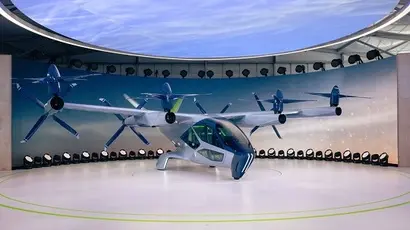
Currently, the company investing the most in UAM-related budgets among domestic firms is Hyundai Motor005380 Group. Its aircraft is being developed by 'Supernal,' Hyundai Motor Group's UAM division in the United States. Korea Aerospace Industries047810 (KAI), which entered the market as a latecomer, has set a goal to develop a UAM aircraft with its own technology by 2030. However, with related budgets allocated only until next year, UAM-related research is still in its infancy. Hanwha invested in 'Overair' to develop an aircraft but eventually withdrew after suffering losses without successfully obtaining one.
The government is establishing laws, infrastructure, and more with the goal of achieving initial UAM commercialization by the end of 2025. Companies are also forming individual consortiums to carry out projects. These include the K-UAM Dream Team (SKT, Hanwha Systems272210, Korea Airports Corporation, etc.), K-UAM One Team (Hyundai Motor, Hyundai E&C, Korean Air, Incheon International Airport Corporation, KT, etc.), Lotte Team (Lotte Holdings, Lotte Rental, Lotte Data Communication, Mint Air), UAM Future Team (Kakao Mobility, LG Uplus, GS E&C, Vertical, etc.), and UAMitra (Urban Air Mobility Industry Technology Research Association, Drone Systems, etc.).
The Ministry of Land, Infrastructure and Transport and some consortiums have conducted demonstrations to test UAM aircraft stability and operations. The first phase of UAM demonstrations is being conducted outside the capital region, and the second phase is set for the capital region. Last April, the K-UAM One Team completed its first phase of demonstration in Goheung, Jeonnam. The second phase of demonstration has not yet been finalized. The K-UAM Dream Team is also scheduled to conduct its first phase of demonstration in Goheung, Jeonnam, next month. The K-UAM Future Team, which previously completed the first phase of demonstration, only finished verifying integrated operations, excluding the aircraft itself. The OPPAV, developed by the Korea Aerospace Research Institute, was used in the first phase of demonstration. However, as the OPPAV is an unmanned UAM, it is difficult to use it for second-phase demonstrations or commercialization. This is why securing an aircraft is so critical.
With the second phase (capital region) of demonstrations for the One Team, Dream Team, and Future Team all expected to be delayed, it is forecasted that commercialization by the end of next year will also face setbacks. All three teams have failed to secure aircraft. Although the K-UAM Dream Team decided to use the U.S.-based Joby Aviation aircraft for demonstrations, it is reported that Joby delayed the supply. Hanwha Systems, part of the Dream Team, invested approximately 30 billion won in Overair in December 2019. It subsequently participated in the development of Overair's Personal Air Vehicle (PAV) 'Butterfly,' but is known to have pulled out after failing to secure the aircraft. The UAM Future Team has also failed to secure an aircraft. Although they formed a partnership with Archer Aviation, it is reported that they were unable to prepare for demonstrations using the aircraft.
The Ministry of Land, Infrastructure and Transport is finalizing infrastructure, equipment, and regulatory adjustments in preparation for the second phase of demonstrations and is also conducting deliberations on regulatory exemptions that include safety standards.
While the government is actively introducing policies to gradually open up the skies, there is currently no domestic company that has independently developed its own aircraft. Only a few companies, such as Hyundai Motor Group and KAI, are actively developing UAM aircraft.
Hyundai Motor Group established Supernal, a specialized UAM corporation in the U.S., in 2020 and is focusing on developing air taxis. Hyundai Motor is the largest shareholder with a 44.4% stake, while Hyundai Mobis012330 (33.3%) and Kia000270 (22.2%) also hold shares. Hyundai Motor Group aims for independent UAM technology development and commercialization through Supernal. The investment is estimated at 1.32 trillion won. The first production facility is located in the U.S., with a target production capacity of 200 units per year by 2028. Kim Chul-woong, head of Hyundai Motor's Advanced Air Mobility Business Promotion Group, explained, "By prioritizing collaboration in UAM development and strategy implementation, we will secure short-term growth momentum and pursue the internalization of group capabilities in the mid-to-long term through the development of core technologies."
Industry insiders point out that it is difficult for the U.S.-based independent entity, Supernal, to significantly contribute to the domestic UAM ecosystem due to its local development and production. Regarding this, Kim Chul-woong explained, "This was a choice made to obtain FAA airworthiness certification and enter the market."
KAI is conducting research on core technologies necessary for aircraft development. Since 2022, it has embarked on securing core technologies for Advanced Air Vehicles (AAV), such as electric distributed propulsion. It is currently conducting basic design for an independent AAV demonstrator model, with a target to complete detailed design by 2025. As part of a second-phase project, it plans to complete the development of a demonstrator by 2028 through manufacturing and test flights. However, since the internal budget is only secured until next year, it is unclear whether follow-up projects will proceed. Furthermore, there is no guarantee that the demonstrators developed this way will lead to actual mass production of aircraft.
KAI is pushing for the development of a dual-use (civilian and military) AAV and has appealed for military support to expedite commercialization. Cho Hae-young, head of KAI's Future Flight Vehicle Research Lab, stated, "We are trying to build an aircraft through our own investment, but more investment is desperately needed. It is expected that the military will also have a strong interest in developing a standalone defense AAV model as a weapon system. We are in a situation where a lot of support is needed."