

[비즈한국] Let's explore why we should pay attention to real estate in Gyeonggi-do at the heart of change and opportunity. To start with the conclusion: Seoul has become burdensome, and Gyeonggi-do is entering a period of reactionary opportunity.
For a long time, Seoul has reigned as the center of the South Korean real estate market. However, soaring home prices, tightened loan regulations, and increasing tax burdens are creating a population that finds Seoul overwhelming.
In contrast, Gyeonggi-do is showing continuous growth through reasonable price ranges, large-scale development projects, infrastructure expansion, and population influx. Gyeonggi-do is no longer just an alternative to Seoul but is emerging as a region with independent growth potential and the optimal area for long-term, stable real estate investment.
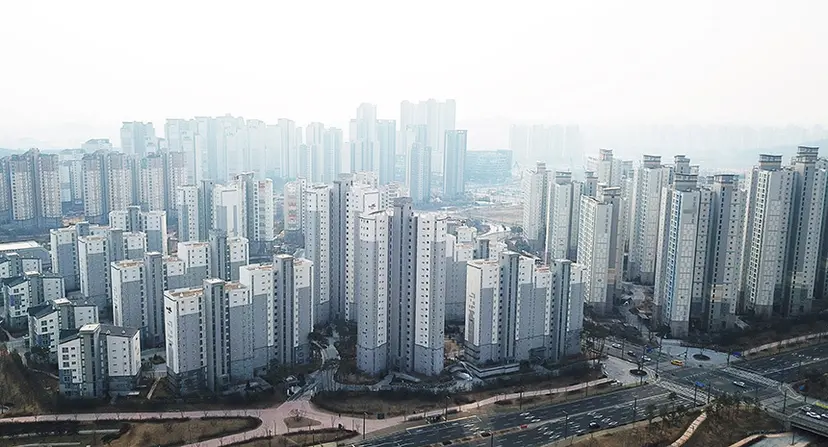
Let's look at the comparison between the real estate markets of Seoul and Gyeonggi-do and why the gap is widening.
First is the higher barrier to entry in Seoul.
The average pre-sale price per 3.3㎡ (1 pyeong) of apartments in Seoul has hit an all-time high of 54.56 million won. This is a very high level compared to 19.93 million won in Gyeonggi-do and 13.57 million won in Incheon. Based on a dedicated area of 84㎡ (25.4 pyeong), there is a price difference of over 1.1 billion won. The average transaction price is even more severe, with Seoul at 41.25 million won per 3.3㎡, Gyeonggi at 18.81 million won, and Incheon at 13.57 million won.
Second, the tax burden is increasing.
As the realization rate of officially assessed prices is maintained in Seoul, the burden of property taxes in areas with rising home prices is expected to grow further. In particular, property taxes and comprehensive real estate taxes are steadily increasing in areas with a concentration of high-priced homes, such as the three districts of Gangnam (Gangnam, Seocho, Songpa) and Yongsan-gu. Consequently, the movement to reduce property tax burdens is accelerating the migration of the population to Gyeonggi-do.
Third is the 'exodus' from Seoul.
As of 2024, more than 360,000 people have left Seoul, and over 70% of them moved to Gyeonggi-do and Incheon. This is not merely a change of residence but can be seen as a choice for quality of life and economic stability. In particular, as the younger generation and the middle class flow into Gyeonggi-do, regional economic revitalization and an increase in real estate demand are taking place.
Then, what are the advantages of Gyeonggi-do real estate that people are focusing on?
First, population influx and job growth.
Gyeonggi-do has recorded a net migration of over 1.15 million people over the past 10 years, the highest population influx in the country. In particular, regions where new towns and industrial complexes are being built are emerging as hubs for job creation and population inflow. For example, Pyeongtaek is showing steady growth due to the Samsung Semiconductor plant and the Brain City development, and Hwaseong Dongtan is seeing a notable population influx as an area well-equipped with transportation and commercial facilities.
Second, the expansion of the transportation network.
Gyeonggi-do’s transportation infrastructure is being continuously expanded. Once the Great Train eXpress (GTX) A, B, and C lines are fully operational, travel time from major areas in Gyeonggi-do to the heart of Seoul will be significantly reduced.
The GTX-A line connects the northern and southern parts of Gyeonggi-do—such as Paju, Goyang, Seoul, Seongnam, Yongin, and Hwaseong—drastically improving accessibility to Gangnam, Seoul. The GTX-B line is expected to drive development in eastern Gyeonggi, such as Namyangju, as well as the Bucheon and Incheon areas, contributing to an increase in real estate value in those regions. The GTX-C line will have a major impact on northern Gyeonggi areas like Yangju and Uijeongbu, as well as southern Gyeonggi areas such as Gwacheon, Anyang, Uiwang, and Suwon. In addition, the Shinansan Line and Seohae Line will improve transportation conditions in southern Gyeonggi areas like Pyeongtaek, Ansan, and Siheung, further strengthening accessibility to Seoul.
Furthermore, large-scale job development projects are underway.
Large-scale development projects taking place throughout Gyeonggi-do are acting as key factors in improving the local living environment and increasing real estate value. Pyeongtaek Brain City is a large-scale mixed-use development project where industrial complexes and residential areas coexist, promising mutual growth for the local economy and real estate market. Hwaseong Dongtan 2 New Town is a new city where commerce, housing, education, and transportation harmonize, with particularly active inflow of the younger generation. The Ilsan, Janghang, and Samsong Techno Valleys in Goyang are improving both job opportunities and residential environments through the integration of high-tech industrial complexes and residential areas.
So, where and how should one invest in Gyeonggi-do?
First, invest in areas with positive transportation news.
Transportation developments like GTX lines are key factors in real estate value appreciation. Areas that the GTX-A line passes through—Paju, Goyang, Hwaseong, and Yongin—and the Namyangju and Bucheon regions included in the GTX-B line will see increased future value. Such areas should be noted as having high investment value from a long-term perspective.
Second, use a strategy of pre-empting large-scale development areas.
Regions where large-scale development projects are underway, such as Pyeongtaek, Hwaseong, and Goyang, can be expected to yield high returns from a long-term perspective. In particular, residential preference is increasing in areas where new towns are built as infrastructure and living convenience improve.
Third, find properties in a reasonable price range.
Gyeonggi-do has a lower barrier to entry than Seoul while still offering many areas where stable rental income can be expected. With high jeonse-to-purchase price ratios, conditions are set for even small-scale investors to invest relatively safely.
The future of Gyeonggi-do real estate should be weighed toward long-term growth potential. This is why mid-to-long-term investment is recommended over short-term investment.
Gyeonggi-do has less price burden compared to Seoul while possessing growth potential in various aspects, including transportation, development, and population growth. While the Seoul real estate market is hardening into a 'league of their own' centered on high-priced homes, Gyeonggi-do is forming a residential and investment market accessible to diverse classes with reasonable price ranges.
Gyeonggi-do is now settling as a region with independent growth potential, not merely an alternative to Seoul. Demand from those wanting to escape Seoul's high housing costs and regulatory burdens is moving to Gyeonggi-do, which will further solidify the stable growth of the Gyeonggi-do real estate market in the future.
Therefore, I believe now is the time to invest in major areas of Gyeonggi-do. The Seoul real estate market is building higher and higher barriers. On the other hand, Gyeonggi-do is becoming an attractive option for investors due to its reasonable price range, abundant development opportunities, and stable demand growth. Through the expansion of transportation networks and large-scale development projects, Gyeonggi-do is increasing its future real estate value. Now is the time to invest in Gyeonggi-do real estate. If you are looking for a valuable investment in a place that will become the center of the future, you should pay attention to Gyeonggi-do now.
Kim Hak-ryul, head of the Smart Tube Real Estate Research Institute, known by his pen name "Pashong," previously served as the team leader of the Real Estate Research Headquarters at Gallup Korea. He operates and hosts the Naver blog "Pashong's World Exploration" and the YouTube channel "Stue TV." His books include "Absolute Principles of Seoul Real Estate (2023)," "The Future of Incheon Real Estate (2022)," "Kim Hak-ryul's Absolute Principles of Real Estate Investment (2022)," "Future Map of South Korean Real Estate (2021)," "From Now On, Only Places That Rise Will Rise (2020)," and "South Korean Real Estate User Manual (2020)."