

[비즈한국] The boycott of Naver Webtoon035420, sparked by a misogyny controversy surrounding a contest submission, has been ongoing for over a month. User metrics are also on the decline. As of the 11th, Naver Webtoon's Daily Active Users (DAU) had dropped by approximately 11% compared to the 4.61 million users on the 4th of last month, when the controversy over the webtoon "Isekai Pongpong-nam" (Another World Pongpong-nam) first emerged. This figure is largely driven by a 20% churn rate among women in their 20s and younger.
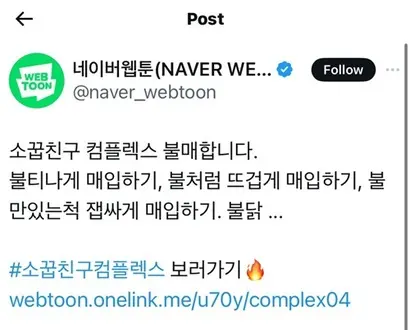
Although the problematic work is an amateur webtoon rather than a serialized official one, the fact that it passed the first round of the contest led to broader criticism regarding Naver Webtoon’s evaluation standards and its enabling of hate speech. Naver Webtoon was criticized for running marketing campaigns using "meme" variations related to the boycott, such as "Buying in a Flash," and belatedly explained that "the posts were created and released before the boycott, and their reappearance was a mistake in advertising campaign operations," but this failed to sway public opinion.
With the boycott showing signs of becoming protracted, writers are keeping a close eye on the situation. There is growing concern among associated writers, especially as works with high proportions of female readers are expected to take a major hit. How do writers view the "Pongpong-nam" situation and the Naver Webtoon boycott?
Female Writers Point to Naver Webtoon's Response: “Why Expose Ads ‘Mocking’ the Boycott?”
Writers who primarily target female readers, such as those creating works in the "female-oriented" genre, are facing difficulties due to protests involving boycotts like account deletions and refunds for "Cookies" (electronic currency for reading). Female-oriented works aside, female readers are considered to have a high actual purchase rate in the webtoon market. Their purchasing power for physical volumes and merchandise is also high. While writers are inevitably anxious about declining revenue, their sense of the problem lies more with Naver Webtoon’s handling of the situation than with the users' boycotting actions themselves.
Writer A, who is serializing a work through a direct contract with Naver Webtoon, believes that Naver Webtoon's response only served to inflame the boycott. In an interview with Bizhankook, Writer A stated, "I am very worried about the decrease in paid revenue, and it is a situation where it feels unstable to continue working. It is unfortunate that even though the boycott is against misogyny, female writers of female-oriented works are the ones taking the biggest hit in terms of income," adding, "However, because the cause of the boycott lies in Naver Webtoon's sexist behavior, not in the readers, the majority of writers are expressing anger toward the company for mocking and evading the users' protests."
Released on September 25, "Isekai Pongpong-nam" is a story about a 39-year-old male protagonist whose family falls apart due to his wife's infidelity and who then crosses over into another world. Despite being the sole breadwinner, he loses money in divorce proceedings, is branded a domestic abuser due to his wife's self-harm, and loses custody of his children. "Pongpong-nam"—a term referring to "a man who marries a woman with a history of many romantic or sexual relationships, only to be reduced to someone who just does the dishes"—is how the protagonist introduces himself. The work features misogynistic neologisms such as "dishwashing theory," which compares marriage to merely washing dishes someone else ate from, and "slaughter theory," which claims that "assets must be divided in a divorce 10 years after marriage."
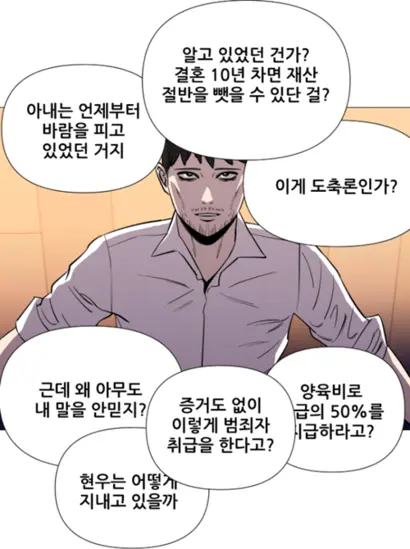
The work passed the first round of Naver Webtoon's "2024 Greatest Contest on Earth." Even as the boycott spread, Naver Webtoon responded passively by stating, "The second round of the contest is still underway," and only after drawing fire for advertisements that seemed to mock the boycott did they belatedly explain that the ad exposure was a mistake. The work stopped uploading after the third episode was released on the 5th of last month. The author stated on their author page, "It was a divorce manga that turned a common female-oriented genre into a male-oriented one," and added, "I condemn the censorship of webtoons that is skewed when it comes to freedom of expression."
Writer B, affiliated with a webtoon studio (production company) who has a track record of serializing multiple works on Kakao and Naver, said, "What (Naver Webtoon) released as an apology was a measure that further increased readers' resentment. It is the result of insufficient communication with readers and writers. Since Naver writers are directly involved, there is an atmosphere of silence regarding this controversy, but as the boycott intensifies and damage is expected, we are contemplating how to respond."
Inconsistent Regulation Standards per Issue… Concerns over ‘Pre-censorship’
Writers also pointed out the issue of inconsistency in content regulation. Writer A criticized, "When male readers claimed that expressions like 'pinching hand,' 'heobeo-heobeo,' and 'ojo-oeok' were misandrist and proceeded to bomb the ratings and insult writers, Naver Webtoon accepted those opinions, corrected the relevant expressions, and did not protect the writers. Although Naver’s principle is that they cannot limit expressions for the sake of creative freedom and the fun of the work, it seems they apply it differently in each case." Writer B explained, "Even between 15-rated and 19-rated works, the standards are inconsistent. There is difficulty in knowing which tune to dance to. However, the situation for contest submissions and general serialized works is slightly different. In the process of submitting and building up the serialization volume before launching a work, webtoon producers sometimes make detailed corrections, which we call 'red penning.'"

Some are concerned that the standards intended to prevent hate speech could lead to the side effect of "pre-censorship." Countering this, others point out that freedom of creativity is not the freedom to spread hate or mockery. Writer B said, "Webtoons have continuously practiced self-regulation. The judgment is that if we don't do it ourselves, greater regulation will follow. Spouting slander or unpleasant content (about specific individuals, genders, or ideologies) is not the be-all and end-all of creativity. I think fairer standards should be applied to female writers, but I agree that platforms have a need to regulate hate speech internally." Currently, the Korea Communications Standards Commission and the Cartoonists Association operate the "Webtoon Self-Regulation Committee" together with platforms to handle complaints regarding things like sexualization or violence.
Writer A emphasized, "Setting standards is ambiguous and difficult, but making those judgments correctly is the platform's duty," adding, "The ability to distinguish those things properly is what qualifies a platform that creates and distributes content."
The prevailing view in the industry is that it is unlikely "Isekai Pongpong-nam" will pass the second round of judging, which will be announced on the 22nd. This is because reader response is evaluated as an important criterion. On the 22nd of last month, 226 webtoon writers released a statement demanding an apology and explanation from Naver Webtoon. A Naver Webtoon official stated, "We are treating this as a serious matter and are deliberating. We apologize for causing disappointment and concern to readers and creators, and we will strive to listen to various voices."
Cartoon critic Park Gwang-cheol pointed out, "Because webtoons deal with long narratives that reflect reality, controversies are inevitable and unavoidable in issues with political dimensions. It has become clear that Naver Webtoon lacks a manual for gender issues in this situation, and their response was indeed wrong," but added, "There must be checks against censorship. Because the issue is socially sensitive, it is difficult to define the proper way to respond. It is a difficult problem that requires collective social wisdom to solve."