

[비즈한국] The news of former US President Donald Trump's return to the White House is a hot topic in the European startup scene. The noisy and dramatic support campaigns by American tech giants, with some backing Trump and others Harris, were an intriguing spectacle to observe from Europe. This is because, compared to the US, Europe's tech titans tend to be somewhat "boring and quiet."
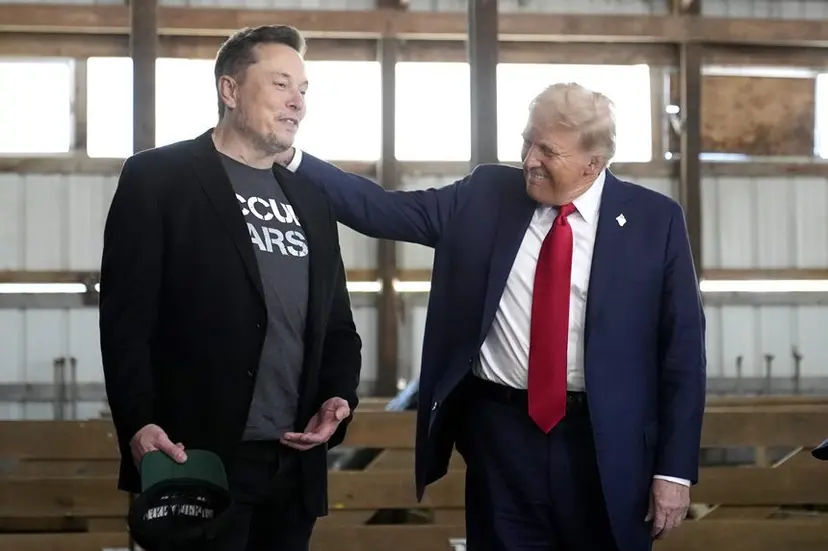
During the US presidential election, Elon Musk took an exceptional path by actively supporting Donald Trump. He organized events donating $1 million a day to create an atmosphere favorable to Trump and supported him with all his might. This is because he expected that if Trump were re-elected, policies to ease technology regulations would have a positive impact on innovative industries such as AI and autonomous driving. Musk frequently posted pro-Trump statements via X, influencing public opinion. As Trump mentioned in his victory speech on November 6, he was a "new star" born through this election.
Beyond Musk, Silicon Valley giants such as Meta's Mark Zuckerberg and Amazon's Andy Jassy also moved to improve their relations with Trump. Zuckerberg restored Trump's social media accounts and communicated with him directly several times, while Amazon made efforts to rebuild ties, including placing a call to check in on Trump. Such moves demonstrate that the big tech industry is looking forward to Trump's deregulation.
On the other hand, there are figures keeping their distance from Trump. Microsoft founder Bill Gates donated a large sum to a group supporting Vice President Harris, advocating for climate change response and stronger regulations. Trump's re-election has clearly exposed the differences in political stances among tech companies not only in Europe but also within the US, intensifying polarization.
Ultimately, the Trump 2.0 era has arrived. The European startup scene is particularly unsettled because Trump has taken a sharp stance against Europe's technology regulatory policies. Moving forward, Europe is expected to be significantly impacted in areas such as climate change response, the defense industry, and AI regulation.
Heightened Sense of Crisis in the Climate Tech Industry
With Trump's election, European climate tech startups are facing new uncertainties. Trump has long defined climate change as a "hoax" and supported fossil fuel development. One of the first things he did upon taking office for his first term in 2017 was to withdraw from the Paris Agreement. Many experts believe that withdrawal from the Paris Agreement is a predicted course of action for Trump's second administration as well.
In particular, while the Inflation Reduction Act (IRA) announced by the Joe Biden administration provided large-scale subsidies for eco-friendly technology companies, Trump has clearly expressed his opposition to it. European climate tech companies could be hit hard in their US market expansion if these subsidies are reduced or withdrawn.
Berlin-based Planet A is an investment firm that invests in European green tech startups. Lena Thiede, a partner at Planet A, assessed in an interview with the European startup-focused media outlet 'Sifted' that "Trump's re-election means a setback for global green innovation," and emphasized that "the need for Europe to independently support climate tech innovation has increased." In the same interview, Daria Saharova, a founding partner at World Fund, a Berlin-based VC specializing in climate tech, stated, "Europe must take this election of Trump as an opportunity to strengthen its self-reliance. To do this, it is necessary to secure sufficient capital to grow climate tech startups within Europe."
Christian Miele, a partner at the Berlin-San Francisco based VC fund Headline, predicted, "Trump's election could increase trade barriers between the US and the EU, negatively affecting supply chains," adding, "In particular, climate tech startups had entered the US with the help of the Biden administration's subsidies, but they will lose such opportunities."

European Defense Tech Startups Tense over 'America First'
President Trump's 'America First' policy is also expected to pose challenges for European defense industry startups. The Trump administration is likely to reduce defense contracts with non-US companies and strengthen supply chains centered on domestic firms.
NATO and European defense budget issues are also acting as important variables for the European tech scene. Trump has continuously demanded that NATO increase spending, warning that European countries could see the weakening of NATO ties if they do not increase their defense budgets.
Paris-based deep tech investor Michael Jackson stated, "Because the US accounts for the majority of the NATO budget, it will have a significant impact on European startups if Trump takes a harder line on NATO," adding, "EU and various European defense ministries must seek ways to increase contracts with European startups on their own."

The possibility that Trump might reduce indirect US support for Ukraine also presents a major risk to defense industry startups. Jack Wang, UK Managing Director at Berlin and London-based VC Project A, said, "There is a high possibility that Trump will withdraw support for Ukraine within two years of taking office, and if that happens, Europe and the UK will have to significantly increase their defense budgets." Wang emphasized preparation, noting, "While this change could be a new opportunity for European defense industry startups, it could lead to short-term revenue shocks for companies that have relied on existing contracts with the US."
Meanwhile, European investors predict that with Trump's return, the US will reduce its interest in Europe and shift its diplomatic policy toward Asia. Accordingly, Europe will focus more on strengthening its defense capabilities and developing its own defense ecosystem. Trump's policy shifts suggest the need for European defense startups to explore more opportunities in their domestic markets.
Startups in Regulatory Areas Feel 'Expectation'
For AI startups, Trump's re-election means greater opportunities in the US market. Trump has mentioned the high possibility of abolishing the Biden administration's 'AI Executive Order (E.O 14110).' The AI Executive Order emphasizes regulation-centered technology development and stipulates that companies must notify the federal government if the AI models they develop pose risks. Trump argued that "it creates an environment where startups cannot compete fairly with large companies," signaling the abolition of the AI Executive Order. With the resulting reduction in regulation expected to improve the big tech investment environment, some predict that data center construction will explode.
The atmosphere is not entirely positive for startups, however. Dr. Roeland Decorte, founder of Cambridge-based AI sound startup Decorte Future Industries and chair of the AI Founders Association (AIFA), which brings together founders from the US, UK, and Europe, expressed mixed feelings: "The Trump administration is highly likely to ease AI regulations, which is a favorable change for large Silicon Valley firms but could have the opposite effect for startups."
European startups that work closely with the US in medical technology and health tech fields are hoping for continued growth opportunities. Ángel Alberich-Bayarri, founder of Quibim, headquartered in Valencia, Spain, expressed his expectations, saying, "As a company headquartered in Europe, we are already conducting various collaborations with many US hospitals beyond regulations. I believe the US will remain a leader in medical innovation under the Trump administration as well."
Solidarity, Solidarity, We Need a Stronger Europe
The primary reaction from the tech industry is that Europe must ultimately unite and become stronger following Trump's election. As Europe has previously been heavily influenced by the political and social changes of major powers like the US, China, and Russia, strengthening Europe's self-reliance has become more urgent since Trump's election. The idea is that as Europe's GDP and tech ecosystem become stronger, it can respond more flexibly to geopolitical risks.
The changes brought by President Trump's election will bring both opportunities and challenges to European startups across various sectors, including climate, defense, AI, and healthcare. The European tech industry is shifting toward strengthening its domestic ecosystem and increasing self-reliance. Therefore, it is expected that preferential investment and protectionist policies for European startups will be strengthened as an opportunity to build new global competitiveness for European startups following this election of Trump.
The author, Lee Eun-seo, majored in law in South Korea and studied theater in Berlin. Based in Berlin, a city of art and a European startup hub, she leads 123factory, which connects the startup ecosystems of Korea and Germany while growing alongside the city.