

[비즈한국] Hanwha Ocean042660 has unveiled its new 'Ocean 2000' submarine, targeting the global export market. While smaller than the 3,000-ton class medium-to-large conventional 'Jangbogo-3' submarine, this model offers improved cost-effectiveness and operational efficiency. It is expected to compete in future export markets against the HDS-2300 submarine from HD Hyundai Heavy Industries329180.
Before discussing Hanwha Ocean's new submarine, it is necessary to briefly understand the background and current status of the submarine export market. The 'Jangbogo-3' submarine currently operated by our Navy is one of the world's premier conventional (non-nuclear) submarines, having achieved various records and milestones.
First, its submerged endurance is exceptionally long. While the Navy has not publicly disclosed the specific submerged performance of the Jangbogo-3 (Dosan Ahn Changho-class), it has stated that it holds the "top record among conventional submarines." Whereas conventional submarines from before the 1990s could only stay submerged for 2-3 days, and the Jangbogo-2 (Son Won-il-class) introduced in the 2000s could submerge for over two weeks, the Jangbogo-3 can remain submerged for at least three weeks to nearly a month.
Another major strength of the Jangbogo-3 is its ability to launch SLBMs (Submarine-Launched Ballistic Missiles), a capability held by only a very small number of conventional submarines. While ballistic missiles can be launched from land, sea, and air, launching them from a submarine is the most lethal method because the submerged nature of the vessel enables surprise attacks.
Due to these features, the Jangbogo-3 submarine is equipped with one of the most expensive and complex missile systems in the world. While there are other 3,000-ton class submarines, they are either like Australia's Collins-class which are nearing retirement, or like France's Blacksword Barracuda which have not yet been fully operationalized. At this moment, the Jangbogo-3 is one of the most expensive, high-performance submarines available for purchase on the export market.
For this reason, although the Jangbogo-3 Batch 2 is being proposed for projects like Poland's Project Orka and Canada's Canadian Patrol Submarine Project (CPSP), in reality, the majority of the export market prefers 2,000-ton class "Middle Class" submarines, where demand is highest.
HD Hyundai Heavy Industries was the first to enter the medium-sized submarine market. The design for its new 'HDS-2300' submarine features a surface displacement of 2,300 tons, a length of 73m, and a beam of 8.5m, placing its size between the Jangbogo-2 and Jangbogo-3.
The greatest feature of the HDS-2300 is its "price-to-performance" ratio. According to data released by HD Hyundai Heavy Industries in Poland, they made a bold proposal suggesting that the budget required to purchase one Jangbogo-3 submarine could cover the cost of two HDS-2300 submarines plus the construction of local maintenance facilities. This is effectively a direct shot at Hanwha Ocean, which is staking its future on the export of the Jangbogo-3 Batch 2.
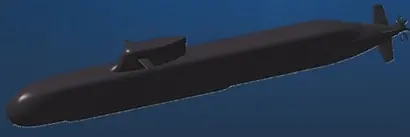
Hanwha Ocean has also responded. On the 12th, at the '2024 ISTC International Submarine Technical Conference' hosted by the Defense Acquisition Program Administration (DAPA), they introduced the export-oriented 'Ocean 2000' submarine.
The Ocean 2000 actually originated from the 'DSME 2000' submarine, which had been in development before the company name was changed to Hanwha Ocean; the DSME 2000 was already unveiled at the 2019 International Maritime Defense Industry Exhibition (MADEX). However, while the original DSME 2000 was a modification of the Jangbogo-2 class, the Ocean 2000 is shaped as a scaled-down version of the Jangbogo-3 Batch 2. It follows the Jangbogo-3's whale-shaped hull design in the hull, sail, and fuselage. However, to improve maneuverability, the rudder has been changed from the traditional cross (+) shape to an X-shape.
A key characteristic of the Ocean 2000 is that it adopts almost all the features of the Jangbogo-3 Batch 2, with the exception of the SLBM capability. It is equipped with lithium-ion batteries and a hydrogen fuel cell AIP (Air-Independent Propulsion) system for long submerged endurance, and it incorporates the same noise-reduction equipment and combat systems found in the Jangbogo-3 Batch 2. The main difference is the removal of SLBM capabilities and a reduced armament capacity of 16 missiles or torpedoes.
The diversification of the Korean submarine business into the export market with three major models—Jangbogo-3 Batch 2, HDS-2300, and Ocean 2000—is a very positive change. These new submarines could become attractive products for medium and small nations that are hesitant to acquire submarines due to excessive cost burdens or are struggling to replace aging fleets, likely playing a positive role in defense exports.
However, much like the failure of the Australian frigate project, the prospect of competing as "two teams" instead of a "one team" remains worrisome. Hanwha Ocean and HD Hyundai Heavy Industries jointly developed the Jangbogo-3 Batch 2, and the intellectual property (IP) is held by DAPA. In a sense, the emergence of the HDS-2300 and Ocean 2000 signifies their "divorce," with each company releasing its own independent submarine design.
Nevertheless, it is not easy for shipyards in the same country to completely separate. Both HDS-2300 and Hanwha Ocean share many core technologies such as horseshoe-shaped sonar, vibration-reduction design, acoustic tiles, fuel cells, lithium-ion batteries, torpedoes, and missiles. While it is possible to source such technology or equipment from overseas companies, doing so would inevitably lead to an increase in unit costs.
While it is commendable for both shipyards to ambitiously pursue new submarine designs to improve export competitiveness, it is now time to acknowledge the reality that they must share core technologies. A strategy is needed that involves dividing target marketing regions by company, continuing joint development for systems like the Jangbogo-3, or establishing an integrated export strategy led by DAPA or the Ministry of National Defense.