

[비즈한국] Following controversy over the detection of dioxin in the blood of incinerator workers in 2021, the Seoul Metropolitan Government decided to implement special health checkups for employees of resource recovery facilities starting this year. This is the first health study conducted by a local government specifically for incinerator workers. According to the summary report of the '1st Year of Workplace Environment Measurement and Workers' Health Impact Assessment at Resource Recovery Facilities' from August 2024, obtained by Bizhankook, dioxin was detected in both the incinerator facilities and the workers' blood. Blood dioxin levels reached a maximum of 14.34 pg TEQ/g lipid, with an average of 6.59 pg, which is higher than the 2021 survey findings of 9.13 pg (maximum) and 5.230 pg (average).
Although dioxin was detected in workers' blood as expected, it was found that the Seoul Metropolitan Government has taken no significant follow-up measures since the results were released. Labor unions are criticizing the city for maintaining a non-responsive stance regarding the formulation of countermeasures.
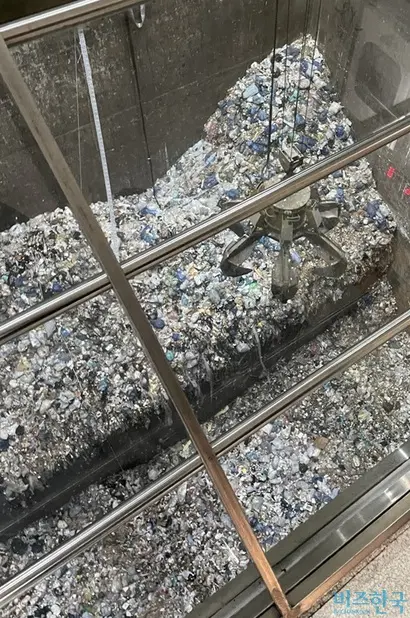
The Nation's First Health Study on Incinerator Workers… What Are the Results?
Discussions on the need for a health study on incinerator workers began in 2022, after it was revealed that the Korea Occupational Safety and Health Agency had detected the toxic substance dioxin in the blood of 10 Seoul incinerator workers in 2021. Dioxin, benzopyrene, and other substances were also detected in the indoor air. That study, however, was a one-time investigation by the Korea Occupational Safety and Health Agency.
While health studies and environmental impact assessments for residents living near incinerators have been conducted in the past, no studies had been carried out on indoor air quality or the health of the employees themselves. This is because, while there are standards for air quality emitted outside of incinerators, there are no established standards for indoor air quality or for blood dioxin levels in workers.

Consequently, during the 2022 National Assembly audit, the Seoul Metropolitan Government promised regular special health checkups for incinerator workers and the establishment of standards for dioxin exposure. At the time, Rep. Yong Hye-in of the Basic Income Party pointed out, “We selected and tested 10 workers from the Mapo and Yangcheon resource recovery facilities. Dioxin was detected in their blood. It’s 14 times the level of surrounding residents. The problem is that these workers’ health checkups do not include screenings for dioxin.” Seoul Mayor Oh Se-hoon stated, “The budget for the health checkups you mentioned is reflected in next year’s budget. We plan to do our absolute best for the physical and mental health management of our workers in the future.”
According to Bizhankook’s report, the Seoul Metropolitan Government conducted health studies on indoor air quality and employees at resource recovery facilities across Seoul for the first time this year. However, this study did not cover all employees working at the incinerators; the city surveyed 10 employees each from the Gangnam, Nowon, Mapo, and Yangcheon facilities, for a total of 40 people.
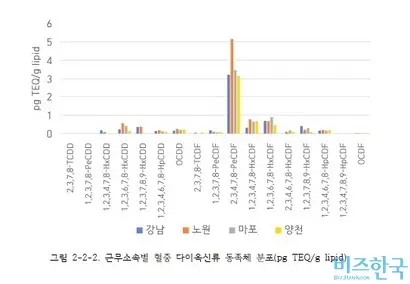
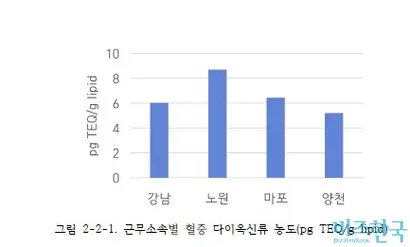
According to the '1st Year Summary Report,' the blood dioxin concentration of workers ranged from 1.12 to 14.34 pg TEQ/g lipid, with an overall average of 6.59 pg and a median of 6.35 pg. In the 2021 Korea Occupational Safety and Health Agency study, the range was 2.184 to 9.134 pg, with an average of 5.230 pg and a median of 5.063 pg. When comparing these, the range of blood dioxin concentrations was wider in this year's study. However, the Agent Orange component (2,3,7,8-TCDD) detected in 2021 was not found this time.
Differences were also observed based on work location and tenure. Of the four facilities, Nowon had the highest average at 8.70 pg. Workers with over 10 years of service averaged 7.03 pg, while those with less than 10 years averaged 5.94 pg. Blood dioxin levels were higher among operation team workers compared to maintenance team workers, with the operation team averaging 7.47 pg and the maintenance team averaging 4.54 pg.
The summary report stated, "Resource recovery facility workers mainly stay on-site and are exposed to various hazardous factors, sometimes experiencing intermittent high-concentration exposure; the wearing and management of personal protective equipment and work clothes are not good. Given that long-term workers experience intermittent high-concentration exposure to various hazardous factors, the risk of developing various diseases such as cancer, cardiovascular disease, and respiratory disease may increase."
Jang Yoon-seok, the lead researcher who conducted the study, explained to Bizhankook, "Highly toxic dioxin is not a substance with rapidly changing concentrations, but once it enters the body, it is not easily eliminated for a long time, so follow-up observation is necessary. The first-year results show that although the concentrations are small, they are clearly elevated in the work environment. When combined with other factors like fine dust, there is a very high need to improve the working environment to protect worker health."
He further noted, "The reason the Nowon Resource Recovery Facility workers showed higher blood dioxin concentrations than those at other facilities appears to be due to the aging of the facility."
Despite Dioxin Detection… Seoul City: "Difficult to Prove Causal Link Between Dioxin and Incinerators"
The problem is that the Seoul Metropolitan Government has taken no action since the investigation. The National Environmental Labor Union states that there has been a total lack of discussion on countermeasures from the city since the health impact assessment results were released. The union claims, "The city conducted the health impact assessment on incinerator workers for the first time in the country, and it confirmed that workers' health is not secure. Discussions on facility improvements and future measures should be held based on the findings, but Seoul City has remained non-responsive so far. In this study, the city again used budget constraints as an excuse to survey only 40 workers."
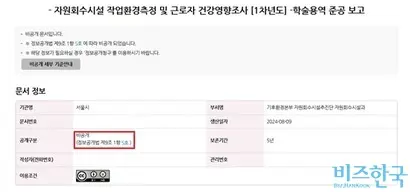
The report was not made public either. Currently, the Seoul Metropolitan Government has marked the 'Workplace Environment Measurement and Workers' Health Impact Assessment for Resource Recovery Facilities' as 'non-disclosed' on its website. The standards for dioxin exposure promised during the 2022 National Audit have also yet to be established.
Seoul City maintains that it is difficult to discuss alternatives immediately since this is only the first year of the study. A city official explained, "We need about three years of measurements to accumulate reliable statistics, and currently only the first year has been completed. There were no extraordinary findings, and it doesn't seem to be at a stage where we can draw definitive conclusions. Dioxin can be generated by the surrounding environment in daily life, so it is difficult to conclude that it is strictly caused by the working environment. We plan to improve the facilities based on accumulated data after reviewing various aspects. Regarding indoor dioxin exposure standards, we requested the Ministry of Environment to establish them, but specific standards have not yet been produced." Regarding the disclosure of the report, they stated after being questioned, "We have requested that the report be uploaded to the Resource Recovery Facility website."
A professor of occupational and environmental medicine who requested anonymity pointed out, "In this study, the average dioxin level in workers exceeds 6 pg, and there is a tendency for blood dioxin levels to increase as the length of service increases. This supports the conclusion that it is influenced by exposure in the work environment. Since exposure varies depending on the nature of the waste incinerated at the facility, it is necessary to include screenings for various heavy metals, including lead, in special health checkups and implement constant monitoring."