

[비즈한국] We’ve discovered water on Mars! But honestly... at this point, confirming the existence of water on celestial bodies other than Earth in our solar system doesn’t sound all that surprising. It sounds like we’re just confirming what should have been there all along. However, this time, you have every right to be amazed. It's not that water was found on the Martian surface, but that there is a discovery suggesting there may be a deep, underground ocean on Mars! Much like Jupiter’s icy moon Europa, there is a possibility that a massive water-filled reservoir exists deep within Mars!
This might change the minds of many astronomers who have been skeptical about humanity's prospects for reaching Mars. Along with the recently discussed possibility of a giant underground ocean on Mars, we take a look at the stories of astronomers who have been searching for traces of water on the Red Planet.
The possibility of water's existence is an essential topic whenever we talk about Mars. Interestingly, from the very first moments astronomers studied the planet, Mars was considered a world that harbored water. Inspired by the book 'Mars' written by Italian astronomer Giovanni Schiaparelli, Percival Lowell—a 20th-century American astronomer (and wealthy businessman)—claimed to have discovered a complex network of straight-line canals on the Martian surface. He argued that these were the remnants of massive structures built by Martians to melt white ice from the polar regions and channel it to the arid equatorial regions.
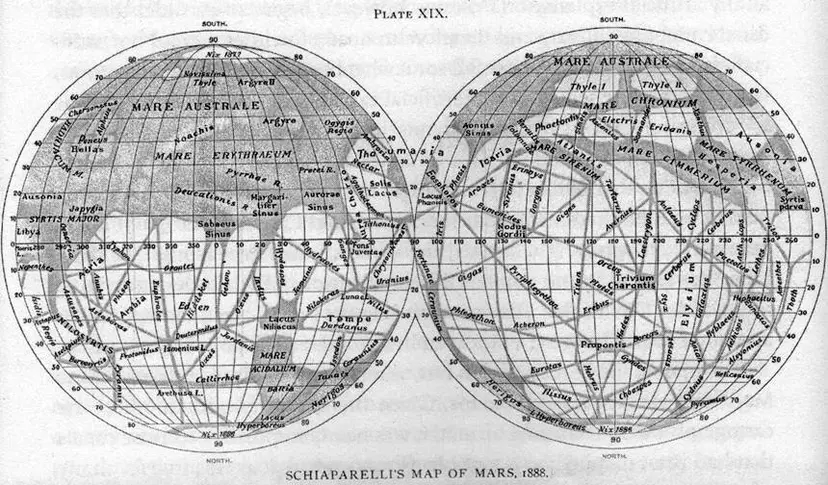
Lowell's somewhat exaggerated claims had a profound impact not only on the scientific community but also on popular culture. Naturally, vague expectations began to emerge that some form of life must be living on Mars. For a time, the term 'Martian' was used as a catch-all word representing 'aliens' in general.
However, after 'flyby' missions began with probes and orbiters passing by Mars, the sad truth was revealed that Lowell's story was just bluster. When exploration robots passed by and looked directly at the Martian surface, there wasn't a trace of artificial structures, lush forests, or even a single drop of water. Mars was a cold, dry, and desolate desert planet of red. As the harsh reality of Mars was exposed, the homes of aliens in science fiction were quietly shifted from Mars to distant stars outside our solar system.
But Lowell wasn't entirely wrong. While a Martian Water Corporation for aliens didn't exist, the expectation that there would be water on Mars wasn't entirely off base. The first step toward vindicating Lowell came in 1972, when Mariner 9 discovered intriguing geological traces on the Martian surface.
Including the Valles Marineris, which spans a staggering 4,000 km, traces of dry riverbeds that appear to have been carved by flowing water were found across Mars. The Viking landers, which left Earth and successfully landed on Mars in 1975, used robotic scoops to dig up Martian soil and analyzed the samples using onboard gas chromatograph-mass spectrometers. Water was detected in every single sample. While there were some minor issues with sample handling, making it difficult to determine the exact water content, the results showed signs that at least 1% water was contained in Martian soil and rocks.
In particular, it seemed highly likely that the Martian polar regions, much like Earth’s North and South Poles, maintained a cold environment where a great deal of water was frozen. In 2008, the Phoenix lander touched down directly on the Martian North Pole and confirmed the presence of massive amounts of water ice. The Phoenix lander left traces as it slightly scraped the surface with an excavation tool at the end of its robotic arm. One of these traces is very famous: NASA named two small, rectangular ditches carved into the soil "Dodo" and "Goldilocks." When Phoenix photographed and analyzed these ditches, bright white material was present in them at first, but it slowly vanished over four days. This appears to be water ice disappearing through sublimation.
A selfie taken by the Phoenix lander the moment it landed on Mars caused controversy among astronomers because something strange appeared in it. Several small, pimple-like bumps had appeared on the surface of the lander’s metallic robotic leg. Some astronomers speculated that because a salty gas was sprayed during the landing process, water vapor in the Martian atmosphere condensed and clung to the surface during the cold night, forming water droplets like a type of frost.
In 2012, NASA's Curiosity rover finally found irrefutable evidence showing that water once existed on Mars. It confirmed the presence of very smooth, round, eroded pebbles and sand on the Martian surface. These were similar to the smooth stones seen in stream beds. Although the water has since dried up, it was geological evidence clearly showing that water once existed and rolled these stones around, wearing them down.
Compared to Earth’s vast oceans, Mars today is a cold, water-starved desert, but the possibility that Mars was a world of water—and even a sanctuary for life—comparable to Earth several hundred million years ago has begun to be seriously discussed.
If there is still a decent amount of water hidden in every corner of Mars, could we dream of a future where humanity settles there? That is an entirely different problem. The biggest reason many astronomers are skeptical about Martian exploration is that Mars lost its magnetic field a long time ago. Although Mars is 1.5 times farther from the Sun than Earth, the solar wind blowing from the Sun remains dangerous. Unfortunately, the small size of Mars meant it could not maintain its own magnetic field for long. A magnetic field acts like sunscreen, protecting the planet's surface from solar wind. The Martian sunscreen dried up quickly, and the atmosphere and oceans hiding beneath it dried up along with it.
The absence of a magnetic field makes it difficult to expect signs of life on the Martian surface. However, there is one alternative: to use the thick Martian crust itself as a bunker to block the threats of solar wind and move underground. Naturally, astronomers' interest has begun to turn away from the Martian surface toward the Martian underground.
How did Mars end up losing its magnetic field? Looking at the traces left on some Martian surface rocks, it's clear it didn't lack a magnetic field from the beginning. At one time, Mars did have one. But at some point, it received a geological death sentence and could no longer maintain a strong magnetic field. To find the answer, we have to look inside Mars, into its depths. Of course, it is impossible to cut Mars in half like an apple to see its interior. Instead, by investigating the patterns of seismic waves spreading through the planet, we can determine the scale and distribution of layers with different densities inside Mars. It’s similar to tapping a watermelon with your fingers to see how ripe it is without actually cutting it open.
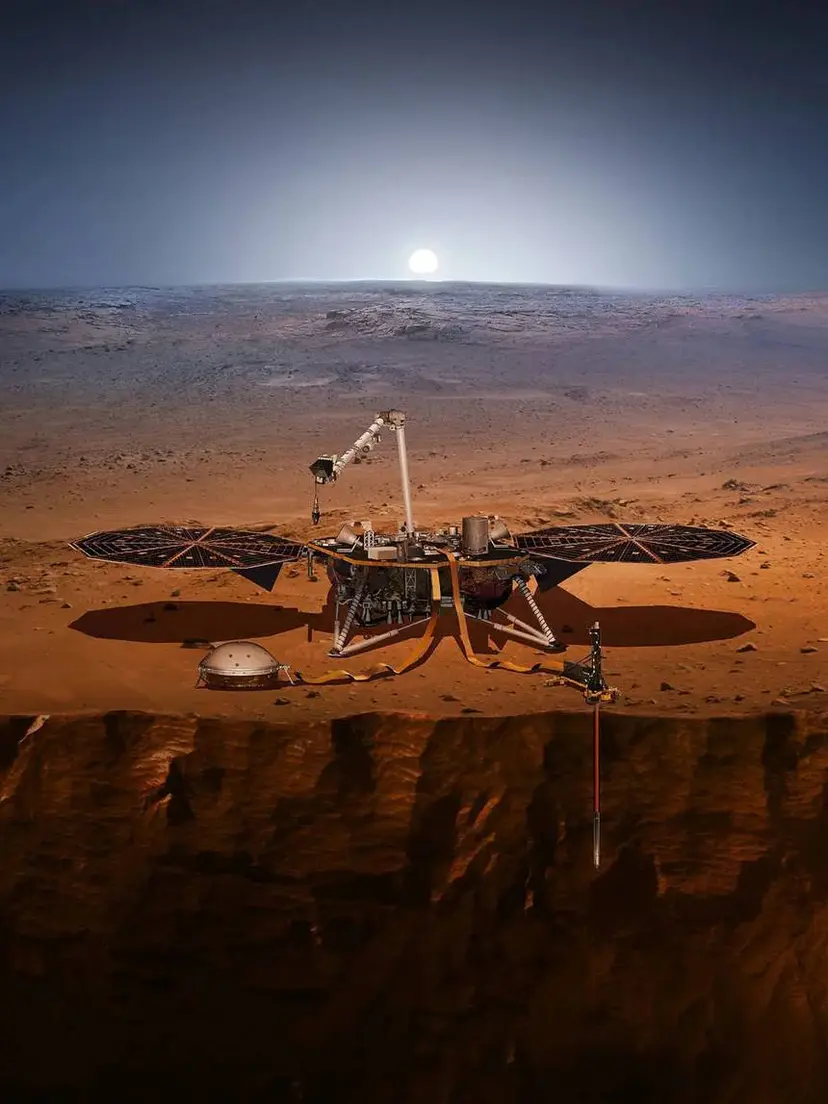
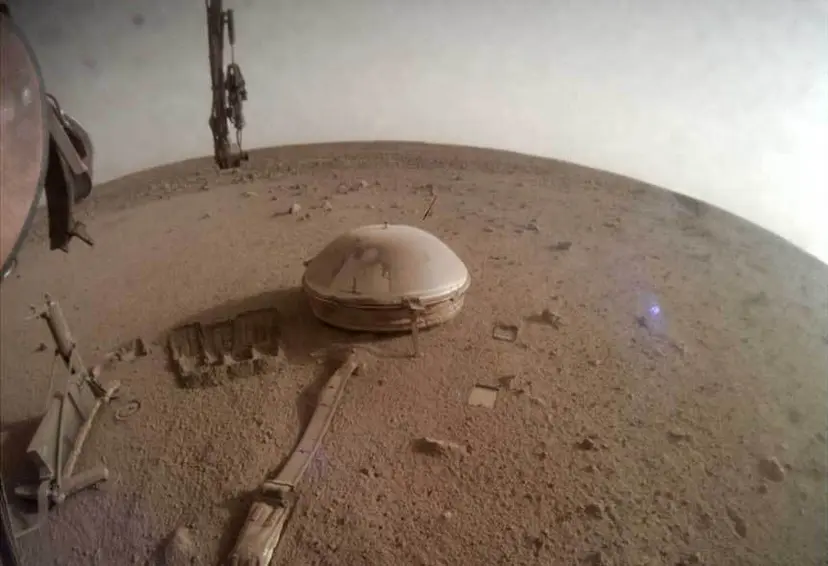
To this end, astronomers conducted the InSight mission, the first to deploy a seismometer to detect earthquakes—or rather, "Marsquakes"—occurring on Mars. Having landed on the Martian surface in November 2018, InSight detected a total of 1,300 ground tremors over four years until its power cut out in December 2022 due to excessive dust accumulation on its solar panels. Of course, since Mars is a geologically dead planet, the ground doesn't shake from tectonic plates colliding like on Earth. Instead, Marsquakes occur when meteors occasionally strike the Martian surface, causing vibrations to spread in all directions.
Astronomers created various models by changing several variables, such as soil density and the size of internal structures. Among them was the variable of an underground water reservoir. They checked which model could best replicate the actual data collected from Marsquakes. According to this study, the model assuming the existence of massive reservoirs filled with water at a depth of 10–20 km below the Martian surface best explained the observed Marsquake data with nearly 100% accuracy.
At first glance, this might sound like a trivial discovery. After all, it's not like we found a massive Pacific Ocean on the Martian surface like we have on Earth. Is the discovery of a high probability of water reservoirs hidden deep underground really that significant? Not at all. It is actually more special precisely because it is underground and not on the surface.
As mentioned earlier, the Martian surface is fully exposed to dangerous solar wind due to the lack of a magnetic field. We couldn't expect oceans or lakes on the Martian surface to have remained safe to this day. Even if a low-level microbial ecosystem existed in Martian surface oceans and lakes hundreds of millions of years ago, there is a possibility that every trace of it was sterilized clean by solar wind showers over hundreds of millions of years. But if it is underground, the story changes. The thick Martian crust itself acts as a shield against the solar wind, allowing us to hope that water—and potentially even an ecosystem—might still remain inside, protected from the interference of solar wind!
This October, the Europa Clipper probe will leave Earth to more closely examine the components of the underground ocean on the icy moon Europa, which orbits Jupiter. It is expected to be the first step in finding possible traces of alien life in the ocean hidden beneath the thick ice. Until 50 years ago, Mars was considered the most likely candidate in the solar system to host traces of alien life. However, consecutive missions yielded no direct evidence, and astronomers slowly turned their eyes to other places like Europa or Titan. Yet, with these recent findings, Mars is once again in the spotlight. Between Mars and Europa, where will we find traces of alien life first? Can we really find traces of alien life in our solar system?
Reference
https://www.pnas.org/doi/10.1073/pnas.2409983121
About the author, Ji Woong-bae? He loves cats and the universe. After watching 'Galaxy Express 999' as a child, he developed a dream of sharing the beauty of the universe. He currently researches the evolution of galaxies through their interactions at the Center for Galaxy Evolution and the Near-field Cosmology Laboratory at Yonsei University. He engages in various science communication activities, including lectures and writing. He is the author of books such as 'The Observatory of Flirting,' 'Thinking About the Universe All Day,' and 'Stars, the Science of Light.'