

[비즈한국] The Ministry of Education and the Korea Institute of Medical Education and Evaluation (KIMEE) are in conflict over "medical school accreditation," leaving universities struggling with uncertainty. Consequently, preparations for medical students expected to return next year remain insufficient. Adding to the confusion, a recent survey revealed that 96% of university professors believe medical school admissions for next year should be frozen or reduced.
Over 16,000 Opinions Submitted During Legislative Notice… Medical Community Calls It "Attempt to Neutralize KIMEE"
On the 4th, the legislative notice period concluded for the amendment to the 'Regulations on Evaluation and Accreditation of Higher Education Institutions,' which would require accreditation agencies to provide at least one year of remediation time before issuing a non-accreditation decision in cases of declining educational standards. Over 16,000 opinions were submitted to the bulletin board. Those opposing the bill commented, "Solving policy errors in this manner is wrong," and "The government and the Ministry of Education promised that there would be no change in the quality of education even after the enrollment increase. KIMEE accreditation must proceed as originally planned." Conversely, supporters argued, "It is a necessary procedure for proactive response," and "While we should listen to the opinions of groups like doctors, the final decision must be made by the government representing the entire nation."
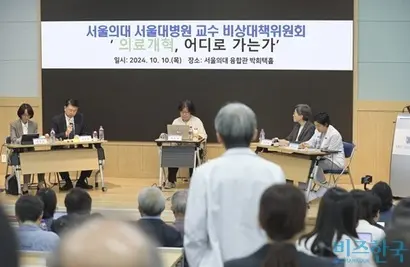
Previously, KIMEE announced it would apply strict evaluation criteria to the 30 medical schools subject to "Major Change Evaluation" due to an enrollment increase of 10% or more. The plan includes expanding accreditation indicators from the existing 15 to 49 and conducting annual evaluations for six years until 2029. Universities must submit their "major change plans" by the end of this month. Universities that fail to receive accreditation may face difficulties in recruiting new medical students for the 2026 academic year. Following the Ministry of Education's legislative notice in September, KIMEE held a press conference to protest, stating, "Any measures that undermine the independence and autonomy of the evaluation agency must be stopped immediately." The Emergency Committee of Medical School Professors, the Korean Medical University Professors Association, and the Korean Medical Association labeled the move "an attempt to neutralize KIMEE."
Universities Face Plan Submission This Month… Will Evaluation Criteria Be Eased?
With the Ministry of Education expected to notify KIMEE of the results of its review of the "major change evaluation" plan in the middle of this month, universities are approaching their deadline to submit their plans by the end of the month. Based on these plans, KIMEE will conduct written and site evaluations in December, with results to be announced in January of next year. In its guidance for plan preparation, KIMEE stated that it would focus on "evaluating validity, evidence-based outcomes, and feasibility," adding that "ultimately, the maintenance of the quality of medical education must be possible." Universities must prove that their human, facility, and clinical training resources are adequate compared to pre-increase levels. During an information session on the evaluation plan in July, university officials expressed difficulties, stating that the criteria were ambiguous and that there was insufficient time.
Aside from KIMEE accreditation for incoming students, universities must also prepare for the medical students who are returning. However, on the ground at schools, there is a sense that the related procedures are not progressing properly. A regional medical school professor, "A," said, "With so much uncertainty, people are naturally hesitant. Since the government's support plan is aimed at national universities, the financial burden remains significant for smaller private universities." Meanwhile, on the 5th, the Emergency Committee of Medical School Professors and the Korean Medical University Professors Association released a survey in which 96.3% of medical school professors answered that next year's admissions should be frozen or reduced. The organizations explained, "The claim that first-year pre-med students only take general education courses, so there is no issue, is not true," adding, "Even after the pre-med stage, students will face a situation where they cannot receive proper education and training for the next 10 years, including medical school proper and residency training."
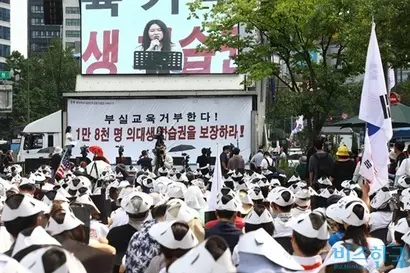
Medical groups, including professors' associations, have argued about the "decline in the quality of medical education" since the initial announcement of the quota increase. However, in June, the Supreme Court issued a ruling that did not support this claim. At the time, the judiciary determined, "Even if the allocation of the increase is not suspended immediately, the increase in 2025 applies to only one grade level, so it is insufficient to conclude that the quality of education received by the plaintiffs, who are currently enrolled medical students, will significantly decline." The court added, "In a situation where there are forecasts of a future physician shortage, suspending the implementation of the quota increase could cause massive disruptions to increasing medical school capacity, which plays a core role in public health."
Meanwhile, on the same day, the expert committee of the National Assembly Education Committee sided with KIMEE in its '2025 Budget Preliminary Review Report,' stating that the Ministry of Education's amendment to the Higher Education Institution Accreditation Regulations "requires correction." The report pointed out, "The amendment to the enforcement decree carries the risk of limiting follow-up measures for major change evaluations," adding, "There are aspects that do not align with the legislative intent of the Higher Education Act."