

[비즈한국] The KF-21 Boramae prototype, having just finished its demonstration flight at the ‘2024 Sacheon Air Show,’ taxied into the hangar. This marked the first time the KF-21 prototype was unveiled at the Sacheon Air Show and the second time it has been shown to the general public. The Sacheon Air Base, where the air show is held, is located right next to Korea Aerospace Industries (KAI)047810, connected by a bridge. The KF-21 moved along this bridge to the ground before entering the hangar. KAI staff immediately entered to inspect the aircraft's condition. This place is the cradle of domestic fighter jets and the site where K-Defense begins.
Bizhankook visited the Korea Aerospace Industries (KAI) headquarters in Sacheon, Gyeongnam, on the 25th of last month. We report on the vivid atmosphere of the site where domestic fighter jets are built.
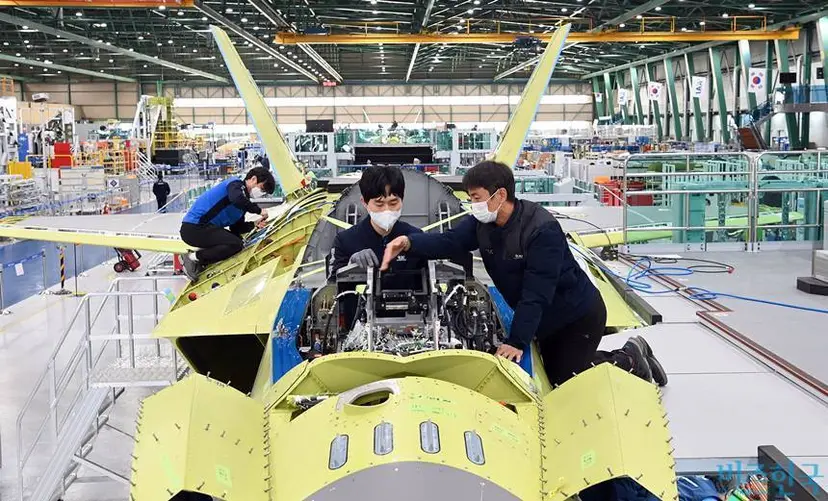
In the fixed-wing production plant right next to the hangar, parts for the TA-50, a domestic tactical lead-in fighter trainer, were waiting to be assembled. The space spans 180m in length and covers an area wider than three soccer fields (21,600㎡). Workers were busy assembling parts on light green fighter jets arranged along neatly organized production lines on a white floor.
The TA-50 is a tactical trainer and the base model for the domestic FA-50 fighter. When armament capabilities and various features are added to the TA-50 trainer, it is reborn as an FA-50. The TA-50, FA-50, and KF-21 are all assembled and manufactured exclusively here. It is truly the cradle of domestic fighter jets. The FA-50 is a domestic light fighter exported to countries such as the Philippines, Iraq, and Poland, and Malaysia.
Because the assembly process differs for each airframe, the fighter configurations were all different. There were airframes where only the front section was completed, and others where the fuselage and wings had been assembled, nearing completion. On-site engineers at each line were carrying out their assigned tasks.
When assembling fighter fuselages, KAI uses the Fuselage Automatic Joining System (FASS), which it developed in-house. FASS identifies the precise position of the fuselage using lasers and moves hydraulic pillars to make minute adjustments. Using this equipment allows for precise work and significantly reduces production time.
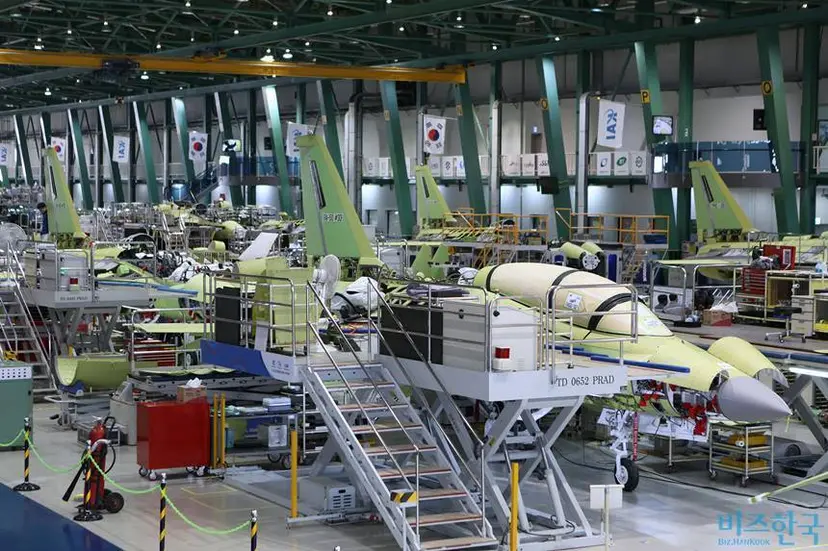
To join the main wing and fuselage of the carbon-composite KF-21, 3,400 holes must be drilled, a task performed by automated equipment called ‘WJDS.’ A KAI official explained, “By using automated equipment, we increase work efficiency while ensuring that our employees can work more safely.”
Fighter jets are moved from one process to the next according to the automated system. Currently, electronic rails are laid inside the fixed-wing building.
Located 10 minutes away from the fixed-wing plant, the rotary-wing plant was in the midst of producing the domestic ‘Surion’ helicopter. The Surion, which has recently garnered interest from Middle Eastern countries, is the first maneuver helicopter developed domestically to replace the aging UH-1H and 500MD maneuver helicopters operated by the Army.
While the fielding of the Surion is complete, the company is working on increasing the localization rate and improving performance. Currently, the localization of the Surion's power transmission system is underway, and future plans include performance upgrades for pilot and crew survival equipment. Beyond the Army's maneuver helicopter, the Surion has been developed and operated in various derivative military forms, such as the Medion for medical evacuation and the Marineon for the Marine Corps.
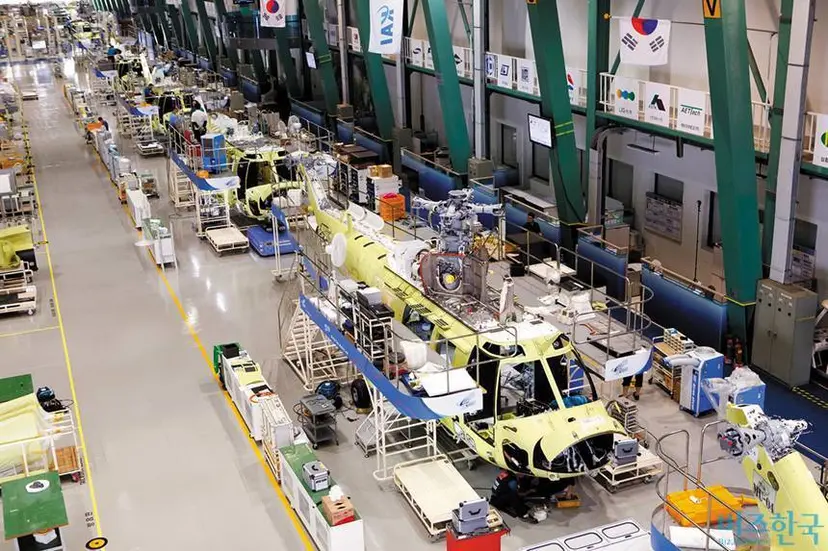
Once basic assembly is finished in the helicopter building, the Surion is moved to be painted and fitted with rotor blades. After that, it undergoes ground testing. A KAI official said, “Once ground inspections are finished, KAI pilots conduct test flights, check the performance, and make further refinements. Afterward, Army pilots come to fly it themselves, followed by more refinements, and only after the unit conducts one final inspection is it officially delivered.”
The LAH, the second helicopter developed with domestic technology, is also produced at the rotary-wing plant. The LAH's tail section is built with a tail rotor. It is equipped with an automatic flight control system that automatically maintains the helicopter's altitude and an automated weapon system that tracks the pilot's line of sight.
At each process line in the rotary-wing plant, there were placards displaying numbers related to "zero defects" and "zero accidents." A KAI official shared that they look at these signs to motivate each other and solidify their resolve to maintain zero defects and zero accidents.