

[비즈한국] As the United States and China enter a supply chain rivalry, causing instability in resource supplies, countries around the world are engaged in a fierce war to secure key resources. In response to China’s move to weaponize rare earths, the U.S. has begun securing these materials by forming alliances with other countries, in addition to its domestic production. China is also showing moves to preemptively secure various resources such as copper through large-scale investments in Africa via the Belt and Road Initiative. Japan has established a plan to increase its self-sufficiency rate for oil and gas to ensure stable supplies.
Amidst this global competition for resources, the Yoon Suk-yeol administration has also pledged to strengthen support for private companies, emphasizing overseas resource development that had been neglected since the Lee Myung-bak administration. However, the number of ongoing overseas resource development projects is decreasing every year, and the special loans supporting private companies venturing into resource development are also in sharp decline. Concerns are growing that South Korea, which already lacks sufficient domestic resources, may fall even further behind in the midst of this intense global competition.
In his policy speech to the National Assembly in October 2022, President Yoon Suk-yeol stated that the government would expand overseas resource development in consideration of the aftermath of the U.S.-China supply chain competition. President Yoon said, “We must strengthen our economic security capabilities to prepare for the intensifying wave of economic bloc formation,” and added, “We will invest a total of 3.2 trillion won to expand overseas resource development investment, stockpile minerals such as nickel and aluminum, and diversify import channels to respond to the supply chain crisis.” This signaled the government’s willingness to once again actively support overseas resource development, which had been considered taboo following the failures of the Lee Myung-bak administration. It was evaluated as the right direction at a time when the world is eager to secure resources.
However, looking at the current situation, contrary to President Yoon’s words, South Korea’s overseas resource development is not just sluggish; it is retreating. According to the Ministry of Trade, Industry and Energy, the number of ongoing overseas resource development projects (oil, gas, and general minerals) in South Korea peaked at 535 in 2013, began to decline, fell below 500 to 480 in 2016, and dropped below 400 to 394 in 2022. This downward trend continued last year, with the number of ongoing overseas resource development projects falling to 387. As of last year, 100 oil and gas projects were underway, of which 55 were currently producing, 10 were in development, and 35 were in exploration. In the case of general minerals, 287 projects are ongoing.
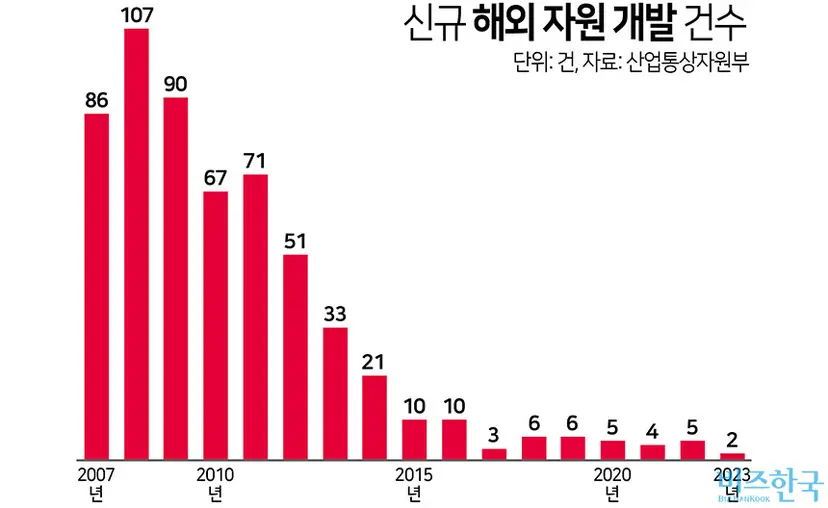
The reason the number of ongoing overseas resource development projects has decreased year by year is that while projects continue to terminate due to failures or other reasons, the number of new projects launched by companies is falling. New overseas resource development projects peaked at 107 in 2008 and began to decline, plummeting to 10 in 2015. In just 7 years, it fell to one-tenth of its peak. This downward trend intensified, dropping to single digits in 2017 with 3 projects, and has remained in the single digits ever since. In particular, the number of new overseas resource development projects fell to just 2 last year.
Critics point out that the sluggishness of new overseas resource development is influenced by the government’s reduction in support for companies bearing the risks, even while claiming to revitalize resource development led by the private sector. The government operates a "Special Loan for Overseas Resource Development" system for companies venturing into resource development. Given the high-risk, high-return nature of resource development projects, the government provides partial financing for project costs; in return, if the project is successful, companies pay a special contribution as a success fee, while if it fails, they are exempted from repaying some of the principal and interest.
However, the budget for these special loans has been shrinking. The special loan for overseas resource development reached 100 billion won in 2017, but it dropped to 70 billion won in 2018 and fell to 36.9 billion won by 2020. After briefly rebounding to 63.1 billion won in 2022, it decreased again to 36.3 billion won in 2023. Although it increased slightly this year, it is still at 39.8 billion won, failing to even reach the 40 billion won mark.