

[비즈한국] Countries around the world are fiercely competing to gain a foothold in Urban Air Mobility (UAM). Major electric vertical take-off and landing (eVTOL) aircraft manufacturers in the United States, Europe, and China are expected to introduce air taxi services connecting city centers as early as 2026. However, as the majority of these companies are suffering from a lack of development funds, there are concerns about cash depletion before commercialization. Because of this, it is projected that the wheat will be separated from the chaff, with only a small number of companies successfully achieving commercialization within the next two years.
Increased UAM development budgets… Companies form consortia to pursue projects
UAM refers to a transportation system that transports people and cargo through urban airspace. Unlike airplanes, it has the advantage of having almost no spatial constraints as it can take off and land vertically in city centers without the need for airports or runways. It can also bypass ground traffic congestion, significantly reducing travel time.
Advanced nations such as the US, Europe, and China are already moving quickly to preempt the market by investing in related businesses. It is understood that 815 models are currently being developed across 50 countries.
The South Korean government has also selected K-UAM as a future growth engine and increased the relevant budget. In May, it proposed the 'Act on the Promotion and Support of Urban Air Mobility,' the world's first legislation for UAM commercialization. The Ministry of Land, Infrastructure and Transport (MOLIT) is continuing to carry out national R&D tasks for UAM commercialization and is conducting various demonstration projects. The goal is to commercialize UAM starting at the end of 2025.
According to the Ministry of Land, Infrastructure and Transport, the global UAM market is expected to grow to 15 trillion won next year, 85 trillion won by 2030, and 842 trillion won by 2040. Accordingly, companies' moves to enter the UAM market are in full swing. Companies are forming consortia to conduct projects. Hanwha Systems272210, Korea Airports Corporation, and SK Telecom017670 have formed the 'K-UAM Dream Team Consortium.' In particular, SK Telecom is fully committed to UAM commercialization by investing 130 billion won in the US UAM manufacturer Joby Aviation.
The 'K-UAM One Team,' which includes Hyundai Motor Company005380, Hyundai E&C, Incheon International Airport Corporation, Korean Air003490, and KT, successfully verified the safety of the entire process from ground movement to flight and landing of UAM for the first time in the world. They are developing airport shuttle services linked to UAM vertiports (take-off and landing sites), a scale model of the next-generation air mobility aircraft 'S-A2,' UAM-based future city models, and UAM flight control systems.
The 'UAM Future Team,' a joint venture between LG Uplus, GS E&C, Kakao Mobility, and Archer Aviation, is also conducting Korean-style UAM demonstration projects. The UAM Future Team plans to develop specialized passenger entertainment services using Vertical Aerospace aircraft from the UK.
Massive investment inevitable… German firm Lilium goes bankrupt
Various companies are throwing their hats into the ring to seize market leadership. While UAM is expected to grow significantly in the long term, the market is still in its early stages and requires massive investment, while demand remains uncertain, making losses inevitable until the maturity phase. A recent hot topic in the UAM industry is cash burn. According to SMG Consulting, the total investment injected into the industry from 2019 to 2023 was approximately $14 billion (19.5 trillion won). According to the Vertical Flight Society, it is estimated that at least $1 billion (1.4 trillion won) is required for a development project to succeed.
Major developers are also in urgent need of securing enough cash to survive until commercialization. In particular, there is an opinion that 4 out of the world's 5 fastest-developing companies (Joby Aviation, Archer, Eve Holdings, Lilium, and Vertical Aerospace) will run out of cash before commercialization.
The German air taxi manufacturer Lilium began the process of selling the company in November. It has filed for bankruptcy due to severe financial difficulties. Lilium had been struggling with financial woes since the end of 2022. The UK's air taxi company 'Vertical' is also running out of capital. It is expected to take at least 2–3 more years to complete type certification and begin commercialization, but its current cash reserves are woefully insufficient.
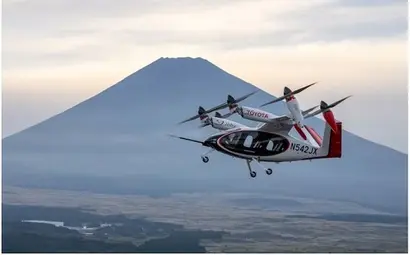
For now, Joby Aviation is in the most stable position. Joby is proceeding with development by receiving massive investments from various countries. It has also successfully completed numerous test flights. Toyota of Japan, which has partnered with the company for seven years, recently announced an additional investment of $500 million (700 billion won). As of the end of the third quarter of 2024, it maintains a strong financial base with $710 million in cash and short-term investment assets. An industry insider predicted, "Except for Joby, all other companies are struggling to receive stable investment. Since most only have conceptual designs for their aircraft, even more development costs will be needed to build and test them in the future. Due to financial pressure, it is predicted that the majority of companies will disappear within 1–2 years, and only a few will survive."