

[비즈한국] What is the heaviest star ever discovered in the universe? There is some debate regarding this. The Large Magellanic Cloud, visible in the Southern Hemisphere night sky, is a site where young stars are still actively being born. One can even see the aftermath of newborn, vibrant stars blowing away dust clouds with the powerful energy they emit in all directions. Among them is a site where the clouds have been sculpted into a terrifying, giant spider-like shape, which is fittingly called the Tarantula Nebula.
In this region, an incredibly heavy star that exceeded astronomers' expectations was once discovered. The star was named R136. When it was first discovered, estimates suggested its mass was a staggering 2,000 times that of the Sun. However, it is generally believed that no matter how massive a star is, it cannot exceed about 100 times the mass of the Sun. This was a mass that simply did not make sense.
Later, the Hubble Space Telescope was used to observe the Magellanic Cloud in great detail. The photo below shows the Magellanic Cloud as seen by Hubble on October 20, 2009. Through Hubble's more detailed observations, astronomers realized that R136 was not actually a single star, but a small star cluster containing several stars. The stars were packed so tightly within such a narrow space that they could not be distinguished from one another.
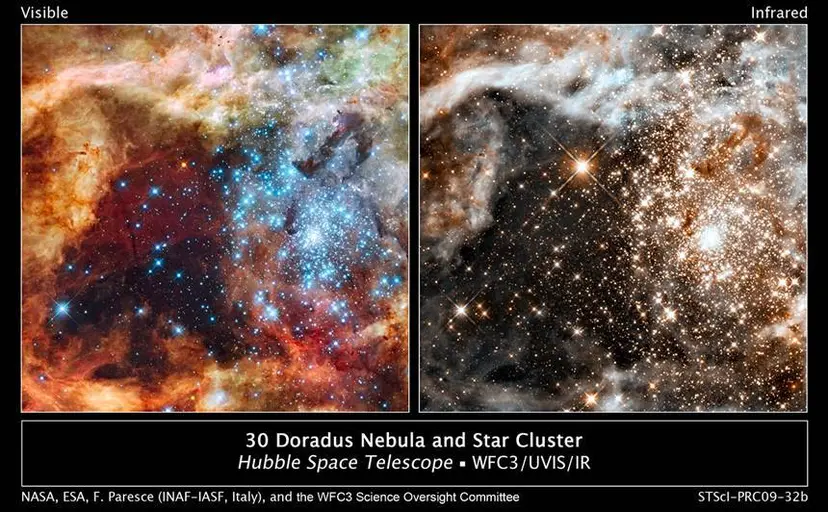
Countless stars are gathered within a space less than 1 light-year across—about 0.6 light-years wide. In fact, at least seven or more of those stars hold a massive weight exceeding 100 times the mass of the Sun. Interestingly, this is a breathtakingly massive site that hosts everything from the 1st to the 25th heaviest stars discovered by humanity to date. Before Hubble, because we viewed such places with blurred vision as a single blob, we had wrongly assumed there was an impossibly heavy star with 2,000 times the Sun's mass.
However, the mystery of this place has not ended yet. While R136 was previously famous as a cluster inhabited only by the heaviest stars, it has now secured another title: the cluster home to the fastest-moving runaway stars.
If the Hubble Space Telescope acted as the eye that showed us the universe most clearly until the James Webb Space Telescope went to space, there is another space telescope faithfully performing its own mission in a different area: Gaia. Gaia orbits the Sun along with Earth, measuring the precise distances and movements of hundreds of millions of stars in our Milky Way. Through this, it has completed a three-dimensional map of stars within tens of thousands of light-years of our neighborhood. It also allows us to trace the paths each star has moved back in time to see where they lived in our galaxy in the past, or predict how they will move in the future, traversing through time.
Thanks to its exceptional performance, Gaia's eyes are not confined to our Milky Way. Stars in the Magellanic Cloud, the dwarf galaxy closest to our own, are also targets for Gaia. Recently, based on Gaia's observational results, astronomers discovered that the stars living in the R136 cluster in the Magellanic Cloud are moving at surprisingly high speeds. It looks as if the stars in the cluster are trying to burst out of it quickly. These stars that appear to be fleeing the cluster are called "runaway stars."
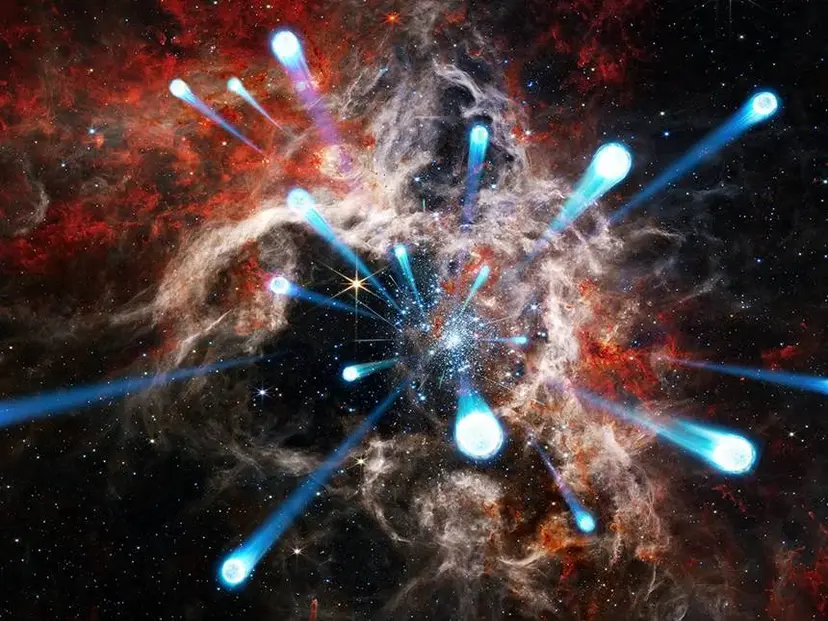
As explained earlier, this cluster is one of the most active star-birth regions where countless young stars are being born explosively. There are over 70 massive O-type stars and violent Wolf-Rayet stars that spew enormous energy in all directions. The total mass of the cluster exceeds 450,000 times the mass of the Sun. Because it is such a breathtaking scene where heavy stars are crowded into a very narrow space, their orbits fluctuate as adjacent stars exert gravity on one another. Thus, poor stars occasionally get knocked out of their original orbits and fly out of the cluster at high speeds. Astronomers had already discovered stars known as runaway stars in this cluster through Hubble observations.
However, this latest Gaia observation data increased the number of runaway stars to 55 in an instant. All of them are rapidly fleeing from the center of the cluster. A surprising fact is that the number of runaway stars identified this time accounts for one-third of the total number of stars previously identified in this cluster. In effect, 30% of the members are carrying out a mass exodus all at once!
Tracing the history of each star's detailed movement backward using Gaia's observational data, it is estimated that there were two major great escapes in this cluster. The first wave occurred about 1.8 million years ago, around the time the cluster was first born. As many stars formed vigorously in an instant, the first gravitational interactions took place, and many stars flew out of the cluster for the first time. The cluster enjoyed a brief peace before the second wave occurred 200,000 years ago as it passed near a neighboring cluster. Astronomers estimate that the neighboring cluster, which was only discovered in 2012, is the culprit. While experiencing this second wave, most of the stars in the cluster were poured out in a similar direction all at once.
The heavier a star is, the shorter its lifespan. They finish their short lives, which last no more than a few million to tens of millions of years, and disappear with a massive supernova explosion. Runaway stars, which have burst out of their original homes and roam the galactic space, can become like ticking time bombs that could go off anytime and anywhere in the galaxy. Astronomers estimate that if such stars, which have been rapidly roaming outer space after leaving their original homes, existed from the distant past, they might have been the key players in reionization, an event where the entire universe was ionized long ago.
The ticking-time-bomb-like stars that flew into every corner of the universe would have eventually exploded, spewing powerful ultraviolet light into the surrounding space. In particular, the explosions of runaway stars that had burrowed into dust clouds in outer space would have ionized a large number of atoms in the surrounding gas clouds.
The Magellanic Cloud is one of the amazing sites that has accompanied the history of humanity and the history of scientific advancement. In particular, many great discoveries in the field of astronomy took place in the Magellanic Cloud. The Magellanic Cloud, which served as a guide for the explorer Ferdinand Magellan when he first sailed the Southern Hemisphere seas and saw the cloudy masses of stars in the sky, later revealed the appearance of the fickle variable stars it harbored in the 1900s. Thanks to the discoveries of astronomer Henrietta Leavitt, who studied these, we learned how to measure distances to stars using variable stars and gauge the scale of the universe, providing an opportunity for Edwin Hubble to reveal the reality of a massive universe filled with countless galaxies outside our own.
And now, the Magellanic Cloud is the most dynamic place near us, hosting the heaviest and fastest stars. It is, in a sense, the most amazing sample box and treasure chest containing the most extreme cases we can encounter in the universe. It is also the most beautiful world that every space telescope, including James Webb and Hubble, observes without fail.
The fact that there are not one, but two such precious treasure chests floating next to our galaxy may, in a way, be a truly astronomical stroke of luck. After all, we can observe the most extreme phenomena occurring in the universe much more conveniently right next door, without having to search through the distant, blurry universe tens of billions of light-years away. If the Magellanic Cloud were not floating next to our galaxy, the advancement of our human astronomy might have been centuries behind.
Reference
https://www.nature.com/articles/s41586-024-08013-8
Who is the author, Woong-bae Ji? He loves cats and the universe. After watching 'Galaxy Express 999' as a child, he dreamed of spreading the beauty of the universe. Currently, he researches galaxy evolution through galactic interactions at the Center for Galaxy Evolution and the Near-Field Cosmology Lab at Yonsei University. He engages in various science communication activities, such as lectures and writing. He has authored books including 'Astronomy on a Date,' 'Thinking About the Universe All Day,' and 'Stars, the Science of Light.'