

[비즈한국] In recent years, the biggest buzzword for software and app developers in the IT industry has been "Agile Software Development." This is the opposite of the "Waterfall" method, which involves top-down, one-way development based on fixed goals. Instead, Agile involves users creating a backlog of tasks to reach a goal, followed by iterative development through multiple sprints and post-mortems of the finished products.
Agile is a development methodology that sparks as much controversy as it does uniqueness in its approach. However, the IT industry, which requires rapid service and quick adaptation to market changes, is now adopting Agile development methodologies everywhere. Beyond invisible software, hardware startups that manufacture physical products are also introducing Agile methodologies. Even in the conservative fields of defense R&D and weapon systems, companies are increasingly challenging themselves with Agile development, starting with the development of "CCA" unmanned aerial vehicles.
"CCA" stands for Collaborative Combat Aircraft. It is an unmanned combat aerial vehicle that does not operate alone but works in a Man-Unmanned Teaming (MUM-T) system alongside humans.
UAVs made in the past operated alone, which resulted in high software development costs, including AI for autonomous flight. Because they were equipped with various systems to avoid being shot down, the cost skyrocketed; for example, the X-47B UCAV developed by Northrop Grumman cost over $200 million per unit, leading to the cancellation of many such projects due to ballooning costs.
The United States, which is spearheading CCA, introduced three concepts to learn from these past failures. The first concept is "Man-Unmanned Teaming." The plan is for the drone not to handle all missions, but to focus on penetrating dangerous enemy lines under the command of manned fighter jets.
The second concept is "Expendable." Since they are likely to be shot down, performance is somewhat limited to keep costs down—rather than increasing the unit price by adding expensive equipment—so they can be sacrificed in place of manned aircraft when necessary.
The final concept is "Agile" development. In the past, the F-22 and F-35 stealth fighters made by the U.S. aimed to maintain world-class performance for decades from the moment of their inception. CCA uses an unfamiliar concept called "Increment." Based on the premise of developing the project in three stages, the U.S. progresses rapidly on the CCA in Increment 1 with achievable performance; it then immediately uses the knowledge gained to build Increment 2, and starts Increment 3 as soon as the second phase begins.
Looking at this, one might think CCA is just another massive U.S. defense project. However, the reality is quite different. Countries that "know how to build aircraft" are all jumping into CCA projects after seeing the U.S. move. As a result, a "CCA development frenzy" is blowing across defense-leading nations worldwide.
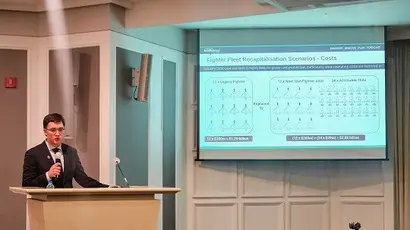
It is not an exaggeration for me to describe this as a "frenzy." Aviation Week Network, the world's oldest aerospace publication, held a briefing on Korean projects for aerospace experts in Seoul on October 29. The most attention-grabbing session was the presentation on global CCA industry trends titled "Rise of the Machine."
Matthew Jouppi, a senior analyst at Aviation Week who led the presentation, stated that nine countries, including South Korea, are already developing CCA aircraft. He predicted that the U.S., by focusing on CCA instead of developing expensive 6th-generation fighters, would see global CCA production exceed 500 units within 10 years, with annual production surpassing 100 units.
The problem is that while South Korea has also joined this "CCA wave," it is completely turning a blind eye to "Agile development," the core element of CCA. Currently, Korean Air003490 and the Agency for Defense Development (ADD) plan to complete a CCA fighter named KUS-LW by 2025. Additionally, Korea Aerospace Industries (KAI)047810 plans to proceed with its own design under the name UCAV. Smaller drones to support these two are also being manufactured.
However, South Korea's CCA development plan adheres to the traditional Waterfall development method rather than "Agile," making future performance improvements and rapid technological expansion currently impossible. In an interview with me, analyst Matthew Jouppi noted with regret that South Korea missed a major opportunity, stating, "In the case of KUS-FC, for which Korean Air cancelled development, it could have been applied to Increment 2, the next-generation CCA project." This was a mistake caused by mimicking the U.S. CCA plan but only copying the low-performance Increment 1 phase.
The issue isn't just the development plan. For CCA, controlling drones with AI is fundamental, and the concept relies on human pilots supplementing the AI's judgments or decisions. While the development and testing of various AIs are essential, the CCA plans currently being developed in Korea lack this "expandability of AI development."
Ahn Min-ho, an adjunct professor in the Department of Defense Industry at Konkuk University who is involved in defense AI development, including AI pilots, said, "CCA is a new concept for a future weapon for which operational concepts have not yet been established. Even the U.S. is still contemplating the direction." He added, "The more it is a new industrial field like this, if creative small and medium-sized enterprises research new solutions and the government and research institutions provide generous support to promising companies, the technological gap with the U.S. can be significantly reduced." However, in reality, the CCA projects currently underway in Korea make it difficult for AI companies to find such opportunities for openness and cooperation.
Why is this? Ahn Oh-sung, a researcher who developed vertical take-off and landing smart drones (TR-60, TR-100) at the Korea Aerospace Research Institute (KARI), said, "Unless we resolve the structural problems of Korea's national R&D projects—the vertical culture and the R&D climate that focuses on receiving large-scale investments and projects from the government—Agile development is impossible." He added, "Agile culture, which evolves through repeated development and revision within a creative organizational culture, requires delegating to leaders who encourage their members and promote creativity, but the absence of an R&D development strategy is blocking this."
So, what "methods" can we use to introduce the U.S. Agile methodology into our CCA development? I cautiously believe that for CCA drone development, at least, giant companies and institutes like KAI or the ADD must adopt project directions where they concede a little, and begin attempts to discover and delegate to small and medium-sized enterprises with creative solutions.
For instance, moving away from the competitive structure of the current CCA programs between Korean Air and KAI, one could consider making the CCA fighters built by both companies a kind of open platform. After "black-boxing" the critical information of the CCA prototype aircraft developed by the two companies, qualified external firms or research institutes could develop the necessary AI for the CCA in various places, and the best-performing product could be adopted. Alternatively, opening up the process for multiple companies to challenge themselves in ways to improve the currently developing CCA using Agile methods could be another approach.
When the Apple iPhone appeared, numerous smartphones imitating it emerged, but eventually, dozens of smartphone companies went bankrupt because they could not withstand Apple's innovation. Although we are imitating the CCA that the U.S. is striving to innovate in its development methods, simply building a plane that looks similar in shape and size to the CCA will not solve the problem. Without introducing the Agile development method that fits CCA development as soon as possible, and without innovation and unconventional moves—like the U.S. Air Force selecting the startup Anduril Industries as a CCA candidate—we will end up with nothing more than a hollow shell of a CCA.