

[비즈한국] The Long-range Surface-to-Air Missile (L-SAM), designed to intercept ballistic missiles, is set to enter mass production in 2025. Along with the Long-range Artillery Interception Defense System (LAMD), the L-SAM is considered a core asset of the Korea Air and Missile Defense (KAMD) system and was jointly developed by three domestic defense companies: LIG Nex1079550, Hanwha Systems272210, and Hanwha Aerospace012450. The United Arab Emirates (UAE), which signed a 4 trillion won contract for mid-range surface-to-air missiles in 2022, is also showing keen interest in acquiring the L-SAM.
According to the Defense Acquisition Program Administration (DAPA), the three defense firms are aiming to submit the project to the Defense Acquisition Program Promotion Committee by the end of this year, with the goal of finalizing the L-SAM mass production contract next year. The L-SAM successfully completed its demonstration-phase interception test in May and received a "combat suitable" rating. This procedure is intended to pave the way for mass production next year following the completion of system development.
Developed with indigenous technology following the Cheongung-II, the L-SAM is a guided weapon system that intercepts enemy aircraft and ballistic missiles at higher altitudes (40–70km) than the Cheongung-II. Once deployment is completed in 2028, it will operate alongside systems such as Patriot (15–40km), Cheongung-II (15–30km), and THAAD (40km).
The L-SAM was developed through the collaboration of the three domestic defense companies. LIG Nex1 serves as the system integrator for the L-SAM, managing overall system integration alongside the development of anti-aircraft missiles. Hanwha Aerospace was tasked with developing the anti-ballistic missile system, involving the development and manufacture of interceptor missiles as well as the production of launchers.
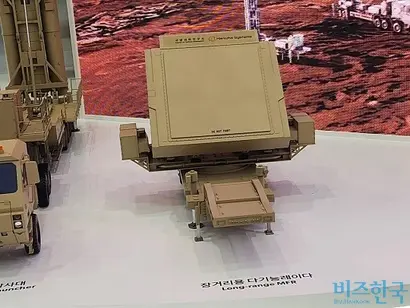
Hanwha Systems is responsible for developing the L-SAM's Multi-Function Radar (MFR). The MFR is capable of simultaneously detecting and tracking multiple targets and performing Identification Friend or Foe (IFF) for aircraft. It is also characterized by its ability to counter high-altitude ballistic missiles, long-range aircraft, and long-range cruise missiles approaching from great distances.
While LIG Nex1, a long-time manufacturer of guided weapons, is producing the anti-aircraft missiles, Hanwha Aerospace is also producing guided weapons for the L-SAM, such as anti-ballistic missiles. An industry insider explained, "Anti-ballistic missiles must intercept targets head-on at higher altitudes than anti-aircraft missiles. It may have been determined that Hanwha Aerospace's technical expertise and testing facilities were better suited for this task than LIG Nex1's."
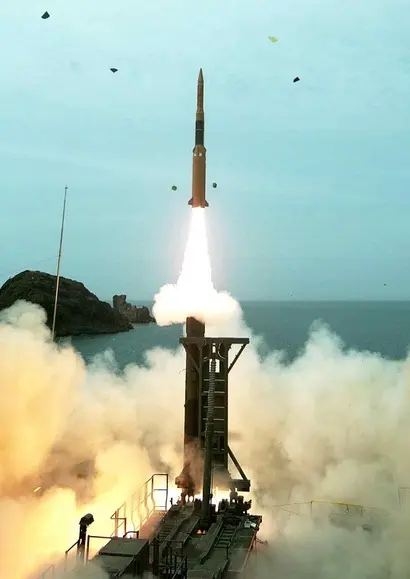
The L-SAM interceptor missile consists of first and second-stage boosters and a kinetic kill vehicle. South Korea is the third country in the world to successfully develop ballistic missile interception technology using a kinetic kill vehicle, following the United States and Israel. An interceptor battery consists of one multi-function radar, one engagement control station, one operation control station, two anti-aircraft missile launchers, and two anti-ballistic missile launchers. A single battery can perform both aircraft and ballistic missile interceptions simultaneously.
There is also an assessment that the L-SAM could become a new powerhouse for South Korea's defense exports. This is because demand for missile interception systems has surged due to the Russia-Ukraine war and the Israel-Iran conflict. Middle Eastern nations are already showing interest in importing the L-SAM. In May, key UAE defense and military officials visited the Air Force Operations Command in Pyeongtaek, Gyeonggi Province, to inspect South Korea's multi-layered air defense system. The UAE faces threats from ballistic missiles and drones launched by the pro-Iranian Houthi rebels in Yemen. Furthermore, Middle Eastern countries are reportedly uninterested in the Israeli "Arrow 2," which is a competing product to the L-SAM. There are also prospects that Eastern European countries, including Poland and Romania, could adopt the L-SAM to defend against Russian missiles.
An announcement has also been made regarding the development of the L-SAM-II system, which will offer a defense range three times larger than that of the current L-SAM and increase the interception altitude to 60–100km. This project is expected to receive a total investment of 1.354 trillion won by 2031, with Hanwha and LIG Nex1 projected to participate.
Experts emphasize that for exports of the L-SAM, which was jointly created by LIG Nex1 and Hanwha, it is necessary to prevent potential conflicts by agreeing on delivery timelines and pricing in advance. An industry insider noted, "Disputes already occurred during the export of the Cheongung-II, a mid-range interception system jointly produced by the two companies, to Iraq. The companies must coordinate in advance to ensure smooth exports without friction. DAPA must also take an active role as a mediator."