

[비즈한국] Following the largest tax revenue shortfall in history last year, another shortfall of nearly 30 trillion won is expected this year, leading the government to dip into the Foreign Exchange Stabilization Fund—often called a financial firewall—and reduce funds allocated to local governments. To overcome the fiscal deficit caused by tax shortfalls, the government is resorting to shuffling funds and demanding sacrifices from local governments.
Instead of implementing fundamental measures to improve tax revenue forecasting accuracy and increase revenue itself, the government is opting for easy, stopgap fixes. Consequently, some argue that it is time to re-examine tax exemption systems that lack sunset (termination) clauses. Because these programs have no end date, they continue to drain tax revenue year after year, even after their intended policy objectives have been achieved.
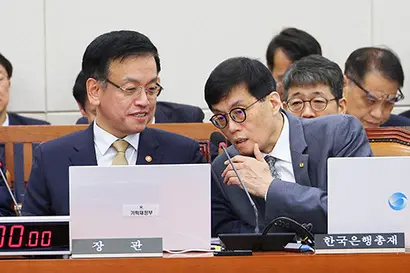
The Ministry of Economy and Finance reported its "Fiscal Response Plan Following the 2024 Tax Revenue Re-estimation" during a plenary session of the National Assembly's Strategy and Finance Committee on October 28. This was a response to the anticipated tax revenue shortfall, which is expected to reach 29.6 trillion won this year, following last year's 56.4 trillion won deficit.
To cover the shortfall, the government has decided to withdraw 4 to 6 trillion won from the Foreign Exchange Stabilization Fund and pull up to 16 trillion won from various other funds. This means dipping into emergency reserves meant for foreign exchange market stability—at a time when external uncertainties are rising due to the U.S. presidential election and conflicts in the Middle East—to fill the gap in tax revenue. Furthermore, local government grants and educational subsidies will be reduced by more than 6 trillion won from their original plans.
Critics point out that while the government is shuffling funds and cutting local fiscal resources, there is no visible effort to plug the holes where tax revenue is leaking. The government introduced special tax treatment systems in the 1960s to promote specific industries alongside economic development plans. However, these tax breaks have essentially become "vested interests," leading to claims that they cause national treasury losses and undermine tax fairness.
In response, the government implemented the Restriction of Special Taxation Act in 1999, introducing a "sunset system" that sets termination dates for tax expenditure (tax reduction) items. The problem is that despite the introduction of this system, many items remain exempt from sunset clauses, citing long-term policy effectiveness. According to the National Assembly Budget Office, 115 out of 280 tax expenditure items (41.1%) have no sunset clause.
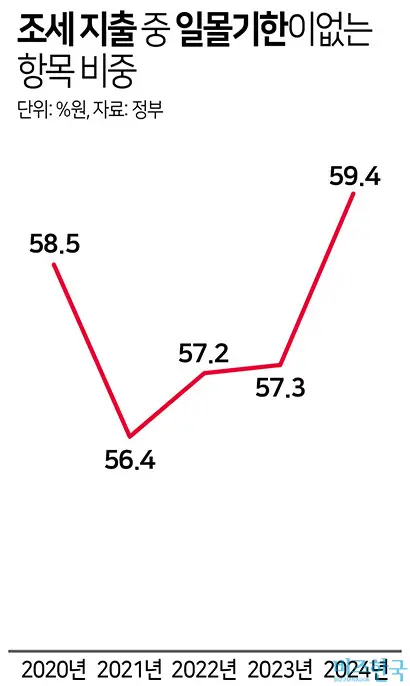
Worse, the proportion of tax expenditures resulting from items without sunset clauses is steadily increasing. In 2021, tax expenditures from such items amounted to 32.1489 trillion won, accounting for 56.4% of total tax expenditures. This rose to 36.3791 trillion won (57.2%) in 2022. In 2023, the figure hit 39.9095 trillion won (57.3%), and it is projected to reach 42.4568 trillion won this year, nearing 60% of total tax expenditures.
Among the top 5 largest tax expenditure items, four lack sunset clauses. Specifically, the special income and tax credits for insurance premiums are expected to represent the largest tax expenditure this year, at 6.9973 trillion won. The government expects this to rise to 7.5095 trillion won next year. The Earned Income Tax Credit ranked second with a projected 4.712 trillion won this year, followed by the pension insurance premium deduction at 4.4348 trillion won. The special deduction for deemed input tax on duty-free agricultural products ranked fifth at 3.5932 trillion won.
A significant number of items that fall under "active management"—meaning they have the potential to be replaced or abolished—are among those lacking sunset clauses, which make up nearly 60% of total tax expenditures. Of the 280 tax expenditure items, 205 (73.2%) are subject to active management, and 70 of those do not have sunset clauses. Therefore, experts argue that to improve the tax revenue situation and pursue fairness, the government must review these items and impose sunset clauses on them.