

[비즈한국] Toss (operated by Viva Republica) has thrown its hat into the facial recognition payment market. While facial recognition was once highlighted as a futuristic payment method, it has struggled to gain a foothold in the market. Several companies attempted commercialization before Toss, but none have achieved significant results. Attention is now focused on whether Toss, which has created new trends in the fintech industry, will finally ignite a "facial recognition" craze.

At Korea Fintech Week 2024 last August, Toss unveiled its facial verification and facial recognition payment services aimed at preventing ticket scalping. Toss dubbed these services "Face Entry" and "Face Pay," respectively. Face Entry is a service that verifies identity via facial recognition when visiting event venues or exhibition halls, while Face Pay allows users to use their registered facial data to make Toss Pay payments at merchants instead of using a mobile phone or card.
Toss established terms and conditions for the Face Entry and Face Pay services on August 21 and set the enforcement date for September 6. With the recent launch of a Halloween-themed avatar creation event, public interest in the service's launch timing has intensified. Users who create avatars on Toss can pre-register for Face Entry. Although it was reported that Toss planned to conduct a closed beta test during the second quarter while collecting pre-registrations for Face Pay around May, it has been confirmed that the testing has not yet begun.
Facial recognition payment is considered a next-generation payment method. While various companies have pursued commercialization, none have succeeded. In the financial sector, Shinhan Card took the lead with "Face Pay." Face Pay was the first attempt at commercializing a facial recognition payment service in Korea. Shinhan Card introduced the service at Korea Fintech Week in 2019 and began a pilot run for employees that August. The following year, it initiated its first commercialization by building the payment infrastructure within restaurants and convenience stores on the Hanyang University campus.
In March 2021, Shinhan Card installed Face Pay devices at the Homeplus World Cup branch, expanding into general credit card merchant locations. However, three years later, it has failed to increase its number of merchants. Face Pay required users to visit a bank or register their face directly at a payment terminal, and the cumbersome nature of this process seems to have limited user adoption.
Following Shinhan Card was Naver035420. In March, Naver Pay introduced "Face Sign" payment at restaurants and cafes within the Kyung Hee University Seoul campus. It can be used at kiosks equipped with Face Sign terminals, and because it relies on artificial intelligence (AI) technology with high accuracy, payments using photos or videos are impossible. Registering a face is relatively simple, as users can do so via their smartphones using the Naver Pay app.
However, even the IT giant Naver found it difficult to move to the next stage. When launching the service at Kyung Hee University, Naver Pay stated, "We will expand the service, focusing on locations with recurring payments such as university campuses, offices, and theme parks." Yet, aside from pop-up events, it has not been officially adopted elsewhere. A Naver official stated, "The facial recognition payment at Kyung Hee University is still being operated as a beta service," adding, "We are continuously updating it to address areas for improvement or supplementation."
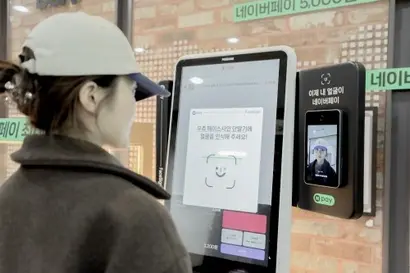
Industry experts cite the difficulty of terminal distribution, resistance to providing facial data, and security concerns as reasons why commercialization is challenging. A financial sector official noted, "From a merchant's perspective, there is no reason to have a dedicated facial recognition terminal alongside a POS system or kiosk," adding, "To expand facial recognition payments, one must persuade and negotiate with merchants, which doesn't seem to be happening smoothly."
Another official explained, "Introducing devices without having a steady base of facial recognition payment users is not efficient for merchants," and added, "The reason they test in limited spaces like companies or universities is because the foot traffic is fixed and predictable."
Unlike previous companies, Toss has increased the possibility of market settlement by adopting a strategy of distributing terminals before launching the payment service. This is because Toss Place, a subsidiary of Viva Republica, sells "Toss Front," a payment terminal with a built-in camera. According to Toss Place, its cumulative number of merchants has exceeded 30,000 in one year, with a total payment volume exceeding 1.05 trillion won. Toss Place is actively recruiting merchants by providing terminal sales support funds to contract agencies.
However, concerns regarding the collection and use of facial data remain an issue to be addressed in the long term. Under the Personal Information Protection Act, biometric data is classified as sensitive information. Once leaked, it is difficult to restore the damage, and the risk of forgery or alteration is significant. Even if technology commercialization lowers the resistance to facial registration, the potential for misuse remains.
Jeon Chang-bae, Chairman of the International Artificial Intelligence Ethics Association (IAAE), pointed out, "Companies must pay close attention to minimizing the possibility of leaks when collecting and storing biometric information." He added, "The deepfake issue is particularly emerging, so efforts must be made to develop technology that detects forged or altered information. If photos collected from social media are used to create fakes, it could cause massive damage to ordinary people." Chairman Jeon further noted, "To prepare for security issues, it is important for both companies and users to have an ethical mindset once facial recognition technology becomes fully commercialized."