

[비즈한국] As the use of customized interpretation and translation based on generative AI like Google and ChatGPT has recently increased, a sense of crisis is growing in the "translation market." With the translation market shrinking, profitability is also worsening. To overcome this crisis, domestic translation companies have started looking for various breakthroughs. "Prolang," which is entering the defense industry, is one of them.
Despite the fierce challenge from AI like ChatGPT, Prolang has viewed the defense sector as a new growth engine and has recently been making investments. This is because most defense materials are classified, making it impossible to use AI for translation. Furthermore, because most military and defense terminology is sensitive, open-source data is limited, creating a structure that is difficult for AI to learn. This is a domain where professional translators with long-term military experience remain more valuable than AI. On the 30th, BizHankook met with Prolang CEO Kwon Young-jo to hear the story behind Prolang's entry into the defense field.
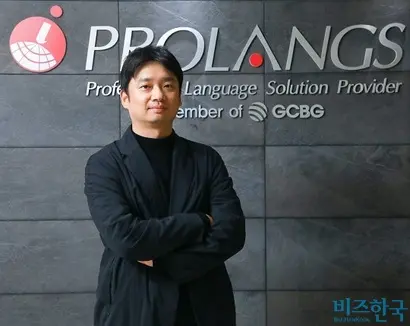
Prolang is a first-generation translation firm established in 1988, which has spent 36 years advocating as a "company that creates a world without language barriers" while providing professional interpretation and translation services in various fields. With 50 full-time employees, it possesses the largest human resources in the interpretation and translation sector in Korea. Prolang has acquired international translation standard ISO 17100 certification and quality management system certificate ISO 9001. Recently, it has been collaborating on projects with numerous domestic and international defense companies.
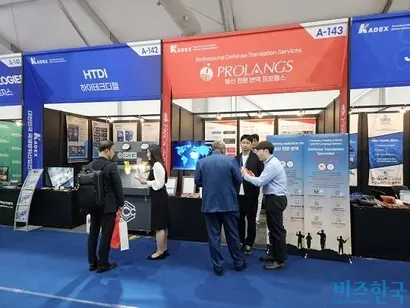
In particular, after being selected as the winning bidder for the "Brown Bear Project" (transfer of Russian weapons technology) in 1995, it began defense-related translation work in earnest. Having won and executed contracts for the translation of offset trade guidelines through public bidding by the Defense Acquisition Program Administration (DAPA) and the Jang Bogo-class submarine translation project, it has also been conducting manual translation work for the Navy Logistics Command and Air Force Logistics Command for several years. As a member of the Korea Defense Industry Association, the company also participated in the recent KADEX 2024 defense exhibition. CEO Kwon emphasized, "While military bidding contracts have high contract values, they are essentially lowest-price bids, making it difficult to turn a profit, but based on this experience, we are now earning the trust of our clients."
CEO Kwon stated that after taking office in 2023, he sought a breakthrough in the "red ocean" translation market and decided to focus on the defense market. He determined that because AI translation, which is emerging as the mainstream, cannot be used, defense translation is a "blue ocean" for a translation company. He explained, "Defense translation requires a closed environment because security is paramount. This means AI translation is difficult to use. If you use ChatGPT or Google, data is bound to leak externally. Moreover, since AI develops through learning, and military/defense terminology is not widely known to the public, it is a field that AI still struggles to understand."
As domestic defense companies expand their footprint in overseas markets, the importance of defense translation is growing daily. This is because businesses can only proceed efficiently when massive amounts of defense-related work are translated. Usually, when a Request for Proposal (RFP) is announced by an importing country, domestic defense firms need rapid translation within days to analyze the RFP. Following this, proposals must be drafted within a deadline according to the RFP requirements, and the "translation" of these proposals must follow sequentially. The translation of supplementary documents that influence the success of the bid (offset trade sections, general contract conditions, special contract conditions, etc.) is also a crucial factor. In this process, the counterparty country may also require notarized translations. Once a defense contract is finalized, there is a need for large-scale manual translations—such as equipment operation, organizational maintenance, field maintenance, and logistics manuals—by the deadline for delivery to the importing country. Additionally, various materials such as handbooks, guidelines, and training materials to be used locally must also be translated.
The defense sector is a field where accuracy and professionalism are essential, and "security" is the most important aspect. To enter the defense field, Prolang is prioritizing active investment in security. It operates a separate defense project office and possesses its own server room. It has also hired additional defense-dedicated staff, IT personnel, and military-specialized translators. CEO Kwon explained, "Most translation firms hire freelancers and do not have resident staff, but because security is critical in the defense sector, translation work cannot be shared via email. Therefore, we hire personnel who have passed the Counterintelligence Command's background checks and use dedicated computers for defense work."
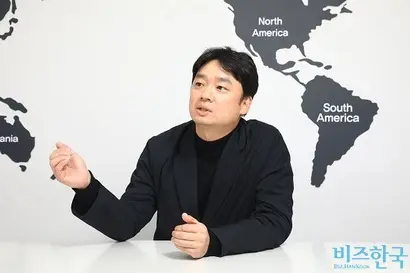
To strengthen data security, a "document centralization" system was also established. Using the document centralization system introduced along with Data Loss Prevention (DLP) security solutions, data is forced to be stored on a central server, making it impossible to save files on employees' PCs. Workers can only access files for which they have authorization, and all records from the creation and modification of files to their deletion and delivery can be managed. Furthermore, the company holds an "excellent" grade with 94 points from the security assessment conducted by the Defense Counterintelligence Command. CEO Kwon explained, "In fact, since translation firms are subcontractors, a security assessment by the Counterintelligence Command is not mandatory. However, we applied for it for our clients. We received a very high score, which has earned us significant trust from our clients. It appears this will be a major strength when attracting clients in the future."
However, there are concerns regarding the increasing number of languages required as defense export countries grow, as well as "cost issues." CEO Kwon noted, "The best approach is to dispatch employees directly to the export country to work. Using the document centralization system, work can be done without security issues. However, the downside is that while the defense translation sector requires heavy investment in security and is much more difficult than general translation, the unit price is unreasonably low. Ultimately, there won't be many companies that can translate while properly maintaining security."
CEO Kwon emphasized that government interest and support are needed regarding defense translation security. "When a nation's core technologies are leaked, national competitiveness declines. Security is just as important for weapons exports. Because there are issues not just with competitiveness but also with national security, work should only be entrusted to places where security is verified. However, since the translation cost in the overall project is too low, it is difficult to continuously invest in security. To facilitate national exports more smoothly, support related to security is urgently needed."